Fine spinel prices have generally climbed since the 2007 Mahenge discovery, with reds, hot pinks and cobalt blues leading and grey staying accessible — observed 2026 trends by colour, not investment advice.
Over the past fifteen-plus years, fine spinel prices have generally risen, driven by real scarcity and rising demand rather than any treatment. Reds, hot pinks and cobalt blues have climbed most; grey and denim material stays accessible. What follows traces observed trends by colour — not predictions, and not investment advice.
Why have spinel prices risen since 2007?
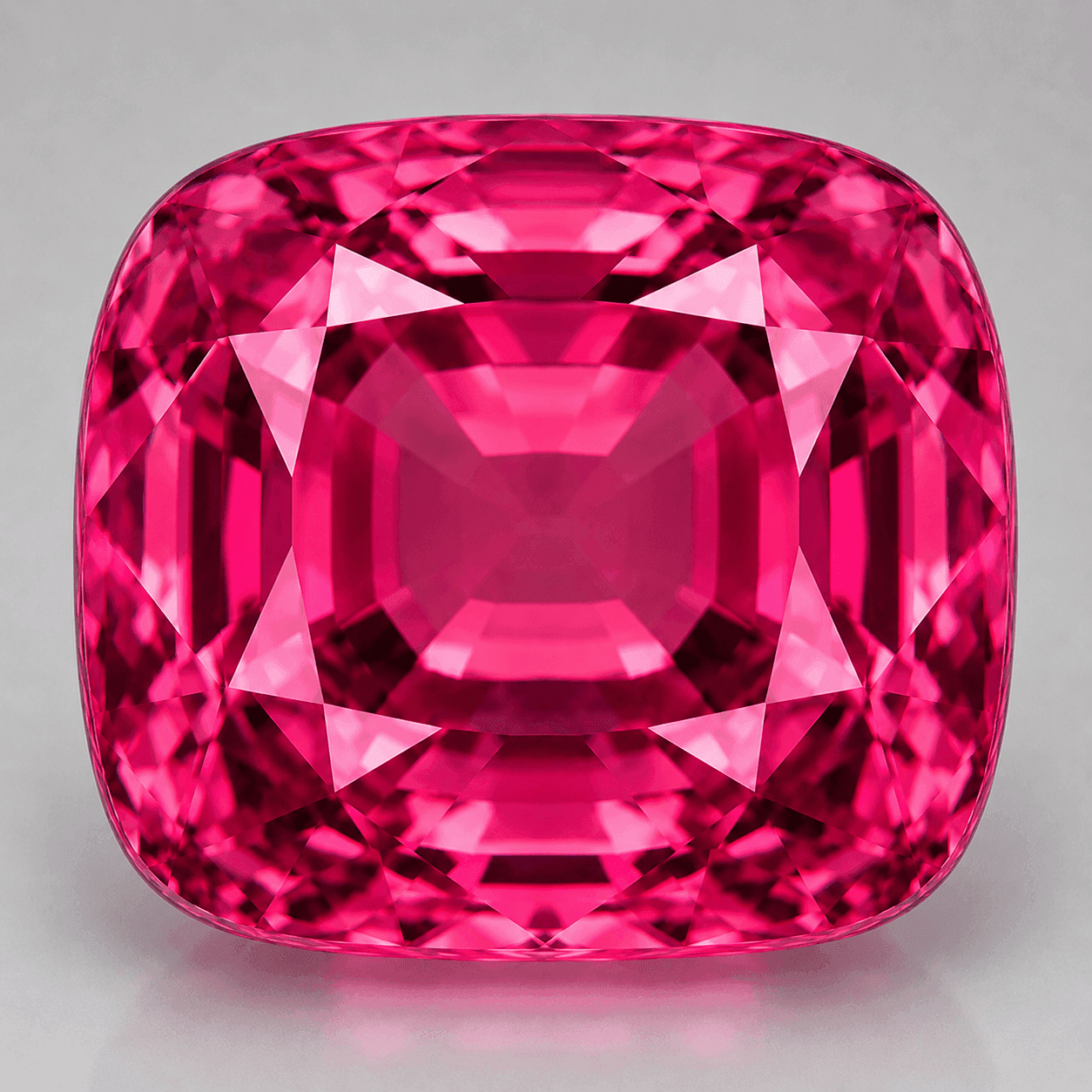
The short version: a run of extraordinary discoveries met a collector base that had finally learned spinel's story, and thin natural supply did the rest. For most of history spinel was mistaken for ruby — the Black Prince's and Timur "rubies" in the British Crown Jewels are famously spinels — so it traded as an afterthought at a small fraction of corundum prices. That began to change in 2007, when miners at Mahenge in Tanzania unearthed a pocket of vivid, almost fluorescent pink-red crystals so saturated they seemed lit from within. Dealers who handled the first parcels understood at once that the category had a new benchmark, and the numbers have rarely looked back since.
Two further currents lifted the whole category. First, a series of cobalt-blue finds — spinel coloured by trace cobalt rather than iron — produced an electric, almost paraiba-like blue that no other affordable gem could match, and the finest examples were quickly re-priced upward. A newer cobalt discovery at Mahenge around 2021–22 added to the earlier Luc Yen material from Vietnam and kept cobalt firmly in the headlines. Second, in 2016 the AGTA and the wider trade named spinel an official August birthstone alongside peridot, an act of institutional recognition that pulled the stone into mainstream jewellery conversation for the first time. Awareness, more than any single mine, is what re-priced spinel.
None of this happened in isolation. Auction houses began cataloguing fine spinel as a headline lot rather than a curiosity, gemmological education improved, and collectors priced out of ruby discovered that a fine red spinel offered comparable presence — often at roughly one-tenth the price of a comparable ruby. The connoisseur's secret slowly became common knowledge, and prices adjusted to reflect what specialists had always known: great spinel is genuinely scarce. Crucially, there is no routine treatment that can stretch supply — unlike heated sapphire or ruby, spinel is not improved in volume to meet demand, so its scarcity has nowhere to hide. For a full breakdown of current numbers, our spinel price guide sets out ranges colour by colour, and is spinel valuable puts those figures in wider context.
How much have spinel prices moved by colour?
Prices have not risen uniformly — the movement concentrates in the colours that combine rarity with visual drama. Chromium reds, hot pinks, cobalt blues and fine lavenders have climbed most, while grey, black and denim-blue material remains an accessible entry point. The table below summarises observed 2026 ranges and direction of travel; treat every figure as a range, because an individual stone's saturation, clarity, cut and size can move it by a multiple within the same colour band.
| Colour | Fine 2026 range (per carat) | Trend since 2007 | What is driving it |
|---|---|---|---|
| Myanmar (Mogok) red | $5,000–$10,000; exceptional $20,000+ | Sharply up | Chromium red, ruby comparison, tight Burmese supply |
| Mahenge hot pink-red | $2,000–$5,000; top well above | Sharply up | The 2007 neon find, finite best material |
| Cobalt blue | $2,000–$8,000; top $20,000+ | Sharply up | Cobalt rarity, electric saturation no treatment can fake |
| Vivid pink (non-Mahenge) | $800–$3,000 | Rising | Birthstone demand, designer adoption |
| Lavender / violet | $500–$2,000 | Rising | Growing collector appreciation |
| Orange (incl. An Phu Sunset) | $500–$2,500 | Rising | Very thin Vietnamese and Mogok supply |
| Denim / grey-blue (iron) | $300–$800 | Modest / stable | Accessible entry point, steady demand |
| Grey | $300–$500 | Slowly rising | Natural, untreated value for money |
The extremes deserve context. A truly exceptional Mogok red or a top cobalt blue can pass $20,000 per carat at the very finest quality and larger sizes, which is why they anchor almost every conversation about the most expensive spinel and the rarest spinel colour. At the other end, grey spinel at roughly $300–$500 per carat remains one of gemmology's quiet bargains — genuinely natural, untreated and every bit as hard-wearing as the pricier bands. The gap between those two poles is not a pricing error; it is the market accurately reading how little fine red and cobalt rough actually exists, and how much sits at the accessible end of the palette. It is also worth noting that size compounds these figures: a saturated three-carat red or cobalt commands a far higher per-carat price than a half-carat of identical colour, because clean rough of any weight is rare and clean large rough is rarer still.
How does spinel compare to ruby and sapphire on price?
Spinel's rise is best understood next to its lookalikes, because much of its value argument is relative. A fine red spinel typically costs a fraction of a comparable ruby of similar colour and size, and a cobalt blue reaches a saturation that heated blue sapphire struggles to match without treatment.
That relative gap explains why spinel's trend line has been steeper than corundum's: it started from a low base set by centuries of mistaken identity. As the ruby and sapphire markets tightened and treatment disclosure became a bigger concern for buyers, spinel's combination of natural colour and honest, near-universally untreated status looked increasingly attractive. Even after fifteen years of gains, the category is still priced well below the corundum it so often resembles — a fine red spinel frequently sells for around one-tenth the price of a comparable ruby. For collectors, that persistent discount is much of the appeal, and it is why some buyers frame the question in financial terms at all, a framing we treat with caution rather than enthusiasm. The honest way to read the comparison is not that spinel is a cheaper ruby, but that it is a distinct gem that happens to have spent centuries mispriced — and the market has spent the past fifteen years correcting that, colour by colour.
What is driving spinel demand into 2026?
Demand rests on three durable pillars: education, the appeal of untreated material, and design adoption. Unlike a passing colour fad, each of these tends to compound rather than reverse, and collectors who learn spinel rarely leave it.
The untreated story matters more every year. Roughly nine in ten blue sapphires on the market are heated, and much ruby is treated too; spinel, by contrast, is almost never treated or heated — what you see is what the earth made. For a buyer increasingly sceptical of enhancement, that honesty is a powerful draw, and it supports resale interest because there is no treatment to disclose or discount later. The cobalt-blue spinel guide explains why that untreated saturation is so hard to source and so quick to sell. Jewellery designers, meanwhile, have embraced spinel's clean, singly refractive brilliance and its unusually wide palette, setting it in signed pieces that reach a broader audience and, in turn, feed the social proof that draws in the next collector.
We are candid with clients about the limits of this story. Spinel is a gem to be collected and worn; while fine material has appreciated, no reputable dealer can promise that it will continue to. The right reason to own a fine spinel is that you are unlikely ever to find its twin — its exact colour, cut and size are effectively one-of-one. You can browse what is available now across our colour collections, organised so you can compare like with like within a single hue.
What supply constraints shape the spinel market?
Supply is the quiet engine under every price move, and for spinel it is structurally tight. The gem forms as isolated octahedral crystals in metamorphic marble and is mined largely by artisanal methods, so output cannot simply scale up when demand rises.
The Mahenge pocket that reset the market in 2007 was, by the nature of such finds, finite — the very best neon material from the original discovery is now largely in collections and rarely returns to market. Burmese (Mogok) spinel faces its own constraints from difficult logistics and export complications, which throttle the flow of the classic chromium reds. Vietnamese material from Luc Yen, including the salmon-to-sunset oranges some in the trade call an "An Phu Sunset", comes from small-scale workings with irregular output. And because octahedral rough yields modestly after cutting, even a healthy parcel of rough produces relatively few fine cut stones. None of these constraints can be engineered away, which is why the finest rough tends to be spoken for long before it reaches a cutter's bench.
No mine turns on like a tap. With spinel, the rough decides the market — and the finest rough is already spoken for.
What could shift the spinel market next?
Two forces could move prices in either direction: a major new deposit, or a change in collector attention. Neither is predictable, which is exactly why we frame everything here as observed trend rather than forecast.
A genuinely large new find — another Mahenge-scale pocket — could ease pressure on hot pinks and reds and briefly soften prices, as happened in the months after 2007 before the best material was absorbed. Conversely, continued designer adoption, tighter Burmese supply, or a fresh wave of new collectors could firm prices further. Currency movements, auction results and the broader coloured-stone cycle all play a part, and none of them can be timed reliably. Past movement does not guarantee future prices, in either direction. The sensible response is not to guess the macro picture but to buy the individual stone well.
Here is how we counsel collectors to read the market rather than chase it:
- Anchor on colour and saturation first — a vivid, well-cut stone in a rising colour band holds interest far better than a large but dull one.
- Confirm the stone is natural and untreated, ideally with a report from a respected laboratory; for spinel an unheated result is the norm rather than a happy exception.
- Compare price per carat only within the same colour and quality band, never across colours — a grey and a cobalt blue live in entirely different markets.
- Weigh origin after colour, not before; a Mogok or Mahenge origin can add a premium but should never rescue a mediocre stone.
- Buy the stone, not the trend — the market rewards genuine rarity and quality over hype, so purchase what you would be happy to keep for its own sake.
Is spinel an investment?
No — and we will say so plainly. This article describes observed market trends, not investment advice, and past price movement does not guarantee future returns.
Fine spinel has appreciated over the past fifteen years, but a gemstone is not a financial instrument: it is illiquid, its value is subjective, and no reputable dealer can promise a resale price. Buy a spinel because its colour, its rarity and its untreated nature make it genuinely hard to replace — and because you want to own and wear it. If it also holds or grows in value over time, treat that as a welcome bonus rather than a plan. For a fuller, measured discussion, read our take on whether spinel is a good investment before you buy. When you are ready to see current stones in the flesh, our shop lists loose spinel by colour with full disclosure on origin and treatment status. For the standards that govern quality assessment across coloured stones, the GIA spinel buyer's guide is a sound external reference, and the mineralogical background on spinel is worth reading for the geology behind the scarcity.
- Have spinel prices actually gone up since 2007?
- Yes. Fine reds, hot pinks and cobalt blues have risen substantially since the 2007 Mahenge discovery, helped by later cobalt-blue finds and spinel's 2016 addition as an August birthstone. Grey and denim-blue material has moved more modestly. These are observed trends, not a guarantee of future prices.
- Which spinel colours are the most expensive in 2026?
- Chromium reds and cobalt blues sit at the top. An exceptional Mogok red or a top cobalt blue can exceed $20,000 per carat at the finest quality, while a fine red typically runs $2,000–$5,000 and top red $5,000–$10,000 per carat. Mahenge neon pink-reds also command strong premiums.
- Is spinel a good investment?
- Fine spinel has appreciated over the past fifteen years, but no reputable dealer can promise a return, and gems should not be bought as a substitute for financial instruments. Buy a spinel because its colour, rarity and untreated nature make it genuinely hard to replace. Past movement does not guarantee future prices.
- Why is fine spinel so scarce?
- Spinel crystallises as isolated octahedral crystals in marble and is mined mostly by small-scale, artisanal methods, so supply cannot scale on demand. Landmark pockets such as Mahenge are finite, Burmese exports are constrained, and octahedral rough yields relatively few fine cut stones — all of which keeps the finest material rare.
- Does an untreated report affect a spinel's value?
- It supports it. Spinel is very rarely treated, so a laboratory report confirming natural origin and no treatment reassures buyers and helps at resale, because there is no enhancement to disclose or discount. For high-value stones, an origin and treatment report from a respected lab is well worth the cost.
Sources
Facts on this page draw on independent gemmological authorities:
- Gemological Institute of America (GIA) · Institute
- Gübelin Gem Lab · Laboratory
- GRS (GemResearch Swisslab) · Laboratory
- Lotus Gemology · Laboratory