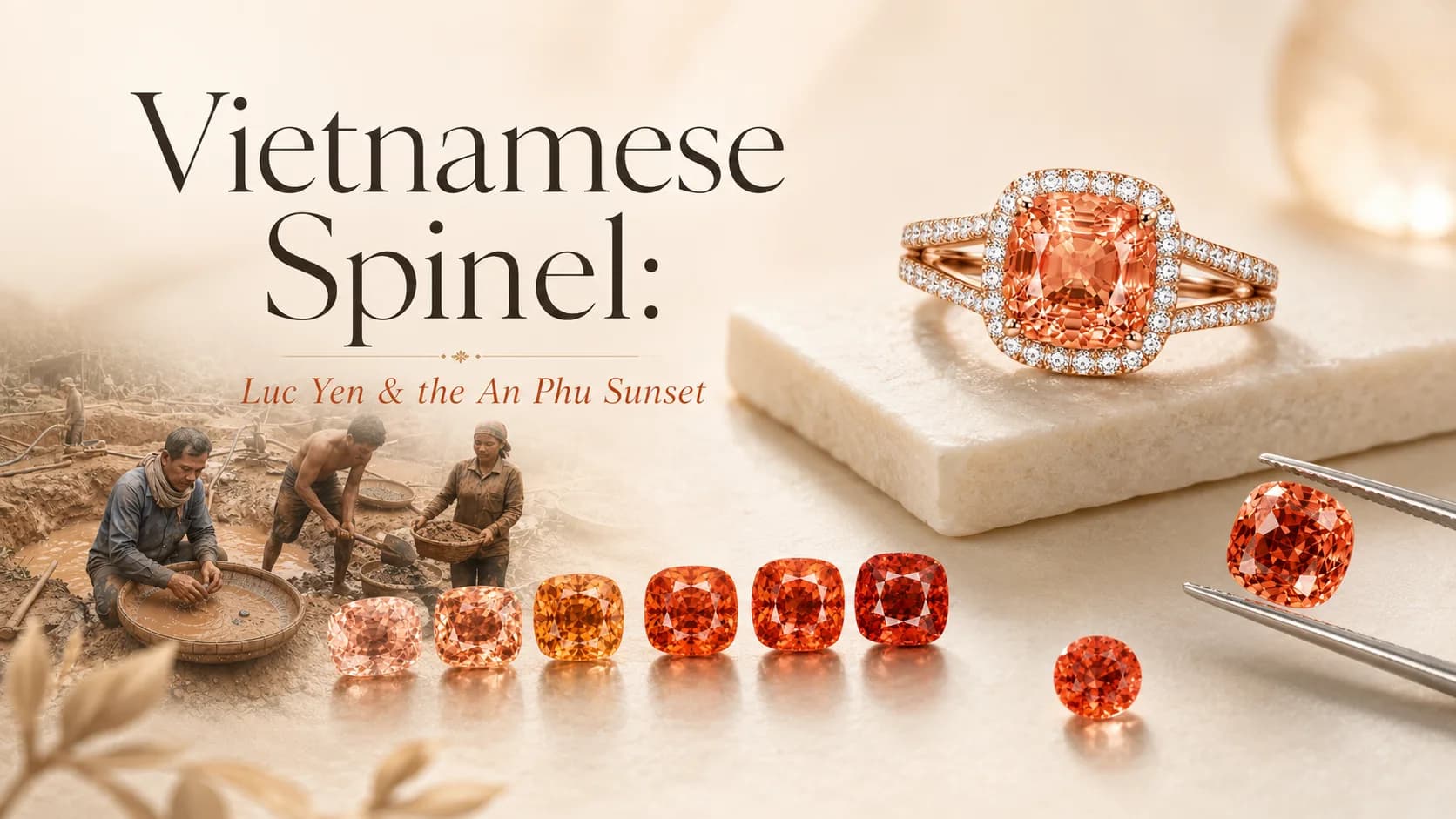
A dealer's guide to Vietnamese spinel from Luc Yen: world-class untreated cobalt-blue, neon pink and lavender, plus the rare salmon-orange we call the An Phu Sunset, with honest buying advice.
Vietnamese spinel is natural, almost always untreated gem spinel from the Luc Yen and An Phu fields of Yen Bai province, prized for world-class cobalt-blue, neon pink, and soft lavender stones grown in a marble host, plus a rare salmon-orange we call the An Phu Sunset. It rivals Burma at a gentler price.
For collectors, Vietnam has quietly become one of the three names that matter in fine spinel, alongside Mogok in Myanmar and Mahenge in Tanzania. What follows is a dealer's working guide to where these stones come from, why the colour is so clean, which hues to chase, and how to buy without overpaying. Spinel itself is magnesium aluminium oxide (MgAl2O4), cubic and singly refractive, Mohs 8, with no cleavage — a tough, brilliant stone that takes light beautifully. Vietnam simply happens to grow some of the finest.
Where does Vietnamese spinel come from?
Vietnamese spinel comes chiefly from the Luc Yen district of Yen Bai province in the country's mountainous north, with the An Phu commune as its most storied pocket. The deposits are marble-hosted, the same broad geological recipe that produced Mogok.
Roughly 180 kilometres north-west of Hanoi, Luc Yen sits in a belt of metamorphosed limestone — marble — laced with gem-bearing pockets. When ancient carbonate rock is cooked and squeezed deep in the crust, trace elements recrystallise into ruby, sapphire and spinel. This is the classic marble-type environment, and it is the single biggest reason Vietnamese spinel looks the way it does. Because the marble host is low in iron, the crystals grow with remarkable purity of colour — few of the grey or brown masks that dull spinel from basaltic or iron-rich settings. Much of the material is recovered from secondary alluvial gravels by artisanal miners working small plots and river flats, then traded at the lively morning gem market in Luc Yen town. For a broader picture of how host rock shapes a gem, our guide to why spinel origin matters sets Vietnam in context against Burma and Sri Lanka.
Commercial gem mining here effectively opened in the late 1980s, making Vietnam a young source by historical standards — yet in three decades it has produced cobalt-blue and pink spinel good enough to sit beside anything from the classic localities. To understand where spinel fits in the wider gem world, start with our complete guide to natural spinel.
What colours of spinel does Luc Yen produce?
Luc Yen is best known for four things: electric cobalt-blue, neon-leaning pink, gentle lavender-violet, and a scarce salmon-orange. The low-iron marble host is what keeps these colours clean and saturated rather than greyed.
The cobalt-blue is the headline act. Where most blue spinel owes its colour to iron and reads steely or denim, a small fraction of Vietnamese blue carries genuine cobalt, which produces a vivid, almost electric blue that glows under daylight. Fine cobalt-blue is one of the rarest and most valuable colours in the entire spinel family — top stones can exceed $20,000 per carat — and Luc Yen is one of the very few places on earth that yields it. Our dedicated cobalt-blue spinel guide explains how to tell true cobalt from iron-blue, and you can see current stones in the cobalt-blue collection.
The pink runs from hot, slightly neon raspberry to softer rose, coloured by chromium just as Burmese pink is; the best Luc Yen pinks fluoresce and seem lit from within. The lavender and violet stones — cool, smoky, sometimes with a greyed elegance — are a connoisseur's quiet favourite. See our pink spinel guide and the purple and violet spinel guide for how these hues are graded and priced.
| Colour from Luc Yen | Cause of colour | Rarity | Indicative 2026 price/ct |
|---|---|---|---|
| Cobalt-blue (true cobalt) | Cobalt | Very rare | $3,000 – $20,000+ |
| Iron-blue / denim | Iron | Uncommon | $400 – $2,500 |
| Neon / hot pink | Chromium | Uncommon | $800 – $4,000 |
| Lavender / violet | Iron + trace elements | Uncommon | $300 – $1,500 |
| Salmon-orange (An Phu Sunset) | Trace transition metals | Extremely rare | Premium, quoted per stone |
What is the An Phu Sunset spinel?
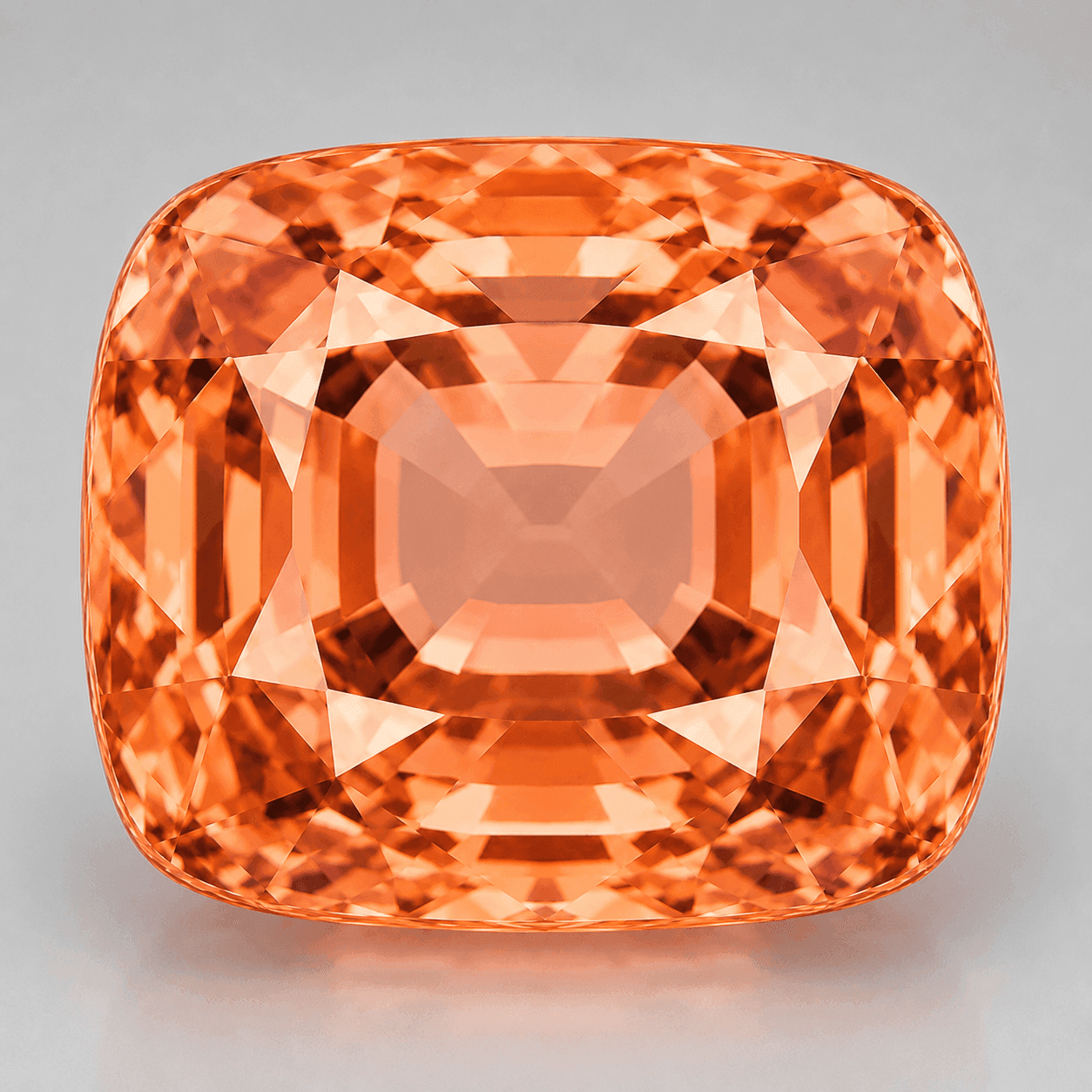
The An Phu Sunset is our house name for a rare, untreated salmon-to-sunset orange spinel from the An Phu gem fields of Luc Yen. It is not a laboratory or grading term — it is simply how we, at THE HOUSE OF SPINEL, describe this particular Vietnamese hue when it appears.
Orange is one of the scarcest directions a spinel can take, and the finest examples drift toward the coral-pink glow of a padparadscha sapphire — warm, soft, and quietly luminous. Every so often the An Phu ground gives up a stone in exactly this register: a delicate salmon that deepens toward sunset orange. We want to be candid about two things. First, these are genuinely rare; you will not see them in quantity, and a fine one is quoted per stone rather than by a tidy per-carat band. Second, in fairness to the record, Mogok remains the classic source of orange spinel — Burma has produced the benchmark oranges and flame-toned stones for generations, and Vietnam's orange output is small by comparison. The An Phu Sunset is not a claim that Vietnam out-produces Burma in orange; it is a name for a lovely, uncommon thing when Luc Yen happens to make it. For the full picture of the hue across all sources, read our orange spinel guide, and browse available stones in the orange collection.
An Phu Sunset is our name for a rare Luc Yen orange — padparadscha in temperament, Vietnamese by birth, and never a lab designation.
Is Vietnamese spinel treated or heated?
In the overwhelming majority of cases, no — Vietnamese spinel is natural and untreated, sold exactly as the earth grew it. This is not a Vietnamese peculiarity but a spinel-wide truth: the species is very rarely treated, which is one of its greatest quiet advantages.
Consider the contrast. Roughly nine in ten blue sapphires on the market have been heated to improve colour and clarity; fine spinel, by long-standing trade custom, simply is not. What you see is what grew. That means the vivid cobalt-blue or neon pink in a Luc Yen stone is intrinsic, not coaxed out of a furnace. For collectors this matters twice over: it protects value, and it makes the stone honest. Our article on whether spinel is treated or heated covers the rare exceptions and the disclosure standards you should expect. When you buy fine or unusual Vietnamese material, a report from a respected laboratory confirming natural, no indications of heat is worth having; see our guide to spinel certification for which labs and which language to look for. The GIA's spinel buyer's guide is a sound neutral primer on quality factors.
How good is the clarity and cut of Luc Yen spinel?
Clarity in Luc Yen spinel is often excellent, because the clean marble host and the stone's singly refractive nature let colour read purely with high brilliance. Cutting is where you should be most discerning, since much rough is fashioned locally with weight retention in mind.
Spinel is singly refractive, so there is no double refraction, no pleochroism and no facet doubling to muddy the view — a genuine optical advantage over ruby, sapphire and tourmaline, and a useful separator too. The result in a well-cut Vietnamese stone is a lively, single, saturated flash of colour. Inclusions, when present, tend to be crystals and the octahedral spinel-in-spinel formations beloved by gemmologists; light silk is common in pinks. Because Mohs 8 and the absence of cleavage make spinel robust, it wears superbly — more on that in our hardness and durability guide. The thing to watch is make: prioritise stones cut for symmetry and light return over those left heavy and windowed. When you evaluate a stone, work through clarity, cut and shape deliberately, as set out in our clarity, cut and shape guide.
How do I buy a fine Vietnamese spinel?
Buy on colour first, cut second, and always for natural, untreated material with disclosure to match. The steps below are the order a dealer actually follows when assessing a Luc Yen stone.
- Fix the colour you want. Decide between electric cobalt-blue, neon pink, cool lavender, or the rare salmon An Phu Sunset — each sits at a different rarity and price.
- Judge saturation and tone in daylight. The best Vietnamese stones glow; reject anything greyed, brownish or overly dark. For cobalt-blue, confirm the blue is vivid rather than steely iron-blue.
- Assess the cut. Look for even light return across the face, no large window, and good symmetry. A sharper cut on a smaller stone often beats a heavy, sleepy one.
- Check clarity to the eye. Minor internal crystals are normal and natural; what you want is a bright, transparent stone that reads clean at arm's length.
- Confirm natural and untreated. Ask for a laboratory report stating natural spinel with no indications of heat, especially above a carat or for any cobalt-blue or orange.
- Weigh origin against price. Vietnamese origin is a genuine merit, but a fine untreated stone is the goal; use our price guide and how to buy natural spinel to sanity-check the number.
On value, Vietnamese spinel tends to offer more colour per pound than Burmese equivalents, which carry an origin premium. A fine red spinel of any origin still sells for roughly a tenth of a comparable ruby, and Vietnam's cobalt-blues and pinks likewise deliver luxury colour at collector-friendly numbers — though top cobalt-blue is genuinely dear. If you are weighing spinel against corundum before you commit, our comparisons of spinel versus ruby and spinel versus sapphire are worth ten minutes. Ready to look at stones? Start with the full shop or the focused cobalt-blue collection.
How does Vietnamese spinel compare with Burmese and Ceylon?
Vietnam and Burma share a marble host and thus a family resemblance, but Burma carries the historical premium while Vietnam offers comparable colour for less. Sri Lanka (Ceylon) trends toward softer, iron-tinted pastels. The table below sets the three side by side.
| Source | Signature colours | Treatment norm | Collector note |
|---|---|---|---|
| Luc Yen, Vietnam | Cobalt-blue, neon pink, lavender, rare orange | Untreated | World-class colour, gentler price than Burma |
| Mogok, Myanmar | Flame red, hot pink, orange, grey | Untreated | The historical benchmark; origin premium |
| Sri Lanka (Ceylon) | Pastel pink, violet, blue, grey | Untreated | Softer, iron-rich, elegant pastels |
None of this makes one source simply better than another — it makes them different tools for different tastes. A collector chasing the loudest possible cobalt-blue has few better hunting grounds than Luc Yen; one who wants the pedigree and flame-red romance will look to Mogok, the valley of rubies and spinel. For the deep history of the species — the Black Prince's and Timur "rubies" that are really spinels — Wikipedia's spinel entry is a reliable starting point.
- Is Vietnamese spinel natural and untreated?
- Yes, in almost all cases. Vietnamese spinel from Luc Yen is sold natural and untreated, consistent with spinel as a species, which is very rarely heated or treated. For fine stones, ask for a laboratory report stating natural spinel with no indications of heat.
- Where is Vietnamese spinel mined?
- Chiefly in the Luc Yen district of Yen Bai province in northern Vietnam, with the An Phu commune among its most celebrated pockets. The deposits are marble-hosted and much of the gem material is recovered from alluvial gravels by artisanal miners.
- What is the An Phu Sunset?
- An Phu Sunset is THE HOUSE OF SPINEL's own name for a rare, untreated salmon-to-sunset orange spinel from the An Phu fields of Luc Yen. It is a house descriptor, not a laboratory or grading term. Mogok in Myanmar remains the classic source of orange spinel.
- Is Vietnamese cobalt-blue spinel as good as Burmese or Tanzanian?
- It can be exceptional. Luc Yen is one of very few sources of true cobalt-coloured blue spinel, which glows electric blue and ranks among the rarest, most valuable spinel colours. Quality varies stone by stone, so judge saturation and cut individually.
- Is Vietnamese spinel a good value compared with Burmese?
- Generally yes. Vietnamese spinel offers colour comparable to Burmese material without the same origin premium, so you often get more saturation per pound. Top cobalt-blue remains costly everywhere, but pinks and lavenders are notably collector-friendly.
Sources
Facts on this page draw on independent gemmological authorities:
- Gemological Institute of America (GIA) · Institute
- Gübelin Gem Lab · Laboratory
- GRS (GemResearch Swisslab) · Laboratory
- Lotus Gemology · Laboratory