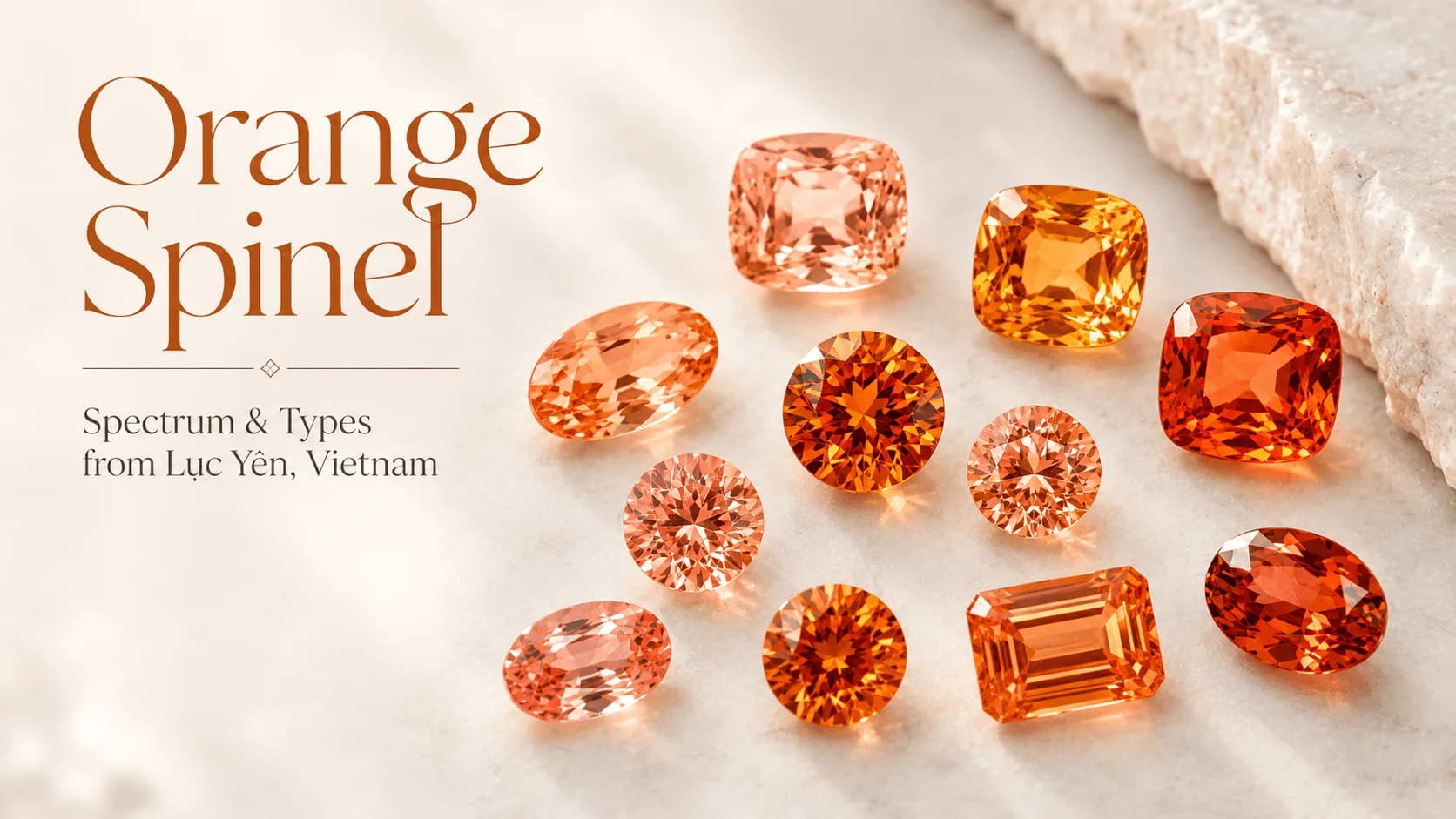
A collector's guide to orange spinel: what causes its flame colour, where it is mined, how rare it truly is, and what fine mandarin and reddish stones are worth in 2026.
Orange spinel is a rare, singly refractive gem coloured by trace elements — chiefly iron with a measure of chromium — that produce warm mandarin to reddish 'flame' hues. Almost never treated and thinly mined, the finest examples are effectively one-of-one stones prized by colour connoisseurs and priced accordingly.
What Gives Orange Spinel Its Flame Colour?
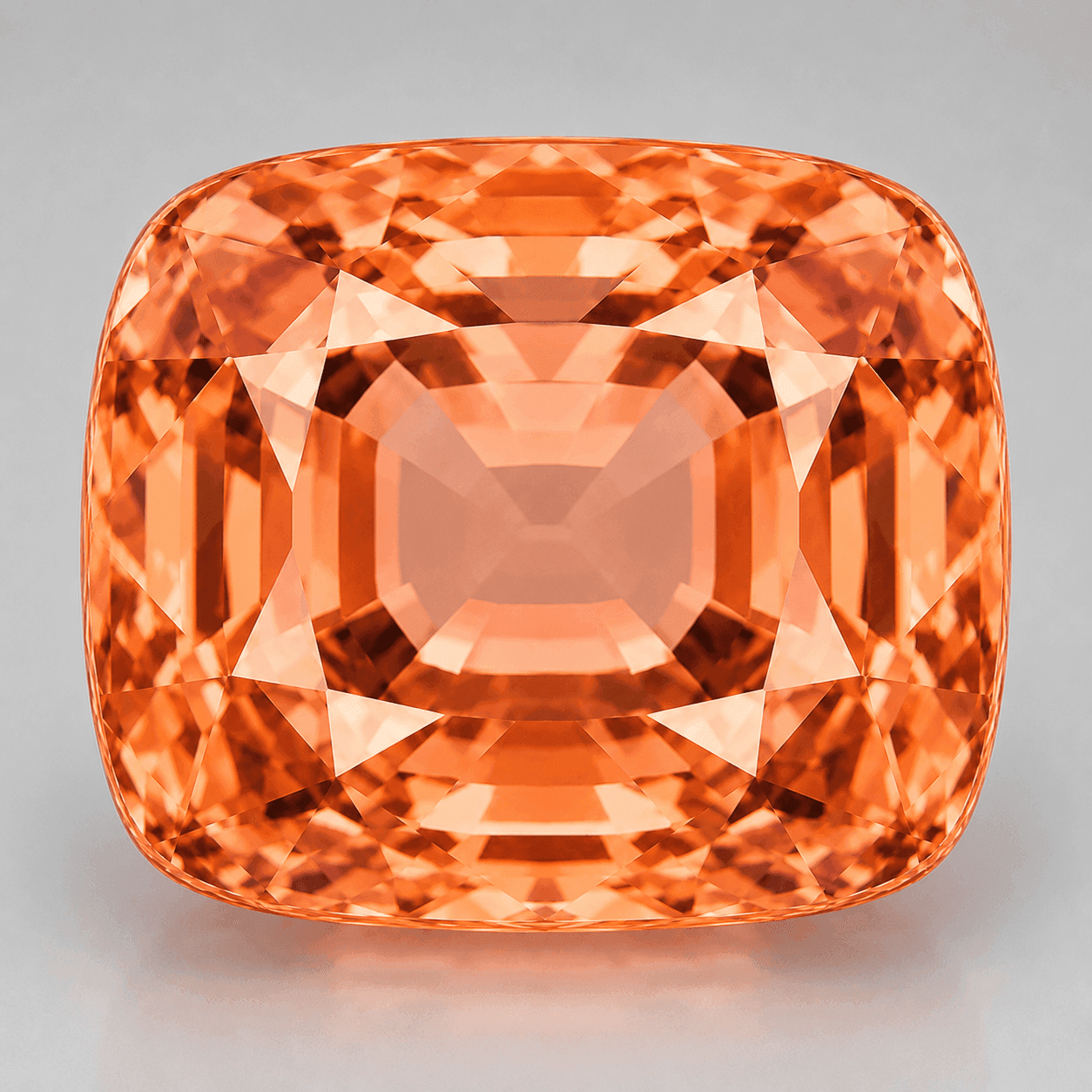
Orange spinel owes its warmth to trace-element chemistry rather than a single colouring agent. In red and pink spinel, chromium does the work; in cobalt-blue spinel it is cobalt; in grey and steely-blue stones it is iron. Orange sits at the crossroads of these mechanisms. The warm body colour comes chiefly from iron, while a measure of chromium contributes the red undertone that lifts a merely yellowish stone into true mandarin or reddish 'flame' territory. That balance is what a laboratory reads when it reports trace-element chemistry, and it is why no two orange stones look quite alike. The trade name 'flame spinel' is reserved for the vivid, slightly reddish oranges that seem to glow from within.
Chemically, all spinel is magnesium aluminium oxide (MgAl2O4), crystallising in the cubic, or isometric, system. That structure makes the species singly refractive, so an orange spinel shows one clean body colour with none of the doubling or pleochroism you see in corundum. It carries a Mohs hardness of 8, a refractive index between roughly 1.712 and 1.762, and a specific gravity near 3.60 — a tidy fingerprint that separates it from look-alikes. Under the loupe, a gemologist reads hue (where the colour sits between yellow and red), tone (how light or dark), and saturation (how vivid). The most sought stones are medium in tone and high in saturation, with a hue that leans a few degrees toward red — the quality the trade calls flame. For a broader tour of the species, our complete guide to natural spinel sets the context.
How Rare Is Orange Spinel for Collectors?
Rarity in coloured stones is not one number but a stack of probabilities, and orange stacks unfavourably at almost every level. Spinel is already a minor production next to sapphire; within spinel, red and pink dominate rough recovery, cobalt blue is the headline rarity, and orange turns up only occasionally — rarely in clean, saturated, well-sized pieces. A parcel of mixed spinel rough might yield a handful of oranges, most of them pale, brownish, or too small to cut a lively stone. That scarcity is genuine rather than manufactured: there is no steady pipeline of orange spinel the way there is for heated blue sapphire. For a collector assembling a colour suite, the orange slot is often the hardest to fill, which is exactly why connoisseurs prize it. When you find a vivid flame-orange of two or three carats with clean facets, you are usually looking at a single stone rather than one of a matched run. Supply, not marketing, sets the order here — a theme we return to across the rarest spinel colours.
Where Does Orange Spinel Come From?
The classic source for fine orange and flame spinel is Mogok in Myanmar, the same valley that yields the world's benchmark rubies and red spinel. Burmese material tends to show the cleanest, most vivid warm hues, and the best flame-orange stones on the market usually trace back there; you can read more in our guide to Mogok, the valley of rubies and spinel. Tanzania contributes orange and orange-pink spinel, often in slightly larger and more open stones. Sri Lanka's spinel carries more iron and tends toward softer, browner, or peachy oranges that make an affordable entry point. Vietnam's Luc Yen district — long celebrated for some of the world's purest untreated cobalt-blue, pink and lavender spinel — occasionally yields a warm stone of rare, luminous character; the finest of these salmon-to-sunset oranges, from the gem gravels around An Phu, are the stones we call the An Phu Sunset, and they earn a section of their own below. Because orange is a by-product of several deposits rather than the target of any single mine, supply is irregular — good months and lean months rather than a reliable flow — which keeps fine material out of the hands of all but attentive buyers.
What Is An Phu Sunset Spinel?
An Phu Sunset is our name for a rare salmon-to-sunset orange spinel from the An Phu gem fields of Luc Yen, in northern Vietnam — a warm, softly pink-tinged orange that recalls the prized padparadscha hue of fine sapphire, yet is entirely natural and untreated. We coined the term because these stones stand apart from ordinary orange spinel: where much orange material reads yellowish or brownish, an An Phu Sunset glows with the clean, luminous salmon-and-mandarin colour of a Vietnamese sunset. It is one of the scarcest things we handle, and only a few ever surface in a good year.
Luc Yen has earned its standing honestly. Its marble-hosted deposits — the same kind of geology that produces the world's benchmark rubies — give up spinel of exceptional transparency and purity of colour: bright, limpid crystals that reach their hue with no heat and no treatment. Where Mogok is prized for fire and Mahenge for neon intensity, Luc Yen is prized for clarity and a delicacy of tone, and its finest cobalt-blue spinel is already regarded among the best in the world. The An Phu gravels sit within this celebrated belt; on the rare occasion they surrender a warm stone, the result is a limpid, saturated salmon-orange we believe stands beside the finest warm spinel from any source.
Rarity is the whole of the story here. Orange is already the hardest colour with which to complete a spinel colour suite; a clean, saturated salmon-sunset from a single Vietnamese locality is rarer still. Because so few exist, An Phu Sunset stones are never sold to a price sheet — each is judged and valued on its own colour, clarity and size, the way the finest red and cobalt-blue spinels are, and the rarest spinel colours always are. For the collector who already owns the obvious hues, an An Phu Sunset is the quiet, singular stone that few peers will ever match — and when one appears in the orange spinel collection, it rarely stays long.
What Is a Fine Orange Spinel Worth in 2026?
Value in orange spinel follows the same logic as the rest of the species — colour first, then clarity, cut, and carat — but with a thinner, more collector-driven market beneath it. Colour is decisive: a pure, vivid mandarin or a reddish flame commands a real premium, while yellowish, brownish, or pale stones sit far lower. Because spinel is singly refractive and takes a bright polish, a well-cut orange stone returns light evenly across the face. Cutters will hold weight on rough this scarce, so a little extra depth is forgivable if the colour is right. Eye-clean clarity is expected in the better stones; spinel's inclusions tend to be modest, but heavy silk or fractures pull value down quickly. Size matters more than usual, too, because clean orange rough above two carats is uncommon, and per-carat prices climb as size rises. Cut style matters as well; oval and cushion shapes dominate because they save weight and flatter the warm hue, while precision-cut rounds are scarce and command a premium of their own.
Here is the honest part a dealer owes you: orange does not yet trade to a published price sheet the way red and cobalt blue increasingly do. There are simply not enough stones changing hands to fix tidy per-carat tiers, so it is negotiated stone by stone. As a benchmark, the best flame-orange — material that reads almost red — is sensibly valued against fine red spinel, which in 2026 runs roughly $2,000 to $5,000 per carat for high quality and $5,000 to $10,000 for top stones, with exceptional Myanmar reds exceeding $20,000. Purer, lighter, or smaller oranges sit well below that, overlapping the broad commercial band that starts around a few hundred dollars per carat. Put that beside ruby, where a fine red spinel often sells for roughly a tenth of a comparable ruby, and the collector logic of buying spinel becomes clear. For the full picture across the species, see our spinel price guide, and remember that at these levels value is a laboratory question, not a seller's opinion.
One quiet advantage sharpens the case. Spinel is very rarely treated, and an orange stone is almost always exactly what it appears to be — an untreated, natural colour. Compare that with the warm corundums it competes against: padparadscha and orange sapphire are routinely heated, and roughly 90% of the blue sapphire on the market has seen a furnace. When you buy a natural orange spinel, you are buying the colour the earth made, with no assist from heat or diffusion. That integrity is a large part of the appeal for buyers who care about origin, and we draw the comparison out further in spinel vs sapphire. GIA's own spinel buyer's guide makes the same point about the species' untreated character.
Is Orange Spinel Durable Enough to Wear?
Durability is worth a word, since an orange stone is one you may want to wear rather than only collect. At a Mohs hardness of 8 it sits above quartz and most garnets, with no cleavage to speak of and good toughness, which makes it practical in rings as well as pendants and earrings. It is not as hard as sapphire, so a daily-wear ring stone still benefits from a protective setting, but for a coloured gem it is among the more resilient choices. We cover this in depth in our note on spinel hardness and durability.
Orange Spinel Compared With Other Spinel Colours
It helps to see where orange sits among its siblings. The table below sets orange spinel beside the colours with established markets — red, cobalt blue, and grey — using verified 2026 price context where a settled range exists and a qualitative note where the market is still too thin for tidy tiers. Colour causes and typical sources are included so you can read each variety's character at a glance.
| Spinel colour | Main colour cause | Notable source | 2026 price context (per carat) | Treatment |
|---|---|---|---|---|
| Red | Chromium | Myanmar (Mogok) | ~$600-2,000 good; $2,000-10,000 fine to top; $20,000+ exceptional | Very rarely treated |
| Cobalt blue | Cobalt | Vietnam (Luc Yen); Tanzania (Mahenge) | ~$2,000 second-tier up to $20,000+ top | Almost never treated |
| Grey | Iron | Sri Lanka and others | ~$300-500 for well-cut stones | Not treated |
| Orange / flame | Iron with chromium | Myanmar; Tanzania; Sri Lanka | Thinly traded; best benchmarked to fine red spinel | Very rarely treated |
How Do You Buy an Orange Spinel Well?
Because the market is thin, buying well is less about chasing a price sheet and more about judging the individual stone. These steps are the same ones we run through on the counter.
- Fix your hue target: decide whether you want pure mandarin, a yellowish-orange, or a reddish flame, since price and availability differ sharply across that range.
- Judge colour in neutral daylight: warm shop lighting flatters every orange, so view the stone against white under balanced light to read its true tone and saturation.
- Check clarity eye-clean first: expect the better stones to be clean to the unaided eye, and note any silk or fractures that could affect brilliance or durability.
- Assess the cut for even light return: a well-cut spinel lights up across the whole face with no dead windows, and symmetry matters as much as raw carat weight.
- Confirm it is untreated and natural: ask the question directly, expect the answer to be yes for spinel, and get that assurance in writing.
- Insist on an independent report: for any significant orange spinel, a laboratory report confirms species, natural origin, and the absence of treatment.
- Buy the individual stone, not the category: because orange is thinly traded, weigh each stone on its own colour, clarity, and price rather than to a fixed per-carat figure.
Certification, Origin, and the August Birthstone
For any orange spinel of real value, an independent report is not optional. A respected laboratory will confirm the species, verify that the colour is natural and untreated, and — on the better reports — describe the trace-element chemistry and sometimes an origin opinion. Labs such as Lotus Gemology and GRS are widely trusted for spinel, and our own primer on spinel certificates explains what each line of a report means. It is also worth knowing that spinel is an official August birthstone: the AGTA added it alongside peridot in 2016, so a warm orange stone makes an unusual, untreated alternative to the traditional green stone — see GIA's August birthstones overview for the background.
- What causes the orange colour in spinel?
- Orange spinel gets its warmth mainly from iron, with a measure of chromium adding the red undertone that turns a yellowish stone into true mandarin or reddish flame. The exact trace-element balance varies by deposit, which is why a laboratory report can describe each stone's colour chemistry precisely.
- Is orange spinel rarer than red spinel?
- Yes. Red and pink dominate spinel production, while clean, saturated orange turns up only occasionally and seldom in larger sizes. A fine flame-orange of two carats is genuinely scarce, often effectively one-of-one, which is why colour collectors treat the orange slot as one of the hardest to fill.
- Is orange spinel treated or heated?
- Almost never. Spinel is one of the few gems that reaches the market untreated, and the stone is typically exactly what it appears to be. That contrasts with warm sapphires, which are routinely heated, and with blue sapphire, of which roughly 90% has been heat-treated.
- Can orange spinel be an August birthstone?
- Yes. The AGTA added spinel as an August birthstone in 2016, alongside peridot, so any colour of natural spinel qualifies. An orange spinel makes a warm, unusual August alternative to green peridot, and being untreated and single-source it carries a collector's story most birthstones cannot.
- How can I tell a real orange spinel from an imitation?
- Spinel is singly refractive with a hardness of 8, a refractive index near 1.712 to 1.762, and a specific gravity around 3.60. Those constants separate it from glass and doubly refractive look-alikes. For any significant purchase, an independent laboratory report is the only fully reliable confirmation.
- What is An Phu Sunset spinel?
- An Phu Sunset is The House of Spinel's name for a rare, untreated salmon-to-sunset orange spinel from the An Phu gem fields of Luc Yen, Vietnam. Its warm, softly pink-tinged orange recalls padparadscha sapphire, yet the colour is entirely natural. Only a handful surface in a good year, which places it among the scarcest and most collectible warm spinels we handle.
Orange spinel rewards the buyer who values character over category — a warm, untreated, thinly mined colour that most collections never manage to include. If you are building a spinel colour suite, or simply want the one warm stone that few of your peers will own — perhaps the rare An Phu Sunset from Luc Yen — this is a natural place to concentrate. When a fine flame-orange appears, it tends not to wait. You can view what we currently hold in the orange spinel collection, read across the family in the many colours of natural spinel, and reach out for a report-backed stone when you are ready to add the colour to your collection.
The rare salmon-orange we call the An Phu Sunset comes from northern Vietnam; read its full story in our Vietnamese spinel guide.
Sources
Facts on this page draw on independent gemmological authorities:
- Gemological Institute of America (GIA) · Institute
- Gübelin Gem Lab · Laboratory
- GRS (GemResearch Swisslab) · Laboratory
- Lotus Gemology · Laboratory