Flame-fusion synthetic spinel has filled costume jewellery for over a century. Here is how gemologists separate it from natural spinel — and why an independent lab report is always the final word.
Synthetic spinel is genuine spinel grown in a factory, almost always by flame fusion, sharing the exact chemistry and hardness of the mined stone. You separate the two under magnification: the lab-grown material shows curved growth lines and gas bubbles, while natural spinel carries angular mineral inclusions. A gem lab settles any doubt.
What Is Synthetic Spinel, Exactly?
The word 'synthetic' causes more confusion than almost any term in gemology, so let us be precise. A synthetic spinel is not a fake, an imitation, or a piece of coloured glass. It is real spinel — magnesium aluminium oxide, MgAl2O4 — with the same cubic crystal system, the same Mohs hardness of 8, the same single refractive index, and the same specific gravity of around 3.60 as a stone mined in Myanmar or Tanzania. The only meaningful difference is origin. One crystal grew slowly inside the earth over millions of years; the other was assembled in a furnace in a matter of hours. Because the two materials are genuinely identical in composition, no amount of admiring the colour will ever reveal which is which. The evidence lives instead in the microscopic record of how the crystal grew. For the full picture of the mined gem, our complete guide to natural spinel is the place to begin.
A Short History of Flame-Fusion Spinel
Lab-grown spinel arrived largely by accident. In the first years of the twentieth century, the French chemist Auguste Verneuil perfected flame fusion, the first commercially successful method for growing synthetic ruby and sapphire. When later experimenters tried to deepen the blue of synthetic sapphire by adding magnesium oxide to the alumina feed, they did not get better sapphire — they got spinel. The flame-fusion process, also called the Verneuil process, drops finely powdered oxides through an oxygen-hydrogen flame onto a slowly rotating pedestal. The powder melts, falls, and re-solidifies grain by grain into a single tapered crystal known as a boule. It is fast, inexpensive, and endlessly repeatable, which is precisely why flame-fusion material went on to saturate the costume-jewellery trade for the next hundred years.
For more than a century this material has done quiet, unglamorous work. Because colourless synthetic material can be tinted with trace elements to mimic almost any gem, manufacturers adopted it as the universal understudy of the jewellery world. It became the standard birthstone simulant in school and class rings, the blue sparkle in inexpensive dress jewellery, and the filler stone in countless mass-market pieces — durable, colour-stable, and available for a tiny fraction of the cost of anything natural. There is nothing dishonest about the material in its proper place. The problem arises only when a flame-fusion stone is presented, through ignorance or intent, as a rare natural gem. That single possibility is why every serious buyer needs to know the tells.
The Gems Flame-Fusion Spinel Was Made to Imitate
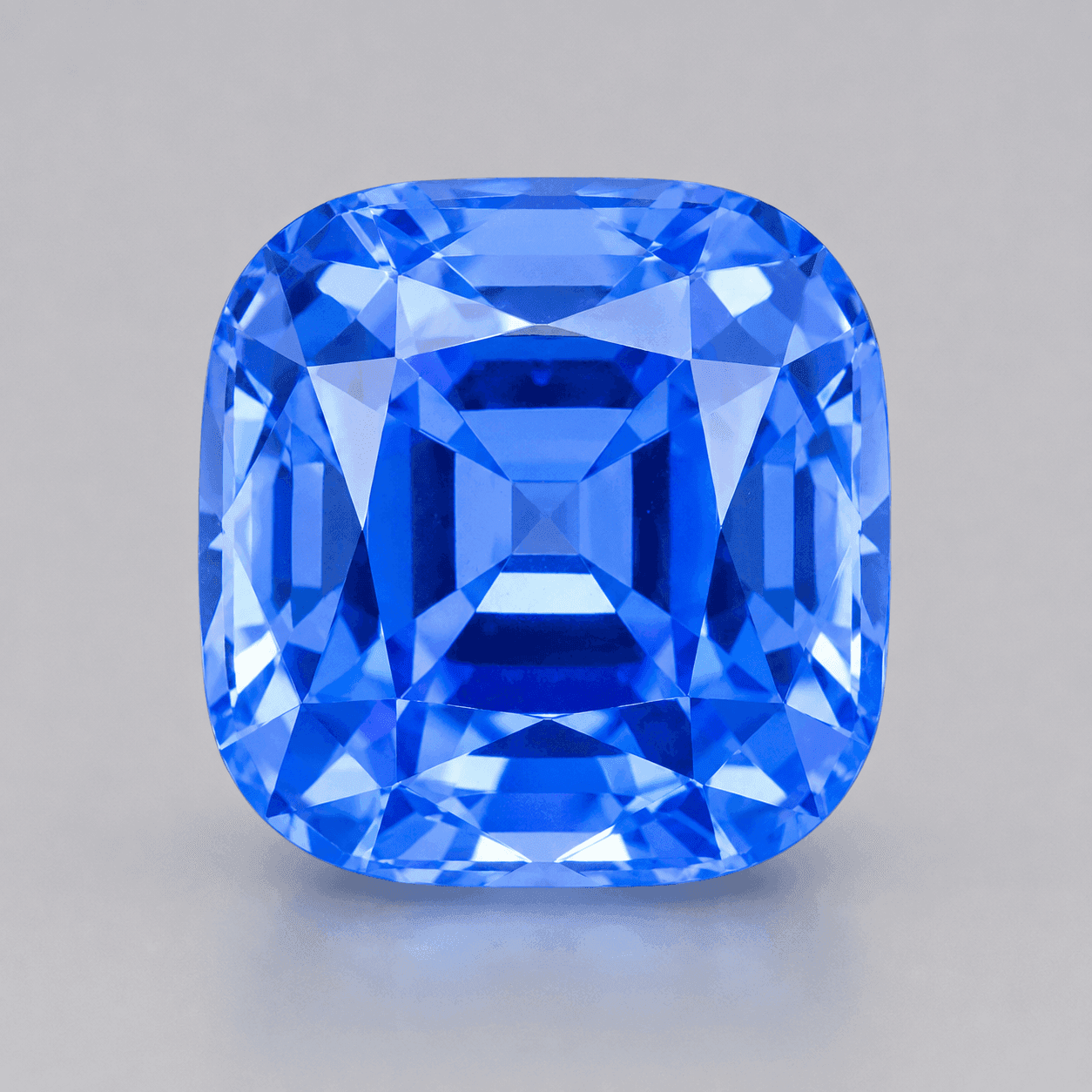
Part of what makes synthetic spinel so pervasive is its chameleon quality. In colourless form it can be tinted to impersonate a long list of gems, and for decades it was the preferred stand-in for stones that were harder or costlier to grow directly. Blue flame-fusion spinel coloured with cobalt has masqueraded as sapphire and as aquamarine; other tints have stood in for blue zircon and blue tourmaline. This matters because cobalt is also what lends genuine spinel its vivid neon blue, so a cobalt-doped synthetic can look convincingly electric to the untrained eye. Natural cobalt-blue spinel, by contrast, is authentically rare and almost never treated — while roughly 90% of natural blue sapphire is heat-treated. That gap in rarity and honesty is exactly why identity and origin are worth verifying, and why we cover cobalt-blue spinel in its own detailed guide.
How Do You Tell Natural From Synthetic Spinel?
Separation comes down to internal evidence, read with a 10x loupe or a gemological microscope. Three features betray flame-fusion origin. The first is curved striae — sweeping, faintly visible growth bands that follow the arc of the boule as it turned in the flame. Nothing in nature grows in these smooth curves; natural spinel, when it shows growth structure at all, shows it as straight, angular planes. The second is gas bubbles: tiny spheres or teardrops of trapped gas, sometimes scattered singly and sometimes gathered into clouds or trailing swirls, which are a hallmark of melt-grown material. The third is clarity that is simply too good to be true — a large, richly coloured, utterly flawless stone offered at a gentle price should raise your suspicion before it raises your pulse. Diffused lighting helps enormously: laying a slip of tissue over the light source, or immersing the stone in a still, colourless liquid, spreads the light evenly and makes curved bands and bubbles far easier to see.
- Clean the stone and view it under 10x magnification with diffused light, rotating it slowly through every direction.
- Look for curved striae — smooth, sweeping bands of colour. Their presence points strongly to synthetic spinel.
- Search for gas bubbles: round or elongated transparent spheres, often grouped in swirls or trails.
- Assess the inclusions overall — angular crystals and fingerprints suggest natural; a flawless, glassy interior suggests flame fusion.
- Weigh the price against the claim. Exceptional clarity and saturated colour at a low price is a warning, not a bargain.
- Send anything significant to an independent gem lab for a definitive natural-versus-synthetic determination.
Inclusions: The Fingerprint Inside the Stone
Gemologists prize inclusions because they are a birth record written inside the stone. Natural spinel typically contains well-formed octahedral crystals — often minute spinel or apatite crystals nested within the host — alongside healed fractures known as fingerprints, and sometimes fine silk or negative crystals. These features are angular, irregular, and unmistakably the product of growth in rock. Flame-fusion material, by contrast, is usually clean to the naked eye, and where it is not, the offenders are gas bubbles and curved striae rather than mineral crystals. A useful shorthand: natural stones tend to be untidy in orderly, crystalline ways, while synthetics tend to be clean in a faintly unreal, glassy way. For a wider authentication toolkit, see our guide on how to tell if a spinel is real.
Natural vs Synthetic Spinel: The Comparison Table
| Feature | Natural Spinel | Synthetic (Flame-Fusion) Spinel |
|---|---|---|
| Origin | Formed in the earth over millions of years | Grown in a furnace in hours |
| Chemistry | MgAl2O4 | MgAl2O4 (identical) |
| Hardness (Mohs) | 8 | 8 |
| Specific gravity | ~3.60 | ~3.60 |
| Typical inclusions | Angular octahedral crystals, fingerprints | Round gas bubbles, curved striae |
| Clarity pattern | Often lightly included | Frequently flawless, glassy |
| Colour zoning | Irregular and natural | Even, or following curved bands |
| Treatment | Very rarely treated | Not applicable — colour added during growth |
| Price (as of 2026) | $100 to $20,000+ per carat by colour and quality | A small fraction of natural prices |
| Confirmed by | Independent gem lab report | Independent gem lab report |
Gemological Properties Under the Loupe
Beyond inclusions, the optical behaviour of spinel adds supporting evidence. Spinel belongs to the cubic crystal system and is singly refractive, with a single refractive index in the range of roughly 1.712 to 1.762 and a specific gravity near 3.60, as catalogued in mineralogical references such as Mindat. Being singly refractive, spinel shows no doubling of its back facets and no pleochroism, which alone rules out many doubly refractive imitators. Under crossed polarising filters, flame-fusion spinel frequently reveals a distinctive patchy, strained extinction — the optical signature of stresses locked in during rapid growth — that natural, unstressed spinel usually lacks. No single one of these observations is proof on its own. Taken together, in trained hands, they build a strong case that a laboratory can then confirm.
Not All Synthetics Are Flame-Fusion
Flame fusion accounts for the overwhelming majority of synthetic material, but it is not the only route. Smaller quantities have been produced by flux growth and by pulling methods, and these can be harder to catch, because a slowly grown crystal may lack the obvious curved striae and gas-bubble clouds that give flame-fusion stones away. In practice you are very unlikely to encounter flux-grown spinel in ordinary trade. Its existence, though, underlines the central lesson of this guide: visual tells are powerful indicators, not cast-iron guarantees. As growth technology advances, the room for confident naked-eye separation narrows, and the argument for a proper laboratory report only grows stronger.
Why a Lab Report Is the Final Word
Here is the honest truth any reputable dealer will give you: loupe work shortens the odds, but only an independent gemological laboratory delivers certainty. Modern labs combine magnification, spectroscopy, and trace-element chemistry to state without ambiguity whether a stone is natural or synthetic — and, for natural spinel, often its likely geographic origin as well. For any stone of real value, we recommend a report from a respected laboratory. The GIA spinel buyer's guide is a sound starting point, and gemological institutions such as Gem-A publish extensively on the identification of synthetic stones. If certificates ever feel opaque, our explainer on spinel certification walks through what each line on the report actually means.
As a rule of thumb, the cost of a report is trivial next to the value it protects on any serious stone, and reputable sellers expect the question. If a dealer resists independent testing, treat that as information in itself. For a modest commercial synthetic stone destined for a fun fashion piece, a full report is overkill — but for anything you are buying as a natural gem, at a natural-gem price, certification is not an optional extra. It is the difference between owning a documented rarity and owning an open question.
What This Means for Value and Rarity
This is where the distinction stops being academic and starts affecting your wallet. Because flame fusion can produce material by the kilogram, synthetic spinel carries almost no intrinsic rarity, and its price sits at a small fraction of the natural stone. Natural spinel is an entirely different proposition. As of 2026, we have handled fine red spinel from roughly $600 to $2,000 per carat, high-grade stones from $2,000 to $5,000, and exceptional Myanmar reds beyond $20,000 per carat — and even then, a top red spinel still typically costs around one-tenth the price of a comparable ruby. Cobalt-blue spinel, the colour on this guide's cover, runs from about $2,000 per carat up into the $20,000-plus range for the finest eye-clean examples. For the collector the lesson is stark: rarity is the entire value proposition, and rarity is the one thing a furnace can never manufacture. If you want the full breakdown of what drives price, read is spinel valuable; when you are ready to see certified stones, browse our collection.
Frequently Asked Questions
- Is synthetic spinel a real gemstone or a fake?
- It is real spinel, chemically and physically identical to the natural stone — the same MgAl2O4 composition and Mohs hardness of 8. It is not a fake, but it is grown in a furnace rather than mined, so it holds almost none of the rarity or value of a natural gem.
- How can I tell if my spinel is natural or synthetic at home?
- Examine it under 10x magnification. Curved growth lines and round gas bubbles point to flame-fusion material, while angular mineral crystals and fingerprint inclusions suggest a natural stone. Home checks only narrow the odds, though — an independent gem lab gives the definitive answer.
- Why is synthetic spinel so cheap compared to natural spinel?
- Flame fusion can grow the material by the kilogram in hours, so there is no scarcity to support a high price. Natural spinel formed over millions of years in a handful of deposits, and that genuine rarity — not appearance — is what makes fine natural stones valuable.
- Does a gem lab report distinguish natural from synthetic spinel?
- Yes. Laboratories such as GIA, Gubelin, SSEF and Lotus Gemology use magnification, spectroscopy and trace-element analysis to state definitively whether spinel is natural or synthetic, and often its geographic origin. For any stone of real value, an independent report is the single most reliable safeguard.
- Is Verneuil or flame-fusion spinel the same as synthetic spinel?
- Yes. Verneuil and flame fusion describe the same process — the most common way this material is made, dropping powdered oxides through a hot flame to grow a boule. Almost all mass-market synthetic material in class rings and costume jewellery was produced this way.
The Collector's Takeaway
The reassuring reality is that telling natural from synthetic is a solved problem. The science is settled, the tells are well documented, and a credible laboratory report removes any remaining doubt. The connoisseur's rule is simply this: buy on evidence, never on colour alone. Every natural spinel we offer is sold with clear disclosure and, for significant stones, independent certification, so you can collect with confidence rather than hope. Explore our loose natural spinel, and ask us for the lab report on any stone before you commit.
Synthetic spinel is most often seen as a colourless diamond simulant — read our white and colourless spinel guide, the facts on whether spinel is treated, and spinel vs diamond.
Sources
Facts on this page draw on independent gemmological authorities:
- Gemological Institute of America (GIA) · Institute
- Gübelin Gem Lab · Laboratory
- GRS (GemResearch Swisslab) · Laboratory
- Lotus Gemology · Laboratory