Most 'white spinel' is synthetic. This guide separates rare natural colourless spinel from the flame-fusion lookalike, weighs it against diamond, and explains how to verify, value and wear an untreated white gem.
White spinel is a rare, genuinely colourless variety of natural spinel — magnesium aluminium oxide (MgAl2O4), Mohs 8, singly refractive and with no cleavage — prized by collectors as an untreated diamond alternative; yet the great majority of "white spinel" on the market is synthetic flame-fusion material, so confirming natural origin matters more here than in almost any other spinel colour. This guide from THE HOUSE OF SPINEL explains what genuine colourless spinel is, how to separate it from the lab-grown lookalike, what it is worth in 2026, and where its quiet brilliance sits beside a diamond.
What exactly is white or colourless spinel?
Colourless spinel is natural spinel carrying no chromophore — no chromium, cobalt or iron to tint it — so light passes through as pure, neutral white. It is among the scarcest natural spinel colours, because most rough carries at least a trace of iron that nudges it toward grey, mauve or pale lavender rather than true water-white.
Spinel takes its colours from specific trace elements: chromium builds the famous Mogok reds and hot pinks, cobalt the electric cobalt-blue, and iron the greys, steely blues and violets. Remove all of them and you are left with the crystal's intrinsic state: transparent and colourless. Because iron is so common in the ground, a stone that reaches true neutrality — no grey cast, no lavender undertone — is genuinely uncommon. Across the full spectrum of natural spinel hues, colourless sits at one quiet end, less celebrated than red or blue but valued by purists precisely for what it lacks. For the broader picture of the species — chemistry, crystal habit and sources — our complete guide to natural spinel is the place to start.
Is white spinel natural or synthetic?
Most "white spinel" sold today is synthetic — flame-fusion (Verneuil) material grown since the early twentieth century as an inexpensive, colourless diamond and white-sapphire simulant. Genuinely natural colourless spinel exists, but it is rare, and the two are routinely conflated by sellers who quietly drop the word "synthetic".
There is real history here. Synthetic spinel has been mass-produced for over a century and turns up in birthstone rings, class rings, mid-century "costume" pieces and countless simulated-diamond settings. It was cheap, hard and clean — an ideal stand-in. That legacy is why an online search for "white spinel" returns oceans of lab-grown goods at a few dollars a carat. Synthetic material is not a scam when it is disclosed honestly; it is a legitimate, attractive stone. The problem is the omission. A natural colourless spinel and a flame-fusion one can look near-identical to the naked eye, yet differ in value by two orders of magnitude, so the single most important question you can ask is simply: natural or synthetic? Our dedicated comparison of natural versus lab-created spinel unpacks the growth methods and the tells in detail, and the GIA spinel buyer's guide is a useful independent reference on the species.
With most spinel colours the question is where it came from. With white spinel the first question is whether it grew in the earth at all.
How can you tell natural white spinel from synthetic?
The naked eye cannot reliably separate natural from synthetic colourless spinel — both are singly refractive, Mohs 8 and glassy-bright. The dependable separators are inclusions under magnification, subtle optical anomalies, and, above all, a report from a respected gemmological laboratory.
Here dealers lean on the microscope and on the lab. Natural spinel typically shows small octahedral crystals, fingerprint-like healed fissures or fine "ladder" inclusions; flame-fusion synthetics tend to be too clean or show curved growth striae and gas bubbles. Under crossed polarising filters, natural spinel often shows a faint tabby or cross-hatched strain pattern (anomalous double refraction) that differs from the pattern in synthetics — a specialist read, not a home test. Because the stakes are high on a colourless stone, insist on documentation. Our guide to how to tell if a spinel is real and our explainer on spinel certification walk through what a good report should state.
- Ask the seller directly, in writing, whether the stone is natural or synthetic — and treat any hesitation as your answer.
- Examine it under 10x magnification: look for natural inclusions (octahedral crystals, healed fingerprints) rather than curved striae or rounded gas bubbles.
- Check for the tell-tale over-clean, flawless look of cheap flame-fusion material; nature rarely makes a large, perfectly clean colourless stone for pocket money.
- Weigh price against plausibility — a "natural" colourless spinel priced like a synthetic almost certainly is one.
- For anything of value, require a report from an independent laboratory (for example GIA or a coloured-stone specialist lab) stating natural origin and no treatment.
How does white spinel compare to a diamond?
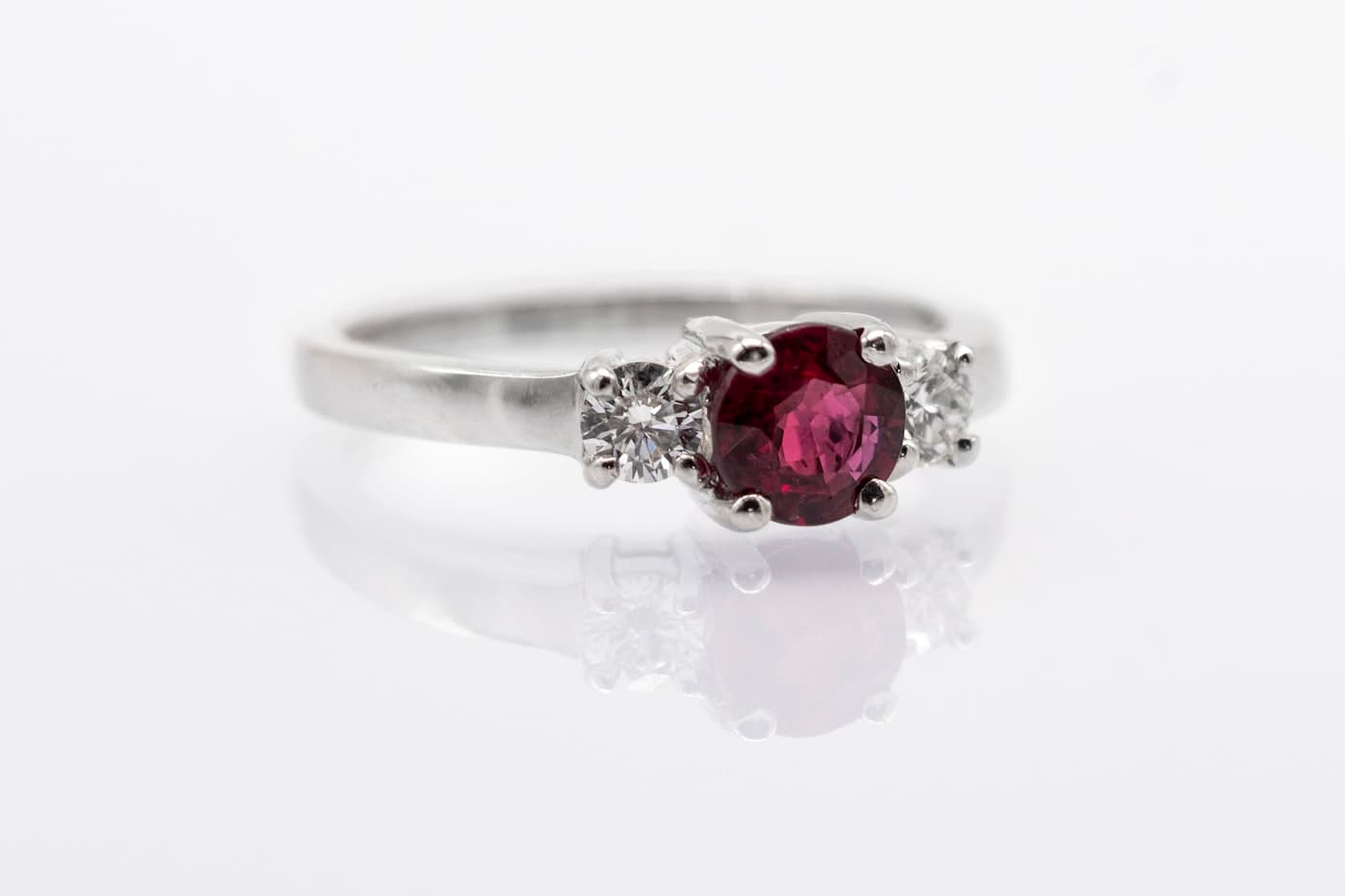
Natural white spinel is a credible, quietly beautiful diamond alternative: bright, hard, untreated and far less expensive. It does not match diamond's fire or hardness, but for buyers who want a colourless natural gem with an honest story rather than maximum sparkle, it earns its place.
The differences are worth understanding before you choose. Diamond is singly refractive like spinel, so neither shows the doubling you see in zircon or moissanite, but diamond's higher refractive index and dispersion give it more brightness and noticeably more rainbow fire. Spinel returns a cleaner, whiter, glassier light — less flashy, some would say more restful. On durability, diamond's Mohs 10 is unmatched, yet spinel's Mohs 8 with no cleavage plane makes it tougher against accidental chips than many gems people wear daily. For the fuller argument, see our head-to-head on spinel versus diamond.
| Property | Natural white spinel | Diamond |
|---|---|---|
| Composition | Magnesium aluminium oxide (MgAl2O4) | Crystalline carbon (C) |
| Mohs hardness | 8 | 10 |
| Cleavage | None | Perfect, four directions |
| Optical character | Singly refractive | Singly refractive |
| Refractive index | ~1.712-1.762 | ~2.417 |
| Dispersion (fire) | Low (~0.020) | High (~0.044) |
| Typical treatment | None - untreated is the norm | Sometimes (clarity/colour) |
| Rough for cutting | Rare in true colourless | Widely available |
| Relative price | A fraction of diamond | Benchmark |
How brilliant is colourless spinel?
Colourless spinel is bright and lively but not fiery: its refractive index of roughly 1.72 gives strong, clean light return, while its low dispersion means little of the rainbow flash diamond is prized for. The effect is a crisp, glassy white brilliance rather than a scintillating firework.
Because spinel is singly refractive, a well-cut colourless stone reads as pure and uncomplicated — no birefringent "fuzz", no obvious dispersion colours breaking up the light. A skilled cutter can maximise brightness with good proportions and clean facet junctions, and because natural colourless rough is scarce, most fine examples are cut to save weight or to flatter a particular piece of rough rather than to a rigid diamond-style ideal. If you are choosing a stone, our notes on spinel clarity, cut and shape explain how proportion and polish drive that brightness.
Where does natural white spinel come from?
Near-colourless and pale natural spinel most often surfaces in the iron-rich alluvial deposits that also yield soft pastels — Sri Lanka (Ceylon) above all, with occasional material from Myanmar and other Southeast Asian fields. Truly water-white stones are the rare, chromophore-free end of a run of rough that usually carries at least a whisper of grey or lavender.
The gem gravels of Sri Lanka are the classic home of the palest spinel, where iron gives a spectrum of gentle greys, mauves and near-colourless stones rather than saturated hues. Historic Burmese material from Mogok — the benchmark valley for red and pink — throws the odd colourless crystal too, though its fame rests elsewhere. For the colourless buyer, the practical point is that origin adds little premium here: a lab report confirming natural, untreated spinel does far more for value than a country name, which is the reverse of what happens with red and blue, where origin can move the price sharply. Collectors who love the pale end of the family often pair a colourless stone with Ceylon's soft greys and lavenders for a quietly coherent suite.
What is a natural white spinel worth in 2026?
Natural colourless spinel is modestly priced compared with red or cobalt-blue spinel, but it commands a large premium over the synthetic material it is so often confused with. Value turns almost entirely on proof of natural origin, then on size, clarity and cutting.
For context, fine natural red spinel runs roughly $2,000-5,000 per carat, top reds $5,000-10,000, and exceptional Myanmar reds beyond $20,000; the finest cobalt-blue can exceed $20,000 per carat, while grey spinel sits nearer $300-500. Colourless natural spinel is a niche within a niche — desirable to collectors of the species and to buyers seeking an untreated white gem, but without the chromatic drama that drives the reds and blues, so per-carat figures are generally modest and rise mainly with clean size and documentation. The essential caution: a synthetic colourless spinel may cost a few dollars a carat, so any "natural" example must earn its price with a report. Our spinel price guide sets the wider market in order, and our piece on whether spinel is valuable frames where the real money — and the real rarity — actually lives. When you are ready to see documented natural stones, explore the House collections or browse the full shop.
Is white spinel durable enough for everyday wear?
Yes. At Mohs 8 with no cleavage, natural spinel is one of the more wearable coloured gems, well suited to rings and daily jewellery. It is softer than diamond and sapphire but tougher than many stones people wear without a second thought.
The absence of a cleavage plane is the quiet advantage: spinel has no built-in direction along which a sharp knock can split it, so it resists chipping better than gems that do. It will still abrade over years against harder materials, so a colourless spinel in a ring benefits from a protective setting and occasional professional checks. Our full account of spinel hardness and durability covers where it excels and where to be careful, and how to care for your spinel jewellery covers cleaning and safe storage. For most owners, a natural white spinel is a gem you can genuinely wear rather than merely admire.
- Is white spinel a real gemstone?
- Yes. Natural colourless spinel is a genuine gemstone — magnesium aluminium oxide, Mohs 8, singly refractive and typically untreated. It is simply rare, because most spinel rough carries enough iron to show grey or lavender rather than true water-white. Much of the "white spinel" sold, however, is synthetic flame-fusion material, so natural origin should always be confirmed.
- How can I tell if my white spinel is natural or synthetic?
- The eye alone cannot tell them apart reliably. Under 10x magnification, natural spinel shows inclusions such as small octahedral crystals or healed fingerprints, whereas flame-fusion synthetics can look unnaturally clean or show curved growth lines and gas bubbles. For certainty on any stone of value, obtain a report from an independent gemmological laboratory stating natural origin.
- Is white spinel a good diamond alternative?
- For the right buyer, yes. Natural white spinel is hard (Mohs 8), untreated and far less costly than diamond, with clean, glassy brilliance. It lacks diamond's fire and top hardness, so it suits someone who wants an honest, natural colourless gem rather than maximum sparkle. Confirm the stone is natural, not synthetic, before comparing on price.
- Why is white spinel so cheap online?
- Because the overwhelming majority of it is synthetic. Flame-fusion colourless spinel has been mass-produced for over a century as a diamond and white-sapphire simulant and costs only a few dollars per carat. Genuinely natural colourless spinel is scarce and priced accordingly. A very low price is itself a strong signal that a stone is lab-grown.
- Does white spinel need any treatment or heating?
- No. Spinel is very rarely treated, and colourless natural spinel is prized precisely because it is untreated — a sharp contrast with sapphire, where the great majority of blue material is heated. Its colourless state comes from the absence of chromophores in the crystal, not from any enhancement. A quality report should confirm no indications of treatment.
Sources
Facts on this page draw on independent gemmological authorities:
- Gemological Institute of America (GIA) · Institute
- Gübelin Gem Lab · Laboratory
- GRS (GemResearch Swisslab) · Laboratory
- Lotus Gemology · Laboratory