Spinel and morganite both wear soft pink, but they are different minerals: spinel is denser, harder and untreated, while morganite is lighter beryl that is frequently heat-treated. Here is how to choose.
Spinel and morganite are entirely different minerals that happen to share a soft pink register: spinel is magnesium aluminium oxide, singly refractive, Mohs 8, denser and almost always untreated, while morganite is the pink-to-peach variety of beryl, doubly refractive, softer at Mohs 7.5-8, notably lighter, and very frequently heat-treated to purify its colour.
For the collector choosing between them, that single-sentence answer hides a genuinely interesting decision. Both stones can look tender and romantic in the pink-to-peach zone, both are cut into clean, brilliant gems, and both are marketed toward the same buyer who wants an alternative to the usual pink sapphire or diamond. But under the loupe, on the scale, and in the long run on a finger, they behave very differently. This guide unpacks the gemology, the treatment reality, the durability, and the money, so you can tell which pink stone is actually in front of you and which one belongs in your collection. If you already lean toward the rarer, untreated option, our pink spinel guide is the natural next read.
What exactly are spinel and morganite?
Spinel is magnesium aluminium oxide (MgAl2O4), a cubic, singly refractive gem of Mohs 8 hardness with no cleavage. Morganite is a variety of beryl (Be3Al2Si6O18), the same mineral family as emerald and aquamarine, and it owes its pink-to-peach colour largely to traces of manganese.
That difference in species is the root of every other distinction that follows. Spinel crystallises in the cubic system, which makes it singly refractive — light passes through without splitting, so there is no pleochroism and no doubling of the back facets when you look through the stone. Beryl is hexagonal and doubly refractive, so morganite can show weak pleochroism (a subtle shift between a paler and a slightly more saturated pink as you rotate it) and, in larger stones, faint facet-doubling under magnification. In pink spinel the colour comes from chromium, sometimes with a little iron; in morganite it comes from manganese. For the full mineralogy of our house stone, see the natural spinel complete guide, and for the beryl side of the family the Wikipedia entry on beryl is a reliable reference.
There is also a matter of pedigree. Morganite is a relatively young name in gemstone terms, christened in 1911 and popularised heavily in the last two decades as a soft, affordable, rose-gold-friendly centre stone. Spinel is ancient — the great "rubies" of European crown jewels are famously red spinels — and pink spinel has quietly become a connoisseur's colour precisely because it stays natural where so many competing pinks are treated.
How can you tell pink spinel and morganite apart?
The two most decisive, non-destructive tests are specific gravity and optic character. Spinel is markedly denser (SG about 3.60) than morganite (SG about 2.71-2.90), and spinel is singly refractive while morganite is doubly refractive — either fact alone separates them cleanly.
In practice a gemologist rarely needs to guess. A refractometer reads spinel at a single fixed index of roughly 1.712-1.762 with no birefringence, whereas morganite shows two readings around 1.58-1.59 with a small but measurable difference between them. Drop both into a heavy liquid and the spinel sinks faster; heft them loose in the hand and, at the same apparent size, the spinel feels heavier. Under a polariscope the morganite blinks light-to-dark as you rotate it (double refraction), the spinel stays evenly dark (single refraction). None of these tests harm the stone, and together they are conclusive.
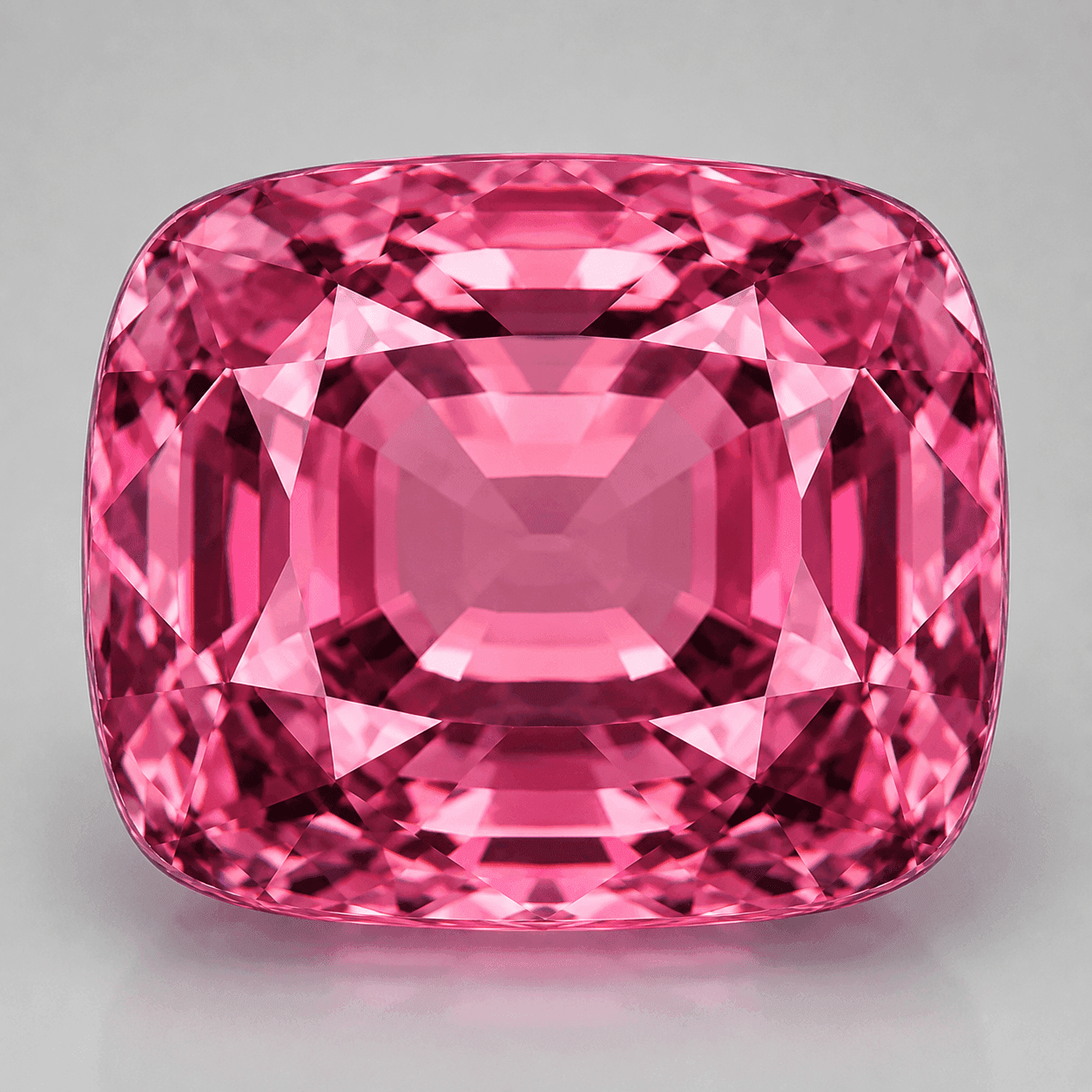
Eyeball clues help too, though they are supporting evidence rather than proof. Pink spinel tends toward a punchier, more crystalline pink — it can climb into hot, almost neon rose — while morganite usually sits in a gentler, more pastel peach-pink and is commonly cut in larger sizes because the rough is more available. If you want a structured walkthrough of confirming a spinel's identity at home and at the lab, read how to tell if spinel is real. Here is the quick field sequence a dealer runs:
- Heft the loose stone: at equal size, spinel feels distinctly heavier (SG 3.60 vs roughly 2.7-2.9 for morganite).
- Rotate it under a strong light: a subtle two-tone pink shift suggests morganite's pleochroism; a steady single pink suggests spinel.
- Loupe the back facets through the table: crisp single edges point to spinel, faint doubled edges point to morganite.
- Confirm on a refractometer: one fixed reading (no birefringence) = spinel; two close readings = morganite.
- If any doubt remains on a stone of value, send it to an independent laboratory for a full report.
Which is harder and more durable for daily wear?
Spinel wins on durability, though the margin is narrower than it first looks. Spinel is a solid Mohs 8 with no cleavage, while morganite runs Mohs 7.5-8 but has the imperfect cleavage typical of beryl, which makes it a little more vulnerable to a sharp knock.
Hardness (resistance to scratching) and toughness (resistance to chipping and breaking) are different properties, and the gap between these two stones is really about toughness. Spinel's lack of any cleavage plane means there is no built-in direction of weakness; it takes a genuinely hard, unlucky blow to chip a well-cut spinel. Morganite, like all beryl, has a cleavage direction, so a knock at the wrong angle can start a chip or fracture more readily. Both are perfectly wearable, but for a ring worn every day — the hardest-working position in the jewellery box — spinel is the more forgiving choice. We go deeper into scratch resistance, toughness and setting advice in the spinel hardness and durability guide.
For an earring, pendant or occasional-wear ring, morganite's slightly lower toughness matters far less, and its typically larger, cleaner crystals let it deliver a big, gentle pink face for modest money. The right answer genuinely depends on where the stone will live.
Is morganite treated? Is spinel treated?
This is the distinction most buyers never hear, and it is arguably the most important. Morganite is frequently heat-treated to drive off yellow-orange tones and leave a cleaner pink, whereas natural spinel is very rarely treated at all — untreated is the norm, and that fact underpins much of spinel's appeal to connoisseurs.
Most commercial morganite you encounter has been gently heated. The treatment is stable, widely accepted in the trade, and not a defect — but it is a treatment, and it means the pink you fell in love with was partly decided in a furnace rather than entirely in the ground. Spinel sits at the opposite end of the spectrum. Where roughly nine in ten blue sapphires are heated, fine spinel typically reaches you exactly as the earth made it, colour and all. That is why we treat "untreated" as spinel's quiet superpower; the full picture is laid out in is spinel treated or heated. The contrast matters because a stone's naturalness increasingly drives both desirability and long-term value.
Morganite's pink is often finished in a furnace; fine spinel's pink is finished by the earth — and collectors are learning to pay for the difference.
Spinel vs morganite: the side-by-side comparison
The table below gathers the load-bearing facts in one view. Read it as a decision aid: durability and naturalness favour spinel, while size-for-money and gentle pastel colour often favour morganite.
| Property | Pink Spinel | Morganite |
|---|---|---|
| Species | Magnesium aluminium oxide (MgAl2O4) | Beryl (Be3Al2Si6O18) |
| Crystal system | Cubic (isometric) | Hexagonal |
| Optic character | Singly refractive (no pleochroism) | Doubly refractive (weak pleochroism) |
| Refractive index | ~1.712-1.762 | ~1.58-1.59 |
| Specific gravity | ~3.60 | ~2.71-2.90 (lighter) |
| Mohs hardness | 8 | 7.5-8 |
| Cleavage | None | Imperfect (beryl cleavage) |
| Colour cause | Chromium (with some iron) | Manganese |
| Typical treatment | Very rarely treated — usually natural | Frequently heat-treated to purify pink |
| Colour character | Rose to vivid hot pink | Soft pastel pink to peach |
| Relative rarity | Rarer, especially in vivid saturations | More available, often in larger sizes |
Which pink gem holds its value better?
Fine untreated pink spinel generally commands stronger and more resilient prices than morganite, chiefly because it is rarer, harder, and natural. Morganite is beautiful and affordable, but its abundance and routine treatment cap its position in the value hierarchy.
Price always tracks the four Cs plus rarity and origin, so any figure is a range rather than a promise. In broad 2026 terms, morganite remains an accessible stone — you can buy a large, clean, pretty pink face for a very reasonable sum, which is a big part of its charm. Pink spinel spans a wider ladder: pale, included material is modest, while vivid, saturated, well-cut natural pinks from sources such as Mahenge in Tanzania or Mogok in Myanmar climb into serious collector territory. For context on where each colour sits, see the spinel price guide, and for the honest, non-hyped view of spinel as a store of value read is spinel a good investment. We never promise appreciation — but scarcity plus naturalness is a durable combination.
One dealer's note on liquidity: because spinel is a connoisseur's stone, its buyers are knowledgeable and its finest colours are genuinely one-of-one, which supports resale among people who understand what they are looking at. Morganite trades more like a fashion-driven coloured stone — lovely, plentiful, and priced accordingly.
How does this compare to other pink-stone matchups?
Spinel versus morganite is one node in a wider web of pink comparisons, and the same logic — species, treatment, hardness, rarity — resolves all of them. Knowing how spinel stacks up against its other rivals sharpens the morganite decision considerably.
Pink tourmaline (including rubellite) is another manganese-coloured, doubly refractive stone often set against spinel; we cover the gemology and the frequent treatment questions in spinel vs tourmaline. Pink sapphire is the corundum rival, usually heated where spinel is not. And within spinel itself, buyers often wrestle with where pink ends and red begins — a distinction of chromium saturation explored in pink vs red spinel. Reading these alongside one another, a pattern emerges: spinel is repeatedly the harder, denser, more often untreated option, which is exactly why it keeps winning the attention of collectors who started out shopping for something else.
If your heart is set on a soft, large, budget-friendly pastel and the stone will not take daily abuse, morganite is a perfectly honest choice — buy it knowing it is likely heated and enjoy it. If you want rarity, natural colour, superior toughness and a stone with real collector depth, pink spinel is the answer. When you are ready to see individual natural stones, browse our pink spinel collection or the full loose-spinel shop, where every stone is natural and untreated unless explicitly stated.
Making the choice: who should buy which?
Choose the stone that matches how you will wear it and what you value most. Spinel suits the collector and the daily-wear ring; morganite suits the large, gentle, affordable pastel piece worn more occasionally.
Think of it as three questions. First, permanence: an everyday engagement or right-hand ring leans toward spinel's toughness and no-cleavage security. Second, naturalness: if it matters to you that the colour is entirely the earth's work, spinel is almost always untreated while morganite usually is not. Third, scale and budget: if you want the biggest, softest pink face for the least money, morganite is hard to beat. There is no wrong answer — only a right answer for your priorities. And if you find yourself drawn again and again to the rarer, natural option, you are simply discovering what the trade already knows about spinel.
- Is spinel or morganite more valuable?
- Fine natural pink spinel is generally more valuable than morganite, because spinel is rarer, harder (Mohs 8 with no cleavage) and almost always untreated, whereas morganite is more abundant and usually heat-treated. Morganite remains an accessible, affordable stone, especially in larger sizes; vivid untreated pink spinel can reach serious collector prices. Value always depends on colour, clarity, cut, carat and origin, so treat any figure as a range.
- Is morganite always heat-treated?
- Not always, but it very frequently is. Most commercial morganite is gently heated to remove yellow-orange tints and leave a cleaner pink; the treatment is stable and accepted in the trade. Untreated morganite exists but is less common. This contrasts sharply with natural spinel, which is very rarely treated at all — one of the main reasons spinel appeals to collectors who prize entirely natural colour.
- How can I tell pink spinel from morganite at home?
- The clearest home clue is weight: at the same size, spinel feels noticeably heavier because its specific gravity (about 3.60) far exceeds morganite's (about 2.7-2.9). Rotating the stone under light can also reveal morganite's faint two-tone pleochroism, absent in singly refractive spinel. For certainty, a refractometer or an independent lab report is definitive, since spinel gives one fixed reading and morganite gives two close ones.
- Is morganite hard enough for an engagement ring?
- Morganite is wearable at Mohs 7.5-8, but it has beryl's imperfect cleavage, which makes it a little more prone to chipping from a hard knock than spinel, which has no cleavage. For an everyday engagement ring, spinel is the tougher, more forgiving choice. Morganite works well in protective settings, in earrings and pendants, or for someone comfortable with slightly more careful wear.
- Are spinel and morganite the same colour of pink?
- They overlap but differ in character. Pink spinel, coloured by chromium, tends toward a brighter, more crystalline pink that can reach vivid hot-pink saturations. Morganite, coloured by manganese, usually sits in a softer pastel pink-to-peach and is often cut large. Side by side, spinel typically reads as the punchier, more saturated pink and morganite as the gentler, more romantic peach-pink.
Sources
Facts on this page draw on independent gemmological authorities:
- Gemological Institute of America (GIA) · Institute
- Gübelin Gem Lab · Laboratory
- GRS (GemResearch Swisslab) · Laboratory
- Lotus Gemology · Laboratory