Spinel and tourmaline compared across colours, hardness, treatment and 2026 value: spinel is harder, singly refractive and untreated, while tourmaline offers unrivalled colour range.
Spinel and tourmaline overlap in the tray but separate sharply under a loupe: spinel is a single mineral (magnesium aluminium oxide), cubic, singly refractive, Mohs 8, and almost always untreated, while tourmaline is a complex boron-silicate group, trigonal, doubly refractive and pleochroic, Mohs 7 to 7.5, and frequently treated. That difference in structure drives everything else.
For a collector deciding between the two, the honest summary is this: they are not really rivals so much as different temperaments. Tourmaline offers the widest colour range in the gem world at accessible prices, but it earns that range through complex chemistry that also invites inclusions, colour zoning and routine treatment. Spinel offers fewer colours, but each one arrives with a cleaner optical signature, greater hardness and a near-guarantee of being natural and unheated. This guide compares them across colours, durability, treatment and value, so you know exactly what you are holding. For the specific red-versus-red question, we keep a dedicated spinel versus rubellite tourmaline comparison; here we take the wider view.
What is the core difference between spinel and tourmaline?
Spinel is one mineral with one simple formula; tourmaline is a family of related boron silicates whose members swap elements in and out of the same crystal framework. That single fact explains why spinel behaves so consistently and why tourmaline is so gloriously variable.
Spinel is magnesium aluminium oxide, MgAl2O4, crystallising in the cubic (isometric) system. Because light travels through a cubic crystal at one speed in every direction, spinel is singly refractive: it shows no pleochroism and no facet-doubling. Its colours come from trace elements borrowed by the lattice, chromium for red and pink, cobalt for that electric blue, iron for grey, violet, lavender and denim tones. Tourmaline, by contrast, is a trigonal boron-silicate group, elbaite, schorl, dravite and their cousins, in which iron, manganese, lithium, chromium and copper produce a spectrum no other gem can match. That complexity is tourmaline's glory and its handicap: it is strongly doubly refractive and pleochroic, so a green tourmaline can look bottle-dark down one axis and bright the other, and cutters must orient the rough carefully. If you want the full mineral picture, our complete guide to natural spinel covers spinel's chemistry and formation in depth.
There is a durability gap too. Spinel sits at Mohs 8 with no cleavage, which makes it forgiving in daily-worn rings. Tourmaline runs 7 to 7.5 and, while it has no true cleavage either, it is more prone to fracture and to internal strain. We unpack the practical side of this in our spinel hardness and durability guide.
How do spinel and tourmaline compare across colours?
Tourmaline wins on sheer breadth, offering colours spinel simply does not have, while spinel wins on purity and saturation within the colours it does offer. Think of tourmaline as the encyclopaedia and spinel as the anthology of best passages.
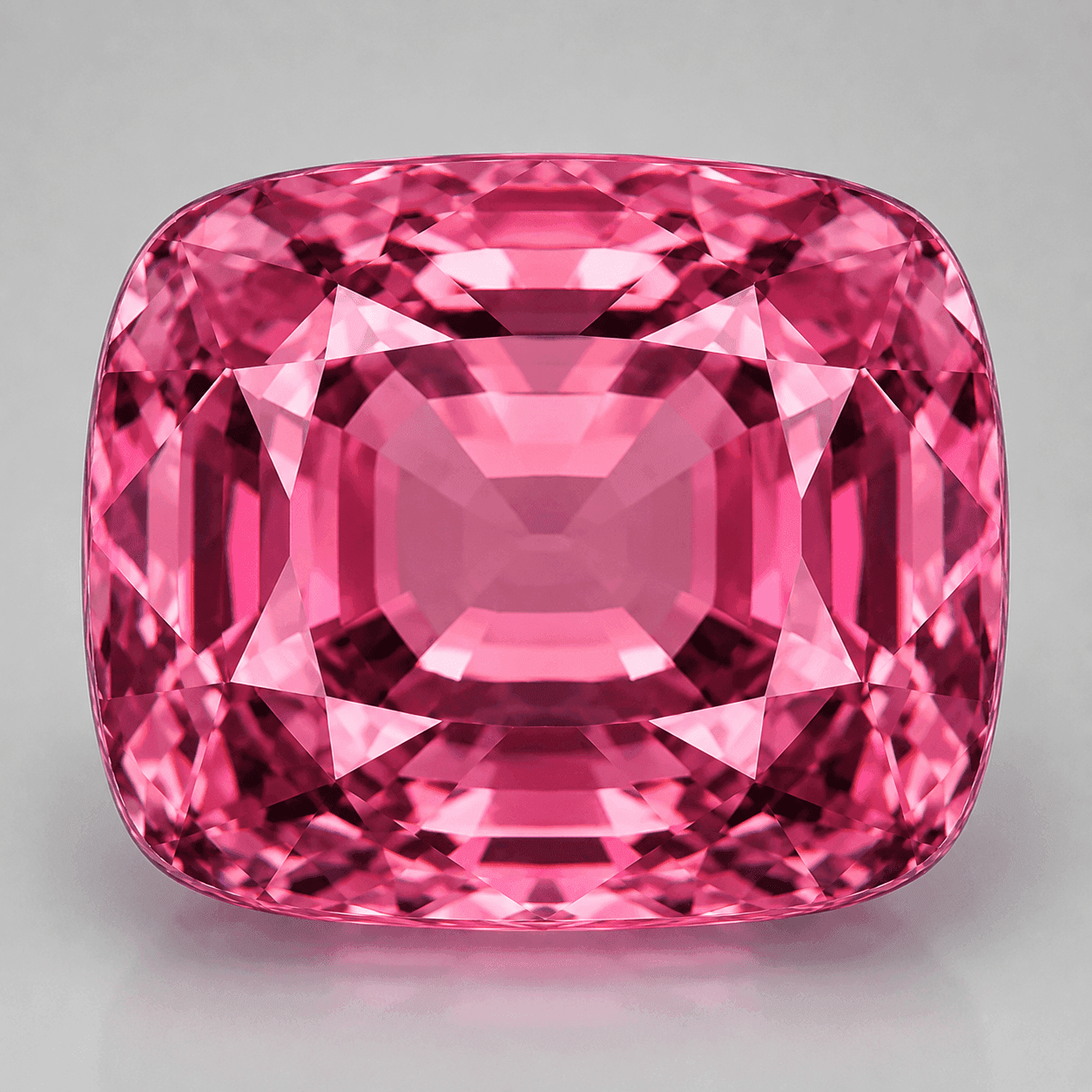
In red and pink, the two collide most directly. Rubellite is tourmaline's celebrated red-to-pink, but it often carries a slightly purplish or brownish undertone and, being manganese-coloured, frequently shows visible inclusions and needs clarity enhancement to reach its best face-up look. Fine red spinel, coloured by chromium, tends to a purer, more open red that many collectors find livelier, and it is almost never treated. Explore the range in our red spinel guide and pink spinel guide, or browse loose stones in the pink collection.
In blue, the comparison is fascinating. Tourmaline's blues, including the copper-bearing Paraiba type, can be extraordinary, and Paraiba's neon glow is something spinel cannot replicate. But everyday blue tourmaline (indicolite) is often dark and heavily included. Spinel answers with cobalt-blue, a rare, vivid, almost sapphire-defying electric blue that stands among the most sought colours in the gem world; our cobalt-blue spinel guide covers what separates the true cobalt stones from ordinary iron blues. In green, tourmaline dominates outright; spinel green exists but is uncommon and usually greyish. For bicolour and watermelon effects, tourmaline is unmatched, its colour zoning turned into a feature, whereas spinel bicolours are genuine rarities. The takeaway: if you want green or watermelon, buy tourmaline; if you want a pure red, a hot pink or an electric blue with a clean optical character, spinel rewards you. It is also worth understanding why the two behave so differently in the same colour. Rubellite owes its red to manganese, an element that enters the tourmaline lattice unevenly and leaves behind the microscopic fractures and colour zoning that force so much clarity enhancement. Chromium in spinel behaves more graciously, distributing evenly and often fluorescing under ultraviolet light, which is part of why fine red and pink spinel seem to glow from within. That inner light, rather than any single colour, is what long-time dealers reach for first when they pick spinel over tourmaline.
Tourmaline gives you every colour; spinel gives you the cleanest version of a few.
Which is more durable for everyday jewellery?
Spinel is the tougher everyday stone: harder at Mohs 8, with no cleavage and generally cleaner internal structure. Tourmaline at 7 to 7.5 is still wearable but demands a little more care, especially in rings.
Hardness measures scratch resistance, and the jump from 7.5 to 8 matters more than it sounds because the Mohs scale is not linear. More important for tourmaline is its internal character: elbaite tourmalines often contain fluid inclusions, tubes and growth features, and heavily included stones carry strain that makes them vulnerable to knocks and to sudden temperature change. Tourmaline can also be sensitive to the heat of a jeweller's torch during repairs. Spinel, lacking cleavage and typically forming with fewer stress fractures, tolerates the bench and the daily grind more calmly. Neither stone should be cleaned in an ultrasonic if it is included; for both, warm soapy water and a soft brush is the safe routine, as we set out in our guide to caring for your spinel jewellery. If you plan to set the stone in an engagement ring or a piece worn hard, spinel's extra hardness and toughness give it a real edge.
Is one more likely to be treated than the other?
Yes, and decisively: tourmaline is frequently treated, while spinel is very rarely treated and is sold untreated as the norm. This is one of the strongest practical arguments for spinel.
Much tourmaline on the market is heated to lighten or improve colour, and rubellite and some green and blue tourmalines are routinely clarity-enhanced with fillers to mask their many fractures. Copper-bearing Paraiba tourmaline is very commonly heated to unlock its signature glow. None of this is dishonest when disclosed, but it means the buyer must ask and, ideally, insist on a report. Spinel sits at the opposite end. It is one of the few important coloured gems where treatment is genuinely uncommon, so the stone you buy is almost always exactly as the earth made it, a striking contrast with the roughly nine-in-ten figure for heated blue sapphire. We cover the specifics in is spinel treated or heated? For any significant tourmaline purchase, treatment disclosure is not optional; the GIA's spinel buyer's guide and the broader tourmaline reference on Wikipedia are useful starting points for understanding what to expect from each.
How can you tell spinel from tourmaline yourself?
The single most reliable home-and-loupe test is double refraction: tilt the stone and look through a facet at the back edges. Tourmaline, being doubly refractive, will often show doubled facet junctions and strong pleochroism as you rotate it; spinel, singly refractive, never does.
Work through these observations in order before reaching for any instrument:
- Rotate the stone in daylight and watch for a colour shift between two directions. If the hue changes noticeably as you turn it, you are seeing pleochroism, which points to tourmaline; spinel holds one colour from every angle.
- Look through a facet with a 10x loupe for doubling of the back facet edges. Doubled lines indicate a doubly refractive stone such as tourmaline; crisp single lines suggest spinel.
- Examine the inclusions. Tourmaline commonly shows thread-like fluid tubes and irregular fractures; natural spinel more often shows octahedral crystals and orderly formations.
- Judge the colour character. A very pure, open red or a vivid electric blue with clean optics leans spinel; a slightly brownish rubellite or a dark bottle-green leans tourmaline.
- For anything of value, ask for a gemmological report. Refractive index alone settles it: spinel reads a single figure around 1.712 to 1.762, while tourmaline reads a birefringent pair near 1.62 to 1.64.
For a fuller walkthrough of separating spinel from its look-alikes, see how to tell if spinel is real. The same double-refraction logic that isolates tourmaline also distinguishes spinel from amethyst, zircon and topaz.
Spinel vs tourmaline: side-by-side comparison
The table below distils the gemmological and market differences. Use it as a quick reference, but remember that individual stones vary and a report is the final word.
| Property | Spinel | Tourmaline |
|---|---|---|
| Composition | Magnesium aluminium oxide (MgAl2O4) | Complex boron-silicate group |
| Crystal system | Cubic (isometric) | Trigonal |
| Optical character | Singly refractive; no pleochroism | Doubly refractive; strongly pleochroic |
| Mohs hardness | 8 | 7 to 7.5 |
| Cleavage | None | None (but more strain-prone) |
| Refractive index | ~1.712 to 1.762 (single reading) | ~1.62 to 1.64 (birefringent) |
| Typical treatment | Very rarely treated | Frequently heated and/or clarity-enhanced |
| Colour range | Red, pink, cobalt-blue, grey, violet, lavender | The widest of any gem, including bicolour |
| Facet doubling | Never | Often visible under loupe |
| Fine red price (2026) | ~$2,000 to $10,000+/ct | Rubellite typically lower per carat |
Which offers better value in 2026?
It depends on what you value: tourmaline offers more colour and size for the money, while fine spinel commands higher prices and, many argue, holds its desirability better because rarity and untreated status are built into the stone. Neither is an investment guarantee.
Tourmaline's abundance keeps most colours affordable, and large clean stones are attainable at prices that would be impossible in spinel, ruby or sapphire, with the notable exception of top Paraiba, which sits among the priciest coloured gems on earth. Spinel occupies a different niche. Fine red spinel in 2026 runs roughly $2,000 to $5,000 per carat, top red $5,000 to $10,000, and exceptional Myanmar reds beyond $20,000, while top cobalt-blue can exceed $20,000 per carat; grey spinel remains accessible at around $300 to $500. A fine red spinel often costs about a tenth of a comparable ruby, which is precisely why connoisseurs regard it as one of the last genuine values in fine coloured stones. We keep this current in the spinel price guide. If you are weighing spinel as a store of value rather than pure adornment, read our candid take in is spinel a good investment? and browse what is currently available in the shop. As ever, buy the stone you love, verify what you are told, and treat any resale upside as a bonus rather than a promise. One last dealer's observation ties the value question back to the whole comparison. Tourmaline's abundance and treatability are exactly what keep it affordable, and there is nothing wrong with that; it is one of the most rewarding gems a beginning collector can explore. But the traits that make spinel scarcer, its narrower colour range, its resistance to easy enhancement, its genuinely untreated nature, are also the traits that give it standing among connoisseurs. You are, in effect, paying for what the earth did rather than what a laboratory added afterwards. That is a fair way to frame the choice between them: tourmaline for range and reach, spinel for purity and permanence.
- Is spinel harder than tourmaline?
- Yes. Spinel is Mohs 8 while tourmaline is 7 to 7.5. Because the Mohs scale is not linear, that gap is meaningful, and combined with spinel's lack of cleavage it makes spinel the more robust choice for rings and daily wear.
- Can you tell spinel and tourmaline apart without a lab?
- Often, yes. Tourmaline is doubly refractive and pleochroic, so it shows doubled facet edges under a loupe and a colour shift as you rotate it. Spinel is singly refractive and does neither. A refractive-index reading confirms it: spinel gives one figure, tourmaline gives a birefringent pair.
- Is tourmaline usually treated?
- Frequently. Much tourmaline is heated to improve colour, and rubellite and some blues and greens are clarity-enhanced with fillers to mask fractures. Copper-bearing Paraiba is very commonly heated. Always ask for treatment disclosure. Spinel, by contrast, is very rarely treated.
- Which has more colours, spinel or tourmaline?
- Tourmaline, by a wide margin. It offers the broadest colour range of any gem, including green, watermelon bicolours and neon Paraiba, which spinel cannot match. Spinel's strength is purity within red, pink, cobalt-blue, grey, violet and lavender rather than sheer variety.
- Is spinel or tourmaline the better value?
- Tourmaline gives more colour and size per pound, so it is the value pick for everyday variety. Fine spinel costs more but is prized for rarity and its untreated nature, often about a tenth the price of comparable ruby. Choose by priority, not by a promised return.
Sources
Facts on this page draw on independent gemmological authorities:
- Gemological Institute of America (GIA) · Institute
- Gübelin Gem Lab · Laboratory
- GRS (GemResearch Swisslab) · Laboratory
- Lotus Gemology · Laboratory