Pink and red spinel are the same chromium-coloured gem on one continuous spectrum. We explain where pink ends and red begins, why the name changes the price, and how to judge a stone yourself.
The line between pink and red spinel is a boundary of saturation and tone rather than a change in chemistry: both owe their colour to chromium, and both sit on one continuous spectrum, so red begins only where the hue reaches a deep, saturated, medium-dark crimson that the trade agrees to call red. Everything lighter, softer or more delicate stays pink. There is no hard cut-off and no laboratory line on a chart, only a threshold of colour intensity that dealers, cutters and collectors have learned to read by eye.
That fuzzy boundary matters more than almost any other single factor in what a stone is worth, because the word red carries a premium that the word pink does not. Two stones can come from the same pocket of the same mine, be cut from the same piece of rough, and differ by a single step of saturation, yet one sells as a fine red and the other as a bright pink at a materially different price. Understanding where that line falls, and why the trade draws it where it does, is one of the most useful things a spinel buyer can learn. For the wider context, our complete guide to natural spinel sets out how colour drives value across every hue.
Where does pink end and red begin?
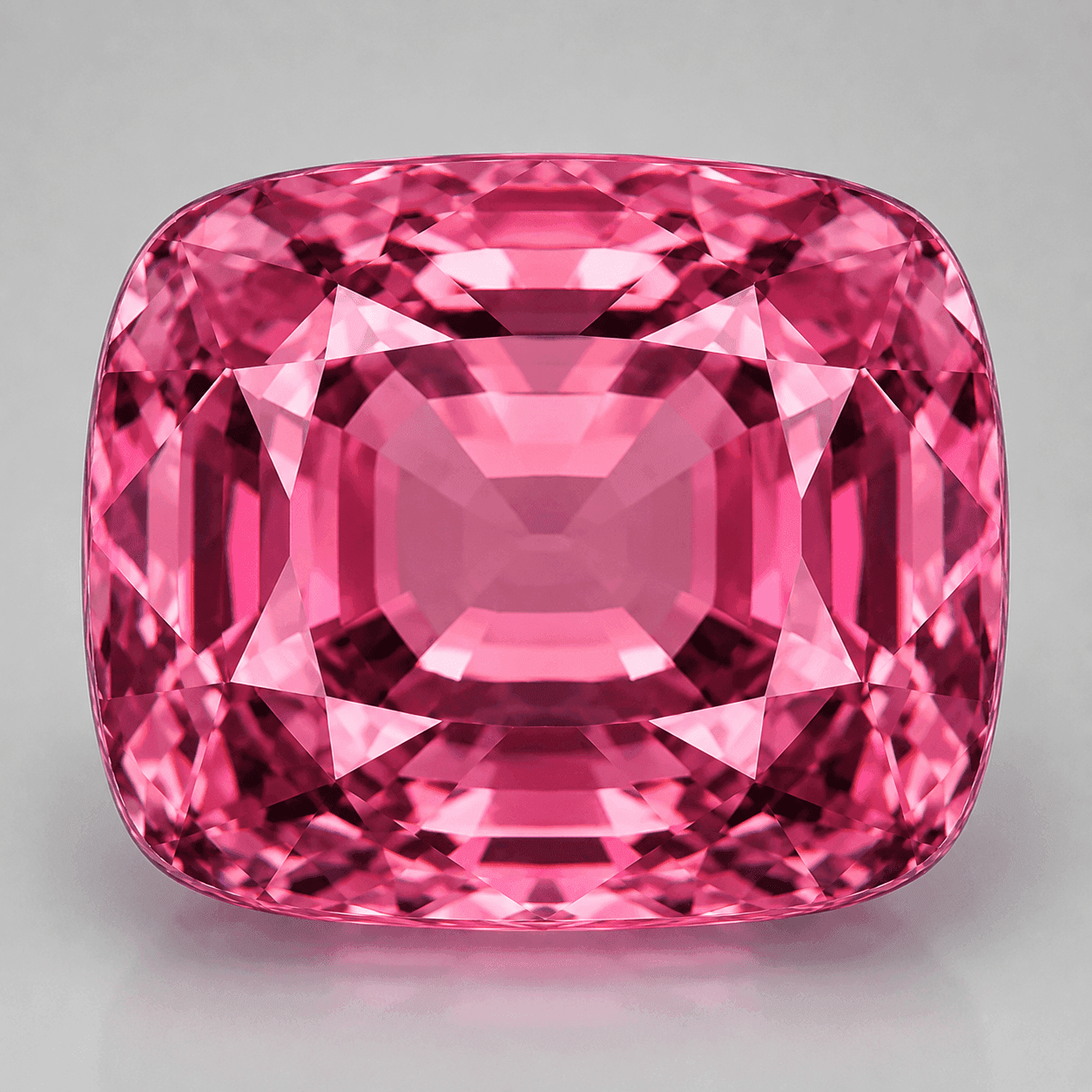
Red begins where chromium saturation pushes the hue into a deep, vivid, slightly dark crimson with no obvious lightness; pink is the very same hue held at lower saturation and higher tone. The transition is gradual, and the exact crossover point is a matter of trade convention rather than fixed measurement. Colour is usually described in three dimensions: hue (the colour itself), saturation (its intensity or purity) and tone (how light or dark it is). Pink and red spinel share essentially the same hue, a red often leaning very slightly toward orange or purple. What separates them is saturation and tone. A pale, high-tone, low-saturation chromium stone reads as pink; drive the saturation up and the tone down toward medium-dark, and the same hue reads as red. Because this is a smooth gradient, the middle ground, a vivid hot pinkish red, is genuinely ambiguous, and two honest experts can disagree on which side of the line a single stone belongs. Our pink spinel guide and red spinel guide each walk this spectrum from their own end.
Why are pink and red spinel the same gem chemically?
Both colours are caused by trace chromium substituting for aluminium in the same crystal structure, magnesium aluminium oxide, MgAl2O4. The difference in appearance is a difference in how much chromium is present and how light interacts with it, not a difference in species. Spinel is a single mineral: cubic, singly refractive, Mohs 8, with no cleavage. A trace of chromium is what produces every warm chromium tone from the softest baby pink to the deepest pigeon-blood red, the very same element that colours ruby. When chromium content is low the stone is pink; as it rises, colour deepens through hot pink into red. This is why pink and red spinel behave identically under the loupe and in the lab: the same refractive index (around 1.712 to 1.762), the same specific gravity (about 3.60), the same absence of pleochroism because a cubic gem is singly refractive. It is also why spinel is so often confused with ruby, a story we tell in spinel versus ruby. Crucially, both pink and red spinel are almost always completely untreated, a rare honesty in a gem world where roughly ninety per cent of blue sapphire is heated.
How does the trade draw the fuzzy line?
The trade draws the line by eye and by consensus, not by instrument: a stone is called red once its colour is saturated and deep enough that most experienced dealers would agree the word fits. Below that threshold it is pink, or a named intermediate such as hot pink or pinkish red. In practice several rough conventions guide the call, and they are worth knowing before you accept anyone's label at face value.
- Purplish-pink and orangey-pink stones are usually kept in the pink camp unless they are very deeply saturated.
- Stones that read clearly light or bright in tone are called pink even when the underlying hue is a true red.
- The word red is reserved for colour that is both saturated and at least medium in tone.
- Named intermediates such as hot pink, pinkish red and raspberry exist precisely because the middle ground resists a single tidy label.
Grading laboratories rarely settle it definitively. Most labs will state a colour on a report, such as 'red', 'pink' or 'purplish red', but these are descriptive opinions rather than fixed grades, and different labs can word the same stone differently. That is why colour communication matters so much; our overview of spinel colour grading explains how hue, tone and saturation are actually assessed. The honest summary is that the line is a soft consensus, and a reputable dealer describes a stone by what it genuinely looks like in neutral daylight rather than reaching for the more valuable word.
| Attribute | Pink spinel | Red spinel |
|---|---|---|
| Colourant | Chromium, lower concentration | Chromium, higher concentration |
| Tone | Light to medium | Medium to medium-dark |
| Saturation | Low to moderate | High to vivid |
| Typical impression | Soft, delicate, romantic | Deep, warm, crimson |
| Treatment | Almost always untreated | Almost always untreated |
| 2026 price guide | roughly $300 to $2,000/ct, top hot pink far higher | fine ~$2,000 to $5,000/ct, top $5,000 to $10,000, exceptional Myanmar $20,000+/ct |
| Naming | Named by hue: baby, hot, Jedi | Commands a fine-red premium |
Does the name 'red' really change the price?
Yes, the word red carries a real premium, because fine red spinel is scarcer and more sought-after than pink at equivalent quality. Crossing the line from pink into red can lift a stone's value substantially, which is exactly why accurate, honest description matters. A fine red spinel in 2026 typically trades in the region of $2,000 to $5,000 per carat, with top reds reaching $5,000 to $10,000 and exceptional Myanmar (Mogok) reds passing $20,000 per carat in larger, cleaner sizes. Pink spinel, by contrast, spans a wide range: soft commercial pinks can sit at a few hundred dollars per carat, while the most electric hot pinks climb toward, and occasionally into, red territory. The premium is real but it is not a licence to over-name; a bright pink called red by an optimistic seller is simply mispriced. For a fuller breakdown see our spinel price guide and the candid take in is spinel a good investment. It is worth remembering that even top red spinel often costs around a tenth of a comparable ruby, one of the reasons collectors regard it as extraordinary value. When you are ready to compare stones side by side, our red spinel collection and pink spinel collection show the spectrum in hand.
A spectacular pink can be worth more than a mediocre red. Judge the stone, not the word.
Can hot pink spinel like Mahenge and Jedi rival red?
Absolutely. The most vivid hot pinks can command prices that meet or exceed ordinary reds, because saturation and glow matter as much as where a stone falls on the pink-red line. A truly electric neon pink is rarer and more thrilling than a merely decent red. Two names dominate this conversation. The Mahenge spinels of Tanzania produce a hot, glowing pink-to-red with an almost fluorescent intensity that made the deposit famous after its 2007 find; the finest stones seem lit from within. The term Jedi spinel, coined for stones with no dark side, a pure neon pink-red untainted by grey or brown, describes exactly the kind of hot pink that can out-price a duller red. In both cases the value driver is not the label pink or red but the sheer purity and glow of the colour. This is the key lesson of the pink-red debate: a spectacular pink can be worth more than a mediocre red, so judge the stone, not the word. Chromium also drives a gentle red fluorescence in many of these stones, adding to their visible glow; we cover that effect in spinel fluorescence.
Does origin change the pink-or-red question?
Origin does not move the line itself, but it strongly influences where a deposit's stones tend to sit on it and how the market prices them. Certain sources are simply more likely to yield the deep reds or the electric pinks that collectors chase. The classic red is Burmese: the Mogok valley in Myanmar has produced the deepest, most velvety chromium reds for centuries, and Mogok material can carry a premium purely on provenance. Tanzania is the modern star for hot pink, above all the Mahenge find, while Tajikistan's Kuh-i-Lal, Vietnam's Luc Yen, Sri Lanka's Ratnapura and Madagascar each contribute pinks and reds across the spectrum. A Mogok stone that just crosses into red and a Mahenge stone that stays a blazing pink can end up at similar prices for very different reasons, one on depth and origin, the other on sheer saturation. This is why a laboratory origin report is often as valuable as the colour call itself; our note on whether origin matters for spinel unpacks how much weight to give it. Whatever the source, the same discipline applies: read the colour in the stone, then let provenance refine, not replace, your judgement.
How do you judge where a stone falls?
Judge colour in neutral daylight, look at saturation and tone before you reach for a name, and compare the stone against known references rather than trusting a seller's label. A few disciplined habits will tell you far more than any single report. Follow these steps in order:
- View the stone face-up in neutral daylight or a 5500K to 6500K lamp, never under warm household bulbs that flatter red and mask grey.
- Assess hue first: is the core colour a clean red, or does it lean pink, purple or orange? Note any secondary tint.
- Read the saturation: the more vivid and pure the colour, the closer to fine red or hot pink, while muted, greyish or brownish tones pull value down.
- Check the tone: light and bright reads as pink, medium to medium-dark with strong saturation reads as red.
- Tilt the stone to watch how colour behaves across the crown, and confirm it holds up under different light rather than washing out.
- Compare against a trusted reference stone or image, and ask the seller for the exact hue description in daylight; an honest dealer will give it.
For a broader buying framework, our guide on how to buy natural spinel puts colour judgement alongside clarity, cut and origin. Independent authorities describe spinel's colour range in similar terms; the GIA's overview of spinel quality factors confirms that saturated reds and vivid pinks sit at the top of the value scale, with grey and brown modifiers pulling colour down. And if warmth is where your eye drifts instead, the rare salmon-to-sunset stones we call the An Phu Sunset show how chromium and iron together can produce a different kind of glow at the far edge of the pink-red spectrum.
- Is pink spinel just light red spinel?
- Essentially, yes. Both are coloured by chromium in the same MgAl2O4 crystal, and pink is simply the same hue at lower saturation and higher tone. The trade calls it red only once the colour deepens into a saturated, medium-dark crimson.
- Why does red spinel cost more than pink?
- Fine red is scarcer and more in demand at equivalent quality, so the word red carries a genuine premium. In 2026 fine reds trade around $2,000 to $5,000 per carat and top reds $5,000 to $10,000, while pinks range from a few hundred dollars up into red territory for the hottest examples.
- Can a pink spinel be worth more than a red one?
- Yes. An electric, glowing hot pink such as a fine Mahenge or Jedi stone can out-price an ordinary, duller red, because saturation and glow drive value as much as the pink-or-red label.
- Are pink and red spinel treated or heated?
- Almost never. Both are typically completely untreated, unlike most blue sapphire, which is routinely heated. This natural, untreated character is one of spinel's great attractions and a genuine point of difference from other red gems.
- How can I tell if a stone is pink or red?
- View it face-up in neutral daylight and judge saturation and tone before the name. Vivid, medium-dark colour is red; lighter, softer colour is pink. Compare against a trusted reference and ask the seller for an honest daylight hue description.
Sources
Facts on this page draw on independent gemmological authorities:
- Gemological Institute of America (GIA) · Institute
- Gübelin Gem Lab · Laboratory
- GRS (GemResearch Swisslab) · Laboratory
- Lotus Gemology · Laboratory