Spinel and topaz share Mohs 8 and look alike in blue and pink, yet differ in cleavage, refraction, treatment and value. A gemologist compares the two and shows which to buy.
Spinel and topaz can look alike in blue and pink, but they are different minerals: spinel is magnesium aluminium oxide, singly refractive, Mohs 8 with no cleavage and almost never treated, while topaz is aluminium silicate fluoride hydroxide, doubly refractive, Mohs 8 but with perfect cleavage and usually irradiated when blue. That single sentence hides the whole story a collector needs. Both are handsome, hard, affordable relative to sapphire and ruby, and both are sold in tempting blues, pinks and colourless whites. Yet the gemmology that separates them also decides how a stone behaves on the bench, how it survives a lifetime of wear, and whether the colour in front of you is natural or man-made. Below, we lay out exactly what dealers check, why the difference matters, and how to choose between the two with confidence.
What is the real difference between spinel and topaz?
They are chemically unrelated minerals that happen to overlap in colour and hardness. Spinel is a cubic magnesium aluminium oxide; topaz is an orthorhombic aluminium silicate fluoride hydroxide, and that crystal system difference drives almost everything else. Because spinel is isometric (cubic), it is singly refractive — light passes through it as a single ray, so there is no double vision at the facet edges and no pleochroism. Topaz is orthorhombic, therefore doubly refractive, showing weak facet-doubling under magnification and subtle pleochroism (two slightly different colours from different viewing angles). For a fuller grounding in the species, our complete guide to natural spinel covers its structure and colour range, and the Wikipedia entry on topaz is a reliable primer on the silicate side.
The practical headline is durability. Both minerals sit at Mohs 8, so they scratch at the same rate. But topaz carries perfect basal cleavage — a plane along which the crystal will split cleanly if struck at the wrong angle — while spinel has no cleavage at all. A single knock on a table edge can chip or cleave a topaz where a spinel would shrug it off. That is the quiet reason many bench jewellers prefer setting spinel, and it is the durability lesson we expand on in our guide to spinel hardness and durability.
Is spinel harder or more durable than topaz?
They tie on scratch hardness but spinel wins decisively on toughness. Mohs hardness measures only resistance to scratching, and at Mohs 8 both stones outrank quartz, tanzanite and every softer coloured stone. Toughness — resistance to chipping and breaking — is a separate axis, and here topaz's perfect cleavage is a genuine liability while spinel's absence of cleavage makes it one of the most forgiving coloured stones you can wear daily.
This is not a theoretical distinction. Topaz cutters orient the table away from the cleavage plane precisely because a facet parallel to it can flake during polishing, and a set topaz can develop a cleavage crack from an impact that a spinel of identical hardness absorbs harmlessly. For a ring worn every day, that difference matters more than any one-point gap on the Mohs scale. Neither stone has the toughness of jade or the brittleness risk of untreated emerald, but between these two, spinel is the safer choice for knuckle-height settings. If you are weighing a stone for an engagement ring or a daily band, read our note on why spinel makes an exceptional everyday gem before you commit.
How do the gemmological properties compare side by side?
The numbers separate them cleanly under standard tools. A refractometer alone will usually settle the question: spinel reads a single value near 1.712 to 1.762 with no birefringence, while topaz reads two values around 1.61 to 1.64 with a measurable birefringence. Add the optic character — singly refractive spinel stays dark under crossed polarisers, doubly refractive topaz blinks light and dark as you rotate it — and the identification is quick.
| Property | Spinel | Topaz |
|---|---|---|
| Chemistry | Magnesium aluminium oxide (MgAl2O4) | Aluminium silicate fluoride hydroxide |
| Crystal system | Cubic / isometric | Orthorhombic |
| Optic character | Singly refractive (no doubling, no pleochroism) | Doubly refractive (weak doubling and pleochroism) |
| Refractive index | ~1.712-1.762 | ~1.61-1.64 |
| Specific gravity | ~3.60 | ~3.5-3.6 |
| Mohs hardness | 8 | 8 |
| Cleavage | None | Perfect basal (key weakness) |
| Typical treatment | Almost always untreated | Blue usually irradiated; some heated |
| Dispersion | ~0.020 | ~0.014 |
Specific gravity overlaps closely (both hover around 3.5 to 3.6), so a hydrostatic weigh alone will not always separate them — which is why the refractometer and polariscope do the real work. Dispersion, the fire that breaks white light into spectral colours, is a touch livelier in spinel at roughly 0.020 versus topaz near 0.014, giving fine spinel a little more life in the same lighting.
Is blue topaz natural, and is blue spinel treated?
Most blue topaz on the market is irradiated and heated; most blue spinel is entirely untreated. This is arguably the most important point for a value-minded buyer. The vivid, inexpensive Swiss blue and London blue topaz you see everywhere begins as near-colourless material that is bombarded with radiation and then heated to produce the blue — a stable, permanent result, but a laboratory colour rather than a natural one.
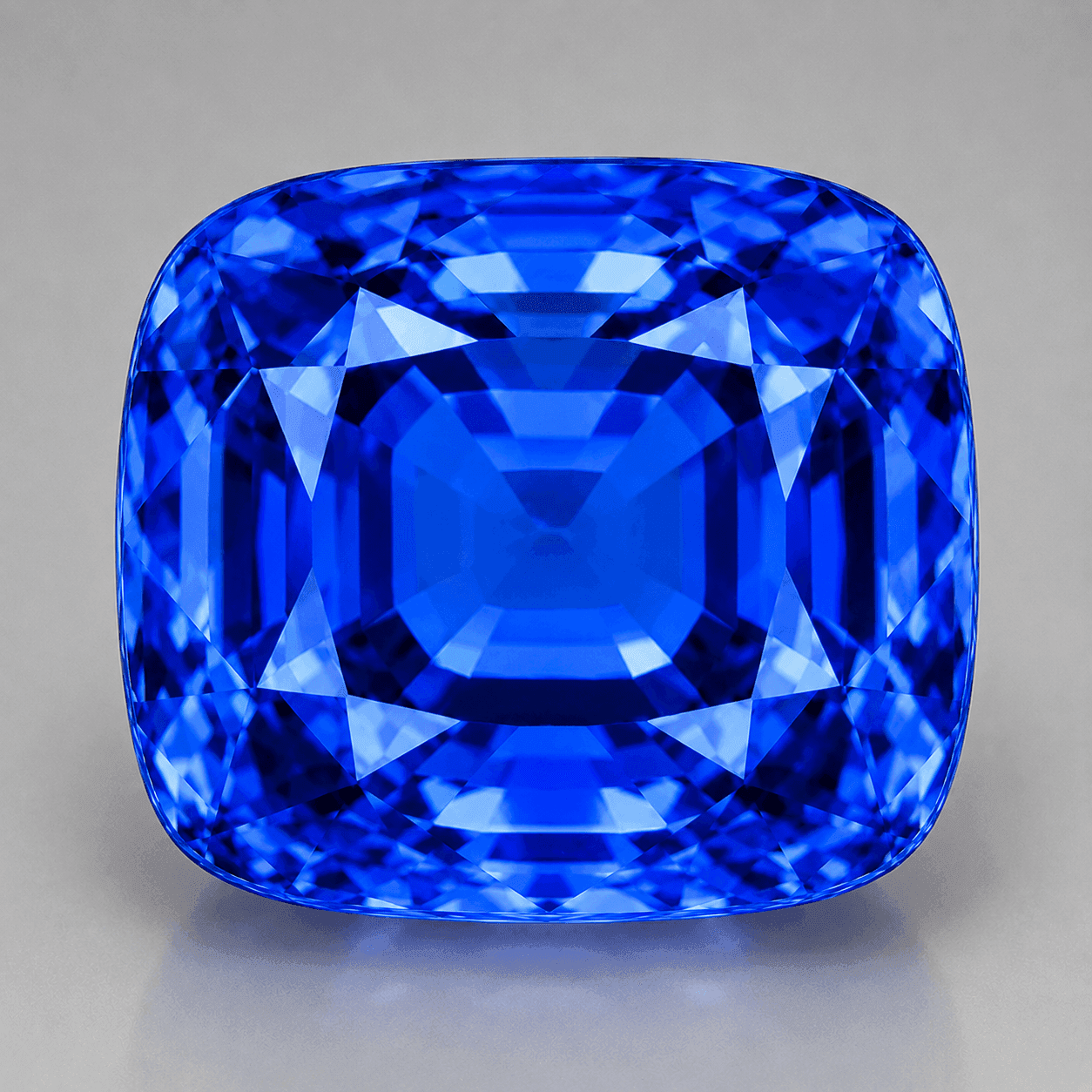
Spinel sits at the opposite end of the treatment spectrum. It is one of the very few gemstones that reaches the market essentially as nature made it — the trade norm is untreated, in sharp contrast to blue sapphire, of which roughly 90 percent is heated. Blue spinel earns its colour from iron (the grey-blues, denim and violet tones) or, in the rarest and most coveted stones, from cobalt (an electric, vivid blue that can exceed $20,000 per carat at the very top). We unpack the full range in our blue spinel guide, and the treatment question generally in is spinel treated or heated. The honest dealer's summary: with topaz you are usually buying a natural mineral with a laboratory-induced colour; with spinel you are buying colour that formed underground.
With topaz you often buy a natural stone wearing a laboratory colour; with spinel the colour itself is natural.
Which is more valuable, spinel or topaz?
Fine spinel is worth considerably more than fine topaz, carat for carat. Topaz is abundant and, in its treated blue forms, genuinely inexpensive — often a modest sum per carat even in large sizes, which is part of its charm as an accessible statement stone. Spinel is far scarcer in gem quality and priced accordingly, especially in red, hot pink and cobalt blue.
To put ranges on it: fine red spinel runs roughly $2,000 to $5,000 per carat, top red $5,000 to $10,000, and exceptional Myanmar (Mogok) red beyond $20,000 per carat; top cobalt blue can likewise exceed $20,000. Even so, a fine red spinel often costs about a tenth of a comparable ruby — the value story that first drew collectors to the stone. Grey spinel, the affordable entry point, sits nearer $300 to $500 per carat. Treated blue topaz simply does not compete at the top of that scale, though it offers unbeatable size-for-money at the bottom. For the full picture, see our spinel price guide and the broader question of whether spinel is valuable.
| Stone | Typical per-carat range | Why |
|---|---|---|
| Grey spinel | ~$300-500 | Abundant iron-coloured spinel; collector entry point |
| Treated blue topaz | Modest, even in large sizes | Irradiated colour, plentiful rough |
| Fine red / hot pink spinel | ~$2,000-5,000 | Chromium colour, genuine rarity, untreated |
| Top red spinel | ~$5,000-10,000 | Vivid saturation, clean, larger sizes |
| Exceptional Mogok red / top cobalt blue | $20,000+ | One-of-one material, benchmark origin |
How can I tell a spinel from a topaz myself?
A loupe and a few simple checks will usually separate them without a lab. The two fastest home tests are for facet-doubling and pleochroism, both of which topaz shows and spinel cannot. Here is the order a dealer runs through them.
- Look through the table with a 10x loupe for facet-doubling — if the back facet edges appear as clean double lines, you are looking at doubly refractive topaz, never singly refractive spinel.
- Rotate the stone under a single light and watch for pleochroism (two slightly different colours from different angles). Spinel shows one colour from every direction; topaz shifts subtly.
- Check for cleavage cracks — flat, mirror-like internal breaks that follow one plane suggest topaz's basal cleavage; spinel's inclusions are typically octahedral crystals or fingerprints, never cleavage planes.
- Note the colour behaviour: an intense, evenly saturated blue that stays the same from every angle leans spinel; the electric, uniform blue of Swiss or London topaz is treated and equally even but often larger and cheaper than any spinel would be at that price.
- When value is at stake, confirm with a refractometer (single reading ~1.72 for spinel versus a double reading ~1.62 for topaz) or a laboratory report.
None of these steps requires destroying or heating the stone, and together they are decisive. For a deeper walkthrough with more separators, see how to tell if a spinel is real. If a seller cannot answer whether a blue stone is spinel or topaz — or whether it is treated — treat that as your answer and walk on; a specialist should know instantly. The GIA spinel buyer's guide is a sound independent reference to keep alongside our own.
Which should I buy — and where does each make sense?
Choose topaz for affordable size and saturated treated colour; choose spinel for natural colour, superior toughness and lasting rarity. If you want a large, punchy blue cocktail stone on a modest budget and do not mind that the colour is irradiated, blue topaz is honestly hard to beat on price per carat. If you want a gem that is untreated, chip-resistant, quietly rare and holds its standing among connoisseurs, spinel is the collector's answer — and it wears beautifully for a lifetime.
For daily jewellery, spinel's lack of cleavage is the deciding factor: it forgives the knocks that can cleave a topaz. For a special-occasion pendant or earrings where impact risk is low, either serves well. If you are building a collection, spinel's untreated nature and one-of-one colour ranges — from cobalt blue to Mogok red — reward patient buying in a way abundant topaz does not. Browse our current natural spinel and the dedicated blue spinel collection to see the difference in person, and if you are torn between species entirely, our comparison of spinel versus sapphire covers the other blue stone every buyer weighs.
The candid dealer's verdict: these are not rivals so much as different answers to different questions. Topaz gives you generous, cheerful, laboratory-perfected colour at an accessible price. Spinel gives you natural colour, exceptional durability and genuine scarcity — the stone that spent centuries mistaken for ruby and is now prized precisely for being itself.
- Is spinel or topaz better for an engagement ring?
- Spinel is generally the better everyday choice. Both are Mohs 8, but topaz has perfect basal cleavage that can chip or split from a knock, while spinel has no cleavage and is far tougher for a ring worn daily. Spinel is also almost always untreated.
- Is blue topaz a natural colour?
- Usually not. Most Swiss blue and London blue topaz starts as near-colourless material that is irradiated and heated to produce the blue. The colour is permanent and stable, but it is laboratory-induced rather than natural. Natural blue spinel, by contrast, gets its colour from iron or cobalt in the ground.
- How do I quickly tell spinel from topaz?
- Look through the table with a 10x loupe. Topaz is doubly refractive and shows facet-doubling and faint pleochroism; spinel is singly refractive and shows neither. A refractometer confirms it: a single reading near 1.72 for spinel versus a double reading near 1.62 for topaz.
- Which is more valuable, spinel or topaz?
- Fine spinel is far more valuable. Fine red spinel runs roughly $2,000-5,000 per carat and top material much more, while treated blue topaz is inexpensive even in large sizes. Topaz wins only on size-for-money at the budget end.
- Do spinel and topaz have the same hardness?
- Yes, both are Mohs 8, so they scratch at the same rate. But hardness is not toughness. Topaz's perfect cleavage makes it prone to chipping and splitting, while spinel has no cleavage and is notably tougher, which is why spinel wears better in daily jewellery.
Sources
Facts on this page draw on independent gemmological authorities:
- Gemological Institute of America (GIA) · Institute
- Gübelin Gem Lab · Laboratory
- GRS (GemResearch Swisslab) · Laboratory
- Lotus Gemology · Laboratory