Purple spinel and amethyst can look alike in a case, yet they differ sharply on hardness, density, rarity and value. Here is how a gemologist tells the two purple gems apart.
Spinel versus amethyst comes down to species and scarcity: spinel is a rare, singly refractive magnesium aluminium oxide (MgAl2O4) at Mohs 8, while amethyst is the abundant, doubly refractive purple variety of quartz (SiO2) at Mohs 7. Both can wear a similar purple, but spinel is denser, harder and far rarer. If you own a purple stone and want to know which one you actually have, the honest answer starts with three tests: hardness, refraction and density. Amethyst is a mass-market gem sold by the tonne; purple spinel is a genuine collector colour that trades in a different league. Below we set them side by side the way we would across a dealer's tray, then give you a step-by-step method to separate them yourself.
Are spinel and amethyst the same stone?
No — they are unrelated minerals that merely share a colour. Spinel is magnesium aluminium oxide crystallising in the cubic system, while amethyst is silicon dioxide (quartz) crystallising in the trigonal system, and that difference in chemistry and structure drives every property that matters.
The confusion is understandable. A saturated purple spinel and a fine Siberian-style amethyst can read as near-identical purples to the naked eye, especially under warm shop lighting. But the resemblance is skin deep. Spinel's cubic lattice makes it optically singly refractive, so it shows no pleochroism and no doubling of back facets; amethyst's trigonal lattice makes it doubly refractive, so it does show pleochroism and, under a loupe, faint doubling of the rear edges. That single optical fact — one refraction versus two — is the cleanest line between them, and it never lies. For a fuller picture of the purple end of the spinel family, see our purple and violet spinel guide.
Which is harder and more durable, spinel or amethyst?
Spinel is harder and tougher for daily wear. It sits at Mohs 8 with no cleavage, whereas amethyst sits at Mohs 7 and, as a quartz, is more prone to chipping and abrasion over years of contact.
Hardness is the difference between a stone that keeps its polish and one that slowly frosts. At Mohs 8, spinel resists the everyday scratchers — airborne dust is largely quartz at Mohs 7, so it cannot scratch spinel but can, over time, dull an amethyst. Spinel also has no cleavage plane, which means it lacks the built-in line of weakness that lets some gems split under a sharp knock; it takes a genuine impact to damage it. Amethyst is durable enough for a ring worn with care, but it is a step down, and it carries a second vulnerability spinel does not: its colour can fade. Prolonged strong heat or intense light can drive amethyst toward a pale, washed-out tone, and sustained heat can convert it toward the yellow-brown of citrine — which is precisely how much commercial citrine is produced. Spinel's colour comes from trace chromophores locked in a stable oxide lattice and does not fade under normal wear. We cover the wear side in depth in our note on spinel hardness and durability.
How does the weight and density differ?
Spinel is markedly denser than amethyst, and you can often feel it. Spinel has a specific gravity of about 3.60 against quartz's roughly 2.65, so for two stones of the same size, the spinel is noticeably heavier.
Density is one of the most useful and least glamorous separators in the trade. A specific gravity of 3.60 versus 2.65 is not a subtle gap — it is roughly a third more mass for the same volume. In practice this means a loose spinel of a given millimetre size will out-weigh an amethyst of identical dimensions, and in heavy liquids spinel sinks faster and lower. If you have a hand scale and a pair of calibrated stones, the numbers give the answer before any optics come into play. It also has a real-world consequence for carat weight and pricing: a 10mm round spinel weighs more carats than a 10mm round amethyst, so like-for-like size comparisons across the two species are misleading unless you account for density.
Which is rarer and more valuable?
Spinel is dramatically rarer and more valuable than amethyst. Fine amethyst is mined in enormous quantities and remains one of the most affordable gem purples on earth, while gem-quality spinel — purple spinel especially — is scarce and commands collector prices.
This is where the two stones part company completely. Amethyst is abundant. Vast deposits in Brazil, Uruguay, Zambia and elsewhere keep supply high and prices low, which is why amethyst is the default purple for high-street jewellery and why even large, clean, deeply coloured pieces stay accessible. Spinel is the opposite story: it forms in far more limited geological settings, fine rough is genuinely scarce, and the purple-to-violet range is one of the harder colours to find in saturated, well-cut stones. For centuries the finest red spinels were mistaken for rubies in royal collections, and that historical under-recognition is part of why spinel remains, even now, undervalued relative to its rarity and beauty. If you are weighing whether spinel belongs in the fine-gem category at all, our piece on whether spinel is a precious stone lays out the case, and the rarest spinel colours put purple in context. In 2026, expect commercial amethyst to sit in the low tens of pounds per carat even for good colour, while fine natural purple spinel ranges from the mid hundreds into four figures per carat as size, saturation and clarity climb — a difference of one to two orders of magnitude, not a few percent.
What gives each stone its purple?
Their purples come from entirely different causes. Amethyst owes its colour to iron impurities activated by natural irradiation within the quartz, while spinel's purple arises from trace transition-metal chromophores held in a stable oxide lattice.
This matters because the mechanism predicts the behaviour. Amethyst's colour centres are relatively delicate: the iron-based colour that irradiation switched on can be switched back off by heat, which is exactly why over-heated amethyst pales or turns toward citrine and why a fine deep 'grape' amethyst should be kept out of prolonged strong sunlight. Spinel's colour is structural and far more robust — the chromophores sit locked in the crystal and do not respond to everyday light or warmth, so a purple spinel you buy today looks the same in decades. It is also worth noting that spinel spans a far wider palette than amethyst: from red and hot pink through the full purple-to-violet range and on into blue, grey and near-black, whereas amethyst is defined by, and limited to, its purple. That breadth is one reason we sell spinel strictly by colour, and why the purple-violet band is treated as its own collectible category rather than a single fixed hue.
How are they treated?
Spinel is one of the few gems that is usually sold exactly as nature made it, while amethyst is frequently heated and sometimes irradiated. This treatment gap is itself a point of value in spinel's favour.
Natural spinel is rarely treated — the great majority on the market is untreated, with no heat, no diffusion and no fracture filling, which is uncommon among coloured stones and a large part of the connoisseur appeal. Everything we sell is natural and untreated, sold by colour. Amethyst, by contrast, sits within a quartz-treatment ecosystem: heat is used to lighten over-dark material or to convert it toward citrine and the greenish 'prasiolite', and irradiation plays a role in some quartz colour work. None of this makes amethyst a lesser gem for its price point — it is honest, attractive and useful — but it underlines the difference in provenance. When a purple stone is naturally coloured, chemically stable and untreated, that is spinel's quiet advantage. For the wider family background, our complete guide to natural spinel covers origins and characteristics in detail.
Spinel versus amethyst at a glance
The table below sets the key gemmological properties side by side. Use it as a quick reference, then rely on the step-by-step method that follows for a hands-on separation.
| Property | Spinel | Amethyst |
|---|---|---|
| Species / formula | Spinel, MgAl2O4 | Quartz variety, SiO2 |
| Crystal system | Cubic (isometric) | Trigonal |
| Refraction | Singly refractive (no pleochroism, no doubling) | Doubly refractive (pleochroism, visible doubling) |
| Mohs hardness | 8 | 7 |
| Refractive index | ~1.712-1.762 | ~1.544-1.553 |
| Specific gravity | ~3.60 | ~2.65 |
| Treatment | Rarely treated; usually natural | Often heated; sometimes irradiated |
| Rarity | Rare; fine purple scarce | Abundant and widely mined |
| Colour range | Red, pink, purple, violet, blue, grey, black | Pale lilac to deep violet-purple |
| Value note | Collector pricing; mid hundreds to four figures per carat for fine purple | Affordable; low tens of pounds per carat even for good colour |
How to tell spinel from amethyst, step by step
You do not need a full laboratory to reach a confident answer. Work through these tests in order — the first three settle most cases on their own.
- Check refraction with a loupe or dichroscope. Look through the table at the back facets: amethyst, being doubly refractive, shows faint doubling of the rear edges and pleochroism (two slightly different purples as you rotate it). Spinel, singly refractive, shows neither. This alone separates most stones.
- Weigh it if you can. Spinel's specific gravity (~3.60) is far higher than quartz (~2.65), so a spinel feels heavy for its size. On a scale against a known reference, or in heavy liquids, spinel sinks faster and reads heavier.
- Test hardness indirectly. Never scratch a set stone, but remember amethyst (Mohs 7) can be marked by quartz grit while spinel (Mohs 8) cannot. Frosted, abraded facet edges hint at the softer quartz.
- Take a refractive index reading. On a refractometer, amethyst reads around 1.54-1.55 with birefringence, while spinel reads a single value near 1.72 — a large, unambiguous gap.
- Inspect inclusions. Amethyst often shows 'zebra' or tiger-stripe twinning and colour zoning in angular bands; spinel tends toward octahedral crystal inclusions and cleaner internal scenes.
- When in doubt, get a report. For any stone of value, a gem laboratory or a trusted specialist confirms species definitively. Our guide on how to tell if spinel is real walks through the same checks in more detail.
Which purple gem should you choose?
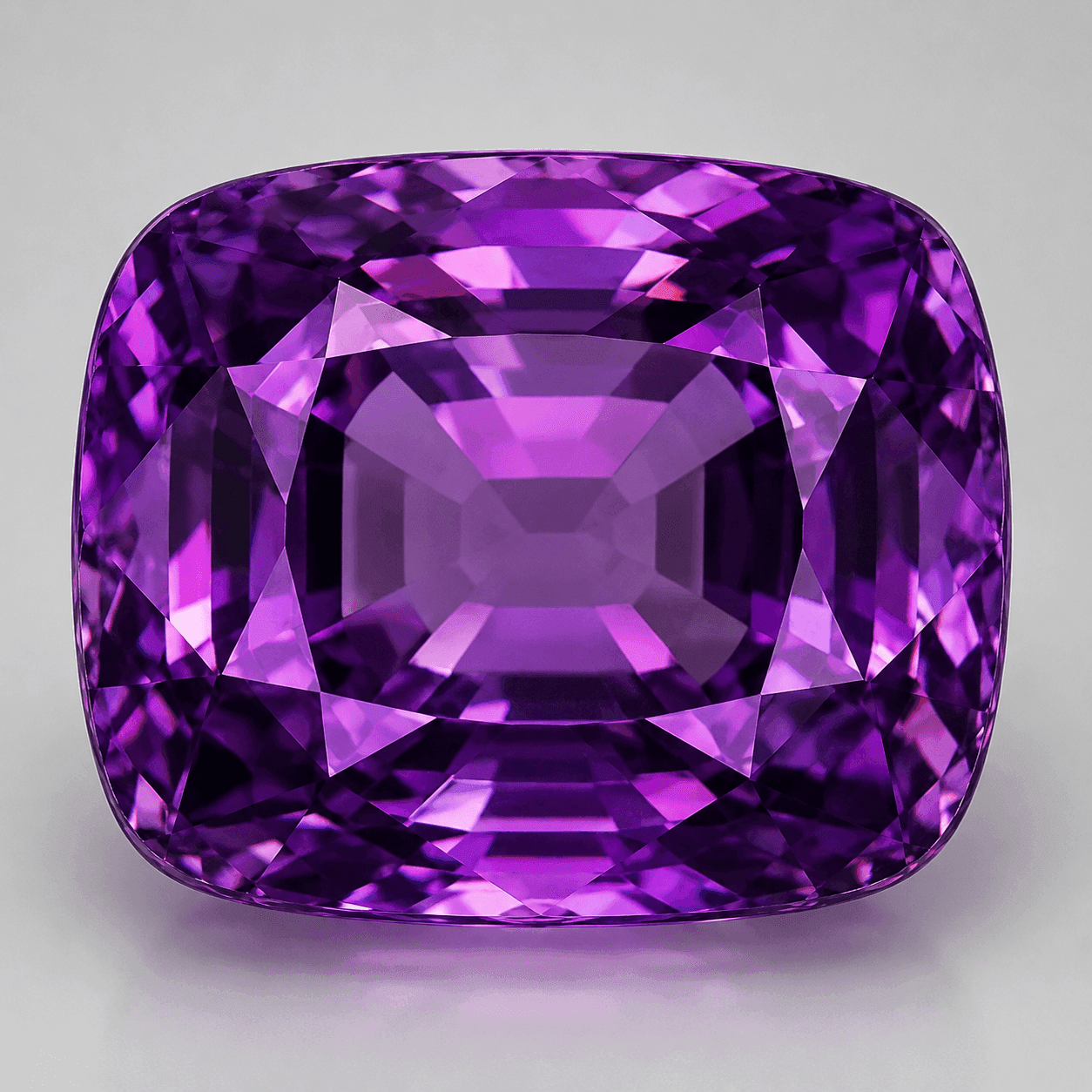
Choose by intent. If you want an affordable, cheerful purple for everyday jewellery, amethyst is hard to beat on value; if you want rarity, superior hardness and a stone that holds its colour and its interest for a lifetime, purple spinel is the connoisseur's pick.
There is no wrong answer here — the two gems serve different purposes. Amethyst delivers big, bold purple for very little outlay, and it has adorned jewellery boxes for millennia for good reason. Spinel offers something scarcer: a hard, untreated, singly refractive stone in a colour that most buyers have never knowingly seen, at prices that still lag its rarity. For those drawn to the second path, our purple-violet spinel collection is the place to start, and the wider shop carries the full spectrum of natural spinel by colour. If you are also weighing spinel against the classic corundum blues and reds, our spinel versus sapphire comparison covers that pairing in the same way.
Frequently asked questions
- Is purple spinel more expensive than amethyst?
- Yes, considerably. Fine natural purple spinel is scarce and trades at collector prices — commonly the mid hundreds into four figures per carat as size and saturation rise — while good amethyst remains affordable at low tens of pounds per carat. The gap reflects a real difference in rarity, hardness and treatment status.
- Can amethyst fade over time?
- It can. Prolonged strong light and heat can lighten amethyst, and sustained heat converts it toward citrine — the same process used commercially to make citrine from amethyst. Natural spinel's colour is stable under normal wear and does not fade, which is one of its quiet advantages.
- How can I tell spinel from amethyst at home?
- Start with refraction: under a loupe, amethyst shows faint doubling of the back facets and pleochroism, while spinel shows neither. Then check weight — spinel feels notably heavier for its size because it is much denser. Those two checks resolve most cases; a refractometer or lab report confirms the rest.
- Is spinel harder than amethyst?
- Yes. Spinel is Mohs 8 with no cleavage, while amethyst is Mohs 7. In practice spinel resists the everyday quartz grit that slowly abrades amethyst, so it holds its polish and sharp facet edges better over years of wear.
- Is purple spinel usually treated?
- No. Spinel is one of the few coloured gems that is typically sold untreated, and everything we offer is natural and untreated, sold by colour. Amethyst, by contrast, is frequently heated and sometimes irradiated within the wider quartz trade.
The bottom line
Spinel and amethyst can share a purple, but they share almost nothing else. One is a rare, hard, dense, untreated oxide that gemmologists have quietly prized for generations; the other is an abundant, softer, lighter quartz that gives the world its most accessible purple. Knowing which you hold is a matter of a loupe, a scale and a little patience — and once you have seen a fine natural purple spinel beside an amethyst, the difference is hard to unsee. For further reading, the GIA offers a thorough overview in its spinel buyer's guide, and Wikipedia's entries on spinel and amethyst give useful background on both species.
Sources
Facts on this page draw on independent gemmological authorities:
- Gemological Institute of America (GIA) · Institute
- Gübelin Gem Lab · Laboratory
- GRS (GemResearch Swisslab) · Laboratory
- Lotus Gemology · Laboratory