A specialist's guide to purple spinel - from lavender to deep violet, its iron-driven colour, its link to colour-change stones, and what it is worth to collectors in 2026.
Purple spinel is a natural gemstone coloured mainly by iron, ranging from soft lavender through mauve to deep violet. It is singly refractive, Mohs 8 and almost never treated. Rarer than amethyst yet a fraction of the price of a comparable purple sapphire, it rewards collectors who value untreated colour and genuine scarcity.
What Gives Purple Spinel Its Colour?
Every spinel shares the same core recipe: magnesium aluminium oxide (MgAl2O4), a cubic, singly refractive crystal with a refractive index of roughly 1.712 to 1.762 and a specific gravity near 3.60. What changes from one stone to the next is the pinch of trace elements held inside that structure. In purple spinel, the dominant colouring agent is iron. On its own, iron pushes spinel toward steely blue, grey and violet. When a little chromium - the same element that turns spinel red and pink - joins the iron, the balance tips toward warmer, redder purples such as lavender, mauve and plum. A trace of cobalt can nudge the colour bluer still. That interplay is why no two violet stones look quite alike.
This matters for buyers, because trace-element colour in spinel is natural and stable. Unlike much of the coloured-stone market, spinel is very rarely treated, and there is no routine heat or diffusion process used to create or improve the colour. As the GIA spinel buyers guide explains, spinel's colours come from these natural trace elements rather than laboratory enhancement, and Britannica's overview of the mineral describes the same magnesium-aluminium structure at work. The violet you see is, in almost every case, the colour the stone carried out of the ground.
From Lavender to Deep Violet: The Colour Range
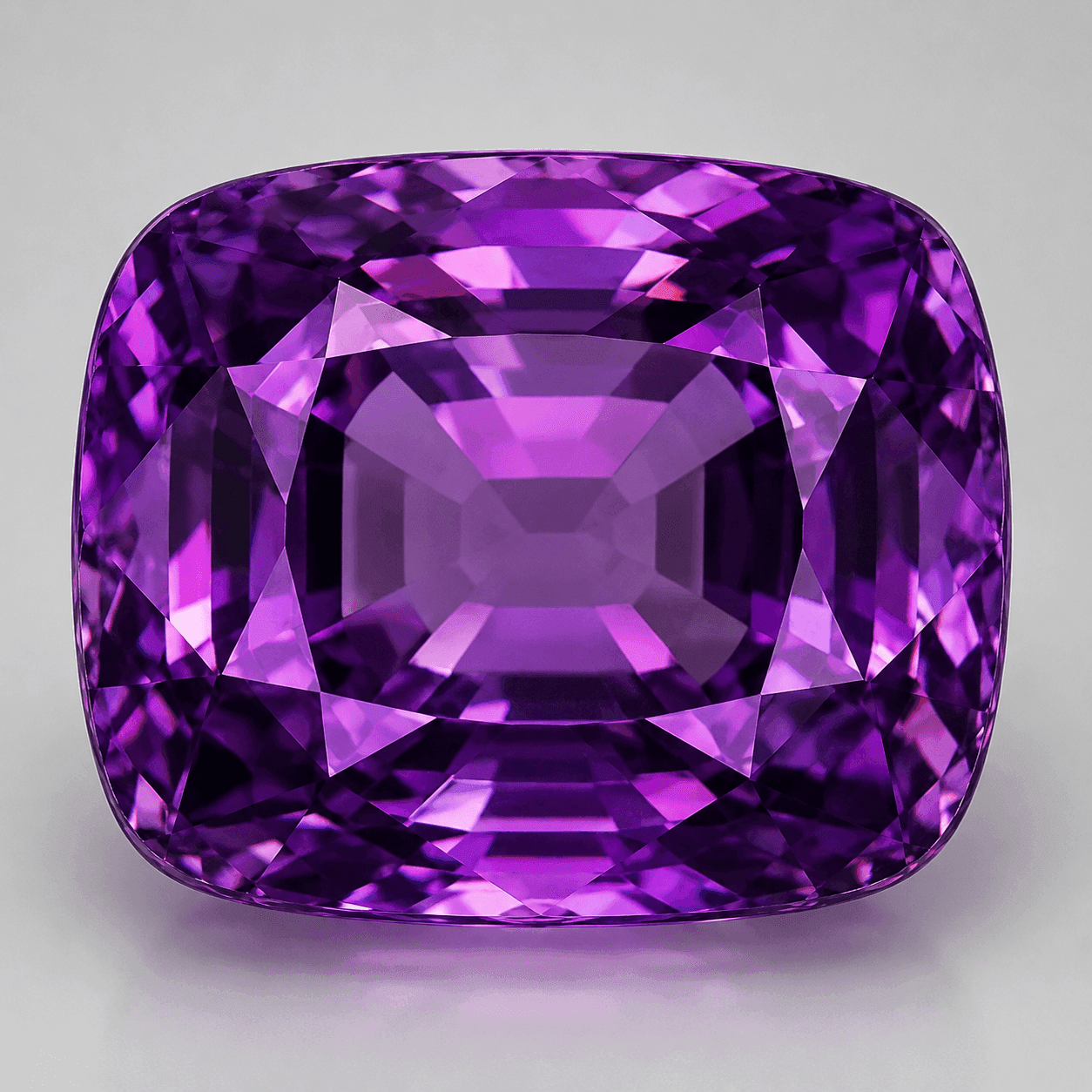
Gemologists describe colour in three parts: hue (the colour itself), tone (how light or dark it is) and saturation (how vivid or muted it is). Violet spinel covers a wide sweep of all three. At the lighter end sit delicate lavenders and lilacs; in the middle come orchid, grape and true violet; at the deep end are rich plum stones that approach the tone of fine amethyst but with far more internal fire. The most sought-after purple spinel shows a medium tone and strong saturation - vivid enough to read clearly as violet, yet not so dark that the stone closes into extinction under normal light.
Buyers often borrow names from other gems to describe what they are looking at - lavender, orchid, grape, plum - but these are marketing shorthand rather than official grades. What actually drives desirability is the same for every violet stone: clean material, strong saturation and a good cut in a tone that flatters the colour. A muddy or brownish overtone drags the price down; a clean, slightly bluish violet with good transparency lifts it. Judge the stone in front of you on those merits rather than on the label attached to it.
Origin plays a part in what you tend to see. Sri Lankan (Ceylon) material carries more iron, which is why the island is known for denim-blue and greyish-violet stones and is often the accessible entry point into the species. Myanmar (Burma) and Tanzania - including the celebrated Mahenge region - yield cleaner, more saturated purples, while Vietnam's Luc Yen deposits are better known for vivid blues and pinks that occasionally cross into violet. Because the colour is mined only in modest quantities wherever it appears, no single origin guarantees supply, and fine violet material surfaces in small parcels rather than a steady stream.
Under magnification, a natural stone often tells its own story. Tiny octahedral crystals - miniature spinels grown inside the host - are a classic natural inclusion, and their presence helps a gemologist separate a natural purple spinel from a lab-created stone. Synthetic spinel has been manufactured for roughly a century and can imitate violet convincingly, which is another reason certification matters. If you would rather check a stone yourself first, our guide on how to tell if a spinel is real walks through the simple tells.
Is Purple Spinel the Same as Colour-Change Spinel?
Not quite, though the two are closely related and often confused. A stable violet stone holds roughly the same hue whether you view it in daylight or under a warm lamp. A colour-change spinel, by contrast, visibly shifts - commonly from a bluer, greyer violet in daylight to a warmer, redder purple under incandescent light. The effect comes from the way the stone's trace elements absorb different parts of the light spectrum. Many purple and violet spinels show at least a hint of this behaviour, and only the strongest, most obvious changers are graded and sold as a separate category. If a shift matters to you, ask about it specifically and look for it noted on the report. Our full colour-change spinel guide explains how the phenomenon is measured and priced.
In practice, then, these stones sit on a spectrum. At one end is a steady, single-colour violet; at the other is a dramatic colour-change gem that behaves almost like two stones in one. A respected independent laboratory will state on its report whether a stone is simply purple or genuinely colour-change - one more reason to insist on documentation for anything significant.
How Much Is Purple Spinel Worth in 2026?
Purple spinel is one of the more accessible colours in the species, which is welcome news for collectors building a collection carefully. For context, red spinel - coloured by chromium - runs from roughly $100 to $600 per carat for commercial stones, $600 to $2,000 for good material, $2,000 to $5,000 for high quality and $5,000 to $10,000 for top gems, with exceptional Myanmar reds passing $20,000 per carat as of 2026. Cobalt-blue spinel is rarer still, reaching $20,000 and beyond per carat at the top. Grey spinel, at the quieter end of the iron-coloured stones, sits around $300 to $500 per carat for well-cut examples. Violet material generally lives closer to that accessible end than to the record-setting reds and cobalts.
That said, the price is not uniform. A pale, greyish lavender is entry-level; a clean stone with vivid, medium-toned violet is considerably scarcer and priced accordingly; and a strong colour-change example can command a real premium over a static one. Size matters too, because fine violet spinel above a few carats is genuinely hard to find. What stays consistent is the value story: because spinel is so rarely treated and because a top red spinel already sells for roughly one-tenth the price of a comparable ruby, purple spinel offers untreated, collector-grade colour for a fraction of what an equivalent sapphire or ruby would cost. For a fuller breakdown, see our spinel price guide.
| Property | Purple Spinel | Amethyst | Purple / Violet Sapphire |
|---|---|---|---|
| Mineral species | Magnesium aluminium oxide | Quartz | Corundum |
| Mohs hardness | 8 | 7 | 9 |
| Optical character | Singly refractive | Doubly refractive | Doubly refractive |
| Main colour cause | Iron, sometimes chromium | Iron plus natural irradiation | Iron/titanium or chromium |
| Typical treatment | Very rarely treated | Often heat-treated | Commonly heat-treated |
| Relative 2026 price | Accessible but scarce | Very affordable | Higher, usually treated |
How to Buy Purple Spinel: A Collector's Checklist
Buying well comes down to a repeatable process. Whether you are choosing a first violet stone or adding to a serious collection, work through these steps in order.
- Start with colour. View the stone in balanced daylight and again under a warm lamp. Look for an even, well-saturated hue and note whether it shifts, since a change can add both interest and value.
- Judge the tone. Aim for a medium tone - light enough to stay lively, dark enough to read as true violet. Very dark stones lose life to extinction; very pale ones drift toward commercial lavender.
- Inspect the clarity. Spinel is frequently eye-clean, so use a 10x loupe to check for silk, crystals or fractures, and favour stones that are clean to the unaided eye.
- Assess the cut. Good symmetry, a minimal window and lively return of light matter as much as the rough itself; a well-cut smaller stone often outperforms a poorly cut larger one.
- Confirm it is natural and untreated. Ask directly about origin and treatment - genuine natural purple spinel should need no enhancement.
- Insist on independent certification. For any significant stone, request a report from a respected laboratory such as GIA, SSEF, Gubelin, GRS, Lotus or AGL.
- Compare the price per carat. Weigh the asking price against the market anchors above, and against a comparable sapphire, before you commit.
If you want a deeper walk-through, our spinel buying guide covers grading and negotiation in detail, while our guide to spinel certificates explains what each laboratory report actually tells you. The GIA spinel quality factors make a useful neutral reference as you compare stones side by side.
Styling and Wearing a Violet Stone
As a loose gem, purple spinel is one of the most versatile colours to design around. Cooler, bluer violets sit well against platinum and white gold, which keep the colour crisp; warmer lavenders and mauves are flattered by yellow and rose gold. Greyish-violet stones, like their grey spinel cousins, read as understated and modern and work nicely in men's rings and signets. With a Mohs hardness of 8, the gem is durable enough for everyday wear, though, as with any fine stone, you should still protect it from hard knocks - our notes on spinel hardness explain what that number does and does not guarantee.
Because we deal in loose natural spinel rather than finished jewellery, many of our clients buy a violet stone unmounted - to hold as a collector's piece, to pair later with a bespoke setting, or simply to enjoy as a self-contained object. Loose stones are also easier to examine, certify and compare, which is exactly how a connoisseur prefers to buy.
Purple Spinel vs Sapphire: Which Should a Collector Choose?
The honest answer is that the two serve different instincts. A fine purple or violet sapphire carries the prestige of the corundum name and slightly greater hardness at Mohs 9. But roughly 90% of blue sapphire on the market is heat-treated, and colour enhancement is routine across corundum, so a large share of what you buy has been improved in a laboratory. Spinel offers the opposite proposition: near-untreated rarity, single-refractive brilliance and a price that undercuts sapphire for comparable colour. For a full side-by-side, read our spinel versus sapphire comparison. Many collectors end up owning both - but they buy spinel for the very reasons the trade once overlooked it.
Why Collectors Are Paying Attention to Violet Spinel
Here is the quiet fact behind the colour: no mine produces fine violet spinel on a schedule. It surfaces in small parcels, each stone a slightly different shade, and once a good one is cut and sold it is effectively one of one. That is the same dynamic that made the species famous in the first place - the Black Prince's Ruby set in the British Crown Jewels is not a ruby at all but a spinel, mistaken for the rarer gem for centuries. Spinel spent generations in ruby's shadow; today it stands on its own, an official August birthstone since 2016 and a favourite of collectors who like to be early.
If untreated colour, genuine scarcity and honest value appeal to you, purple spinel deserves a place on your shortlist. Start by browsing our purple and violet spinel collection to see what is available now, or explore the wider loose spinel shop if you are still weighing colours. When a stone catches your eye, ask us for its certificate and origin; and if you are considering it as a long-term hold, our notes on whether spinel is a good investment set out the case plainly, with no promises attached. For the complete picture of the species, begin with our complete guide to natural spinel.
- Is purple spinel natural or is the colour treated?
- Yes, it is entirely natural. The violet colour comes from trace elements - mainly iron, sometimes with a little chromium - locked into the crystal as it formed. Spinel is very rarely treated, so in almost every case the colour you see is exactly what came out of the ground, untouched by heat or diffusion.
- What is the difference between purple spinel and colour-change spinel?
- A stable violet stone keeps roughly the same hue in daylight and lamplight. A colour-change spinel visibly shifts, usually from a bluer violet in daylight to a redder purple under warm light. Many violet spinels show a faint shift, but only the strongest changers are graded and sold as colour-change stones.
- Is purple spinel rarer than amethyst?
- Yes, considerably. Amethyst is abundant quartz mined in huge quantities worldwide, whereas violet spinel forms only in small parcels at a handful of deposits in Sri Lanka, Myanmar, Tanzania and Vietnam. That scarcity, plus spinel's greater hardness and untreated colour, is why fine violet stones outprice amethyst.
- How much does purple spinel cost in 2026?
- It is one of the more accessible spinel colours, generally priced well below red or cobalt-blue spinel and below a comparable purple sapphire. The exact figure depends on size, tone, saturation and clarity, with vivid violet and colour-change stones commanding the strongest premiums. Always check price per carat against an independent certificate.
- Is spinel an August birthstone?
- Yes. Spinel became an official August birthstone in 2016, when the AGTA added it alongside peridot, so any violet stone qualifies. Its Mohs 8 hardness and rarely-treated colour make it an unusual but durable alternative to the traditional green peridot for an August birthday.
Many of the loveliest violets are Sri Lankan — see our Ceylon spinel guide — while the cooler blue-greens are covered in our teal spinel guide. For the softer end of purple, see our lavender spinel guide. Compare it with the abundant look-alike in spinel vs amethyst.
Sources
Facts on this page draw on independent gemmological authorities:
- Gemological Institute of America (GIA) · Institute
- Gübelin Gem Lab · Laboratory
- GRS (GemResearch Swisslab) · Laboratory
- Lotus Gemology · Laboratory