Jedi spinel is a trade term, not a lab grade, for the most saturated glowing pink-red spinel with no grey or brown modifier - chiefly from Man Sin and Mahenge. Here is what it really means.
Jedi spinel is a trade and marketing term, not a laboratory grade, for the most intensely saturated hot-pink to red spinel that shows no grey or brown modifier and glows with a near-neon inner light. Coined by dealer Vladyslav Yavorskyy around 2015, it describes only the very finest chromium-rich stones, chiefly from Man Sin (Namya) in Myanmar and Mahenge in Tanzania.
For collectors, few phrases in the coloured-stone world carry the mystique of "Jedi." It is spoken with a certain reverence at gem shows, printed on high-end dealer memo, and whispered across the counter when a truly electric pink-red spinel changes hands. Yet the word means something precise, and understanding exactly what it does (and does not) certify is the difference between paying a fair premium for genuine phenomenon and overpaying for marketing. This guide, written from a dealer's chair, unpacks the term with the accuracy it deserves.
What exactly is a Jedi spinel?
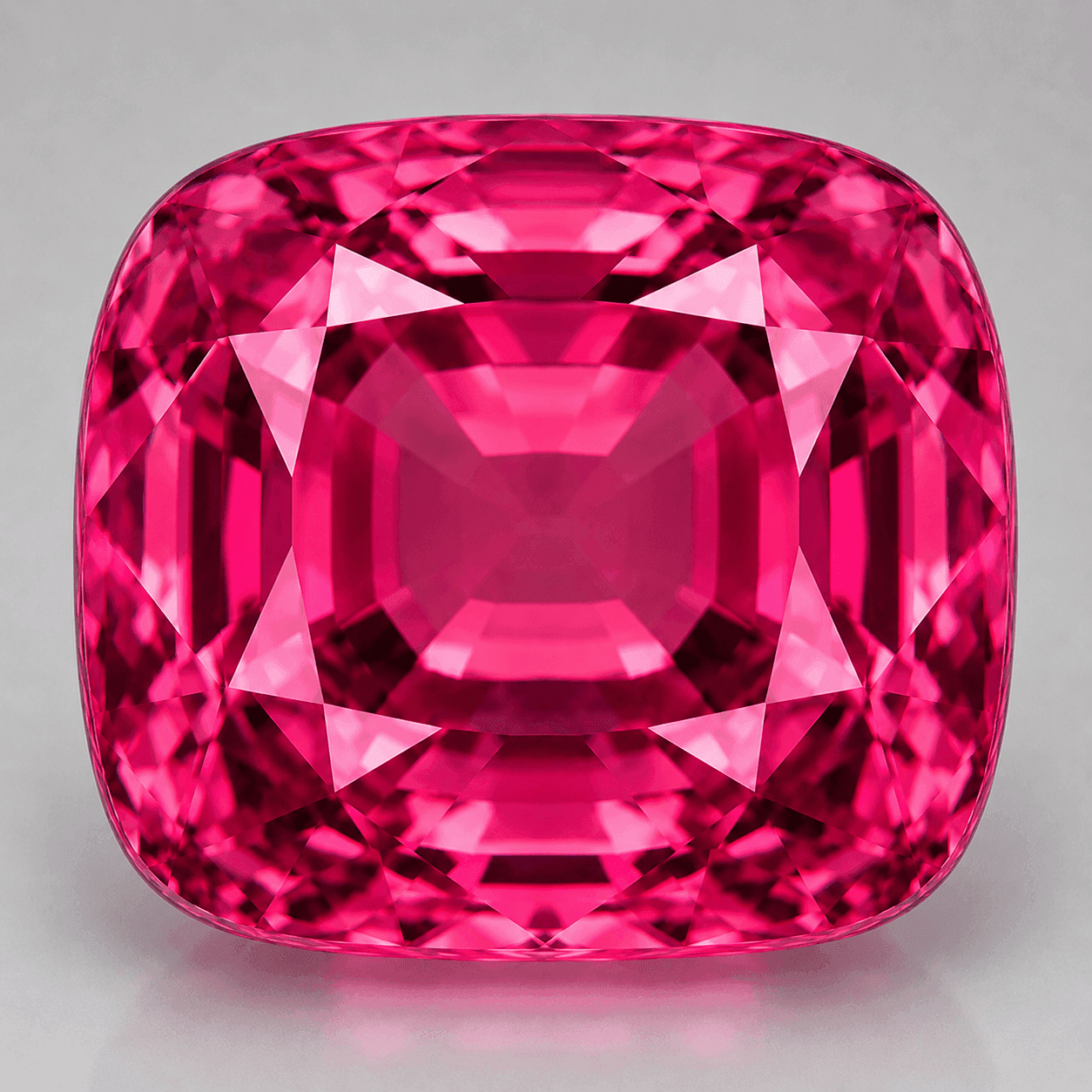
A Jedi spinel is a natural, untreated spinel of such pure, high-saturation pink-red colour that it appears to glow from within, with no visible grey or brown mask. It is a description of a colour ceiling, not a species, origin, or certified grade. Every Jedi is a spinel, but only a tiny fraction of spinel earns the name.
Chemically, all of this sits on ordinary foundations. Spinel is magnesium aluminium oxide (MgAl2O4), cubic and therefore singly refractive — it shows no pleochroism and no doubling, which is one of the cleanest ways to separate it from ruby, sapphire, and tourmaline. It is a Mohs 8 with no cleavage. The colour that defines a Jedi comes from chromium substituting into the crystal lattice, the same element that reddens ruby and colours the finest red spinel. What sets Jedi material apart is the near-total absence of the iron that would otherwise dull the hue toward grey or brown. Strip out that iron, load in chromium, and you get a colour that behaves almost like a light source.
The visual signature has three parts: saturation (the colour is fully switched on, never diluted), tone (medium — light enough to stay vivid, dark enough to read as serious colour), and glow (a strong chromium fluorescence under daylight that makes the stone look lit from the inside). Miss any one of these and the stone is still a lovely pink or red spinel, but it is not a Jedi. The bar is deliberately, almost frustratingly, high.
Where does the name "Jedi" come from?
The term was coined by gem dealer and author Vladyslav Yavorskyy around 2015 to describe the most saturated, glowing pink-red spinels he was seeing come out of Burma. The name is a nod to the idea of these stones having "no dark side" — no grey, no brown, no muddiness.
That origin story matters for one reason above all: Jedi is a dealer's word, not a gemmological one. You will not find "Jedi" printed as a grade on a report from a serious laboratory. A lab will tell you the species (natural spinel), confirm no treatment, and often give an origin opinion — and the best labs are conservative about colour language for exactly this reason. When a report and a trade term travel together, treat them as two different kinds of information. The certificate verifies the facts; the word "Jedi" is a market's shorthand for where a stone sits on the colour ladder. If you would like a fuller picture of what documents actually confirm, our guide to spinel certification walks through it in plain terms.
Jedi is not a grade you can buy on a certificate. It is a ceiling of colour that the market recognises on sight.
Because the term is unregulated, it is also occasionally stretched. A vivid-but-slightly-grey pink spinel gets labelled "Jedi" to justify a price it has not earned. This is not fraud in the way a treatment lie would be — it is optimistic marketing — but it costs buyers real money. Knowing the genuine benchmark protects you.
Where do Jedi spinels come from?
Two sources produce the overwhelming majority of true Jedi material: the Man Sin and Namya deposits in Myanmar, and the Mahenge region of Tanzania. Both are geologically capable of the low-iron, chromium-rich chemistry that the glow requires.
The Burmese story runs through Man Sin (Namya), a deposit in the wider Mogok belt famous for producing hot, glowing pinks. Mogok itself is legendary — the valley of rubies and spinel has yielded the world's most storied red gems for centuries — and Namya's pink-reds are among its crown jewels. These stones tend to be smaller on average, so a clean Jedi over a couple of carats from Burma is a genuinely scarce object.
The Tanzanian side belongs to Mahenge, whose 2007 discovery reset the market's expectations for neon pink-red spinel. The best Mahenge rough delivered exactly the electric, fluorescent colour the Jedi term was built to describe, and often in larger, cleaner sizes than Burma typically offers. Anyone serious about this colour should read our dedicated Mahenge spinel guide, because that single locality is responsible for much of what collectors now picture when they hear "Jedi." You can see current examples of the material in our Mahenge collection.
A note on origin honesty: not every Jedi-coloured stone is Burmese, and the reverse marketing — calling a fine Mahenge stone "Burmese" for prestige — does the collector a disservice. Mahenge stands on its own merit. If you are weighing how much a country of origin should move your decision, our discussion of whether spinel origin matters sets out the honest case on both sides.
What makes a spinel reach "Jedi" saturation?
A spinel reaches Jedi level when chromium saturates the colour fully while iron stays low enough to leave the hue unmasked, producing strong fluorescence in daylight. It is a narrow chemical window, which is precisely why the material is rare. Here is how a dealer actually judges it in the hand.
- Assess it in daylight or daylight-equivalent light first. Jedi glow is driven by chromium fluorescence, and daylight excites it; poor indoor lighting can flatter a mediocre stone and hide a great one.
- Check the tone. You want medium tone — bright and alive. Too light and the colour looks washed; too dark and it drifts toward ordinary red without the neon lift.
- Hunt for grey and brown. Tilt the stone and look into the shadowed facets. Any steely, smoky, or muddy undertone disqualifies it from true Jedi, however slight.
- Judge the glow directly. A genuine Jedi looks lit from inside — the colour seems to sit above the surface rather than within it. Compare side by side with a merely 'good' pink and the difference is unmistakable.
- Confirm it is natural and untreated with a reputable report. Spinel is very rarely treated, but Jedi prices demand documentation, and the report should also address whether colour is natural.
- Only then weigh clarity, cut, and size. Colour is the deciding factor here; the other Cs modify value once the colour has already qualified.
That fifth point deserves emphasis. Spinel is one of the few important coloured stones that is almost always sold exactly as nature made it — untreated is the norm, in stark contrast to blue sapphire, roughly 90% of which is heated. That natural purity is part of why connoisseurs prize spinel, and why a Jedi's glow is so compelling: nothing has been done to it. For the wider context on treatment, see is spinel treated or heated.
How rare and valuable is Jedi spinel?
Jedi spinel sits at the very top of the spinel price ladder, commanding a substantial premium over fine pink and red material of lesser saturation. Because true Jedi colour appears in only a sliver of production, clean stones above two or three carats are genuinely scarce, and price rises steeply with size.
To keep expectations grounded, it helps to see where Jedi material fits against the broader spinel market. The figures below are 2026 dealer ranges for fine, natural, untreated stones; every real quote turns on the specific combination of colour, clarity, cut, size, and origin.
| Type of spinel | Typical 2026 range (per carat) | What drives it |
|---|---|---|
| Grey spinel | ~$300 to $500 | Steely colour, iron-dominant, abundant |
| Fine red spinel | ~$2,000 to $5,000 | Chromium red, clean, good tone |
| Top red spinel | ~$5,000 to $10,000 | Vivid saturation, strong glow |
| Jedi-grade pink-red | Overlaps top red and beyond, size-dependent | Neon glow, zero grey/brown, scarcity |
| Exceptional Myanmar red / top cobalt-blue | $20,000+ | World-class colour, superb provenance, larger sizes |
Two points a candid dealer will always add. First, even at these numbers a fine red spinel typically costs around one-tenth the price of a comparable ruby — which is why so many connoisseurs consider spinel the great value in red gemstones, Jedi included. Second, the Jedi label does not confer a fixed price; a genuine Jedi is priced by its colour and size, and the word is a signpost to that quality, not a multiplier you apply on top. For the full landscape, our spinel price guide breaks down each colour, and the most expensive spinel survey shows where the ceiling really sits. If you want to understand value without hype, is spinel valuable is a level-headed companion piece.
We deliberately avoid quoting auction records or promising appreciation. Fine spinel has a strong collector following and genuine one-of-one scarcity at the top, but no gemstone is a guaranteed investment, and any dealer who tells you otherwise is selling a story, not a stone.
Jedi versus other hot-pink and red spinel — how do you tell the difference?
The difference is the glow and the absence of any modifier. A regular fine pink or red spinel can be beautiful and highly collectible without ever reaching Jedi; the Jedi bar is specifically about maximum saturation plus that neon, lit-from-within quality with zero grey or brown.
Where does one draw the line between hot pink and red in the first place? Chromium content and tone. Lighter, brighter chromium colour reads as pink spinel; as tone deepens it crosses into red. Jedi lives right at the electric junction of the two — a saturated pink-red that refuses to be called merely one or the other. Our comparison of pink versus red spinel maps that boundary in detail, and if pink is your target colour you can browse our pink spinel collection.
| Feature | Ordinary fine pink/red spinel | Jedi-grade spinel |
|---|---|---|
| Saturation | Good to strong | Maximum — fully switched on |
| Grey or brown modifier | May be faintly present | None visible |
| Glow | Pleasant, occasional | Strong neon fluorescence in daylight |
| Typical sources | Many localities worldwide | Chiefly Man Sin/Namya and Mahenge |
| Price position | Fine coloured-stone tier | Top of the spinel ladder |
One more separation worth knowing, because it is where spinel's whole story began: for centuries the finest red spinels were mistaken for ruby, including several 'rubies' in historic crown jewels. That single-refractive nature and slightly softer glow distinguish them; our piece on why spinel is mistaken for ruby tells the tale, and spinel versus ruby covers the practical separations.
How do you buy a genuine Jedi spinel with confidence?
Buy on colour, verify on paper, and buy from a dealer who uses the term honestly. Because "Jedi" is unregulated, your protection is a combination of a reputable lab report confirming natural, untreated spinel and your own trained eye for the glow. Never let the word alone justify the price.
Practical safeguards a seasoned buyer relies on: insist on a report from a respected laboratory; view the stone in daylight and reject anything with a grey or brown cast; compare against a known reference if you can; and ask the seller to explain, specifically, why they consider the stone Jedi rather than simply fine. A confident dealer will welcome the question. Our broader guides on how to buy natural spinel and the common spinel buying mistakes are worth reading before you commit at this price level. For an authoritative outside reference on evaluating the stone, the GIA spinel buyer's guide is a sound starting point, and the research team at Lotus Gemology has published widely on spinel colour and fluorescence.
When you are ready to look at genuine material, our curated inventory runs across the colour spectrum — you can start in the full shop or narrow straight to the Mahenge collection where the neon pink-reds live.
Is Jedi spinel worth it for collectors?
For a collector who values colour above all, a genuine Jedi is one of the most rewarding gemstones money can buy — untreated, phenomenally saturated, and far more affordable than the ruby it resembles. Whether it is 'worth it' depends on your priorities, but few stones deliver this much visual drama with this much natural integrity.
Think of it this way. Spinel gained modern recognition when it joined peridot as an August birthstone in 2016, and the collecting world has been catching up ever since. Jedi sits at the pinnacle of that story: the purest expression of chromium colour in a durable, cleavage-free, singly refractive stone. If you want the definitive overview of the species, the natural spinel complete guide is the place to go deeper. Buy the best colour you can find, verify it, and enjoy owning a genuine one-of-one — because at Jedi level, no two stones glow quite alike.
- Is Jedi spinel a real gemmological grade?
- No. Jedi is a trade and marketing term coined by dealer Vladyslav Yavorskyy around 2015 for the most saturated, glowing pink-red spinel with no grey or brown. Laboratories do not certify 'Jedi' — a report confirms natural, untreated spinel and often origin, while the word describes where the colour sits.
- Where do the best Jedi spinels come from?
- Chiefly two sources: Man Sin (Namya) in Myanmar's Mogok belt, and Mahenge in Tanzania. Both have the low-iron, chromium-rich chemistry that produces the neon glow. Mahenge's 2007 discovery in particular reset expectations for electric pink-red spinel.
- Why does Jedi spinel glow?
- The glow comes from strong chromium fluorescence combined with very low iron. Chromium creates the saturated red-pink colour and fluoresces in daylight, while the near-absence of iron means nothing masks that colour toward grey or brown — so the stone appears lit from within.
- How much does Jedi spinel cost?
- It sits at the top of the spinel ladder, overlapping and exceeding top red spinel (roughly $5,000 to $10,000 per carat in 2026), with clean larger stones climbing higher. Even so, fine spinel typically costs about one-tenth the price of comparable ruby. Every quote depends on colour, size, clarity, and origin.
- Is Jedi spinel treated or heated?
- Almost never. Spinel is one of the few important coloured stones sold as nature made it — untreated is the norm, unlike blue sapphire, around 90% of which is heated. At Jedi prices you should still insist on a reputable report confirming no treatment and natural colour.
Sources
Facts on this page draw on independent gemmological authorities:
- Gemological Institute of America (GIA) · Institute
- Gübelin Gem Lab · Laboratory
- GRS (GemResearch Swisslab) · Laboratory
- Lotus Gemology · Laboratory