Pink and lilac spinel versus kunzite compared: hardness, cleavage, colour permanence, treatment and price. Why spinel outlasts fade-prone kunzite for everyday wear, and when each gem makes sense.
Spinel vs kunzite comes down to durability and permanence: spinel is a Mohs 8, singly refractive, cleavage-free magnesium aluminium oxide that holds its colour indefinitely, while kunzite is a softer Mohs 6.5 to 7 spodumene with perfect cleavage and a delicate pink-lilac hue that can fade in daylight. Both stones offer beautiful pinks and lilacs, but they behave very differently on the wheel, in the setting, and over a lifetime of wear. If you love that soft pink-to-violet register, understanding the trade-offs before you buy will save you disappointment and, quite often, money.
At THE HOUSE OF SPINEL we sell spinel, so treat this as a candid dealer's comparison rather than a neutral referee's. Even so, the mineralogy is not a matter of opinion. Kunzite is a genuinely lovely gem with a devoted following, and there are collectors for whom nothing else will do. But if you are choosing a stone to wear every day, to pass on, or to set in a ring, the differences below are the ones that matter. For the full picture on the pink end of the spinel spectrum, our pink spinel guide and lavender spinel guide are the natural companions to this piece.
What exactly are spinel and kunzite?
Spinel is magnesium aluminium oxide (MgAl2O4), a cubic, singly refractive mineral of Mohs 8 hardness with no cleavage. Kunzite is the pink-to-lilac variety of spodumene (LiAlSi2O6), a lithium aluminium silicate that is doubly refractive, softer at Mohs 6.5 to 7, and cursed with perfect cleavage in two directions.
That single sentence contains most of what separates them. Spinel crystallises in the isometric system, forming octahedra and the famous flattened triangular twins that gave science the term spinel-law twinning. Because it is cubic, spinel is optically isotropic: it shows no pleochroism and no facet-doubling, and its colour is the same from every angle. Kunzite, by contrast, is monoclinic and strongly pleochroic, showing different colours down different crystal axes, which is both a cutter's headache and part of its charm. As the reference literature on spodumene notes, kunzite was first described from California in 1902 and named after the gemmologist George Frederick Kunz. Spinel's history runs far deeper: many of the world's most storied "rubies," including the Black Prince's Ruby, are in fact red spinels, a story we tell in famous spinels in history.
Where do they come from? Kunzite's classic sources are pegmatites in Afghanistan, Pakistan, Brazil, and Madagascar, where lithium-rich pockets grow it in impressively large, clean crystals — part of why big kunzites are affordable. Fine pink and lilac spinel is a rarer thing, drawn from the alluvial gem gravels and marble-hosted deposits of Myanmar's Mogok valley, Tanzania's Mahenge, Vietnam's Luc Yen, Sri Lanka, and Tajikistan's Kuh-i-Lal. Those are the same legendary grounds that produce the reds and cobalt blues spinel is prized for, and the pinks that come out of them share that pedigree. It is a difference of geology that quietly explains the difference in price and rarity.
Which is harder and more durable to wear?
Spinel wins decisively on durability. At Mohs 8 with no cleavage, spinel is a true everyday stone; kunzite at Mohs 6.5 to 7 with perfect cleavage in two directions is fragile enough that many cutters and jewellers treat it as a pendant or earring gem rather than a ring stone.
Hardness measures scratch resistance, and the jump from roughly 6.5 to 8 on the Mohs scale is larger than it looks because the scale is not linear. But hardness is only half the story. Cleavage is the tendency of a crystal to split cleanly along planes of weak atomic bonding, and kunzite has perfect cleavage in two directions plus a parting tendency. A sharp knock on the wrong plane can cleave a kunzite in an instant, regardless of how carefully it was cut. Spinel has no cleavage at all, so it fractures only conchoidally and resists chipping far better. We go deep on this in spinel hardness and durability, but the short version is that spinel is one of the toughest coloured stones you can set in a daily-wear ring, and kunzite is one of the trickiest.
Kunzite is a stone you cut nervously, set carefully, and wear gently. Spinel you simply wear.
There is a reason bench jewellers charge a premium to set kunzite and often decline to size a kunzite ring with heat nearby. The cleavage makes it prone to breaking during setting, and steam or ultrasonic cleaning can be risky. Spinel asks for none of that caution — a point we cover in how to care for your spinel jewellery.
Does the colour last? The fading question
This is the decisive practical difference. Kunzite's pink-lilac colour can fade with prolonged exposure to sunlight and strong light, which is why it is often called an "evening stone," whereas spinel's colour is stable and permanent under any lighting.
Kunzite owes its colour largely to manganese, and much of the kunzite on the market has been irradiated to deepen or induce the pink. Irradiated and even some natural kunzite colour can be photosensitive: worn in daily sunlight or left in a bright window, a vivid kunzite can pale over months or years. Reputable sellers disclose this, and it is the origin of the evening-stone reputation — a gem to enjoy under lamplight, kept out of the sun. Spinel is a completely different proposition. It is one of the very few gems that is almost never treated; untreated is simply the norm, in stark contrast to blue sapphire, of which roughly ninety percent is heated. Spinel's colours come from trace chromium (red and pink), cobalt (electric blue), and iron (grey, violet, lavender), and those colours do not fade. If you want to understand why spinel so rarely sees the oven, read is spinel treated or heated, and the GIA spinel buyer's guide confirms that spinel is one of the few gems typically sold in its natural, untreated state.
How do spinel and kunzite compare side by side?
The table below sets the two gems against each other on the properties that decide how a stone looks, cuts, wears, and lasts. Read it as a buyer's cheat-sheet rather than a full gemmological report.
| Property | Pink/Lilac Spinel | Kunzite (Spodumene) |
|---|---|---|
| Chemistry | Magnesium aluminium oxide (MgAl2O4) | Lithium aluminium silicate (LiAlSi2O6) |
| Crystal system | Cubic (isometric) | Monoclinic |
| Mohs hardness | 8 | 6.5 to 7 |
| Cleavage | None | Perfect in two directions (fragile) |
| Optical character | Singly refractive (no pleochroism) | Doubly refractive, strong pleochroism |
| Refractive index | ~1.712 to 1.762 | ~1.66 to 1.68 |
| Specific gravity | ~3.60 | ~3.18 |
| Typical treatment | Almost never treated | Frequently irradiated |
| Colour stability | Permanent, holds in all light | Can fade in sunlight (evening stone) |
| Everyday ring wear | Excellent | Cautious — better as pendant/earrings |
| Fine price (2026) | Fine pink ~$800 to $3,000+/ct | Modest; often well under $200/ct |
A note on that last row: pink spinel of fine quality commands real money because it is rare, natural, and durable, while kunzite is relatively abundant and affordable even in large, clean sizes. Neither fact makes one gem "better" — but it does explain why a large, clean kunzite can look like a bargain, and why a fine pink spinel of the same size costs many times more. For the full spinel picture see our spinel price guide.
How can I tell spinel and kunzite apart?
You can separate them quickly with a few gemmological checks, because their optical and physical properties barely overlap. The two cleanest tests are refractive index and optical character: spinel is singly refractive with an RI around 1.72, while kunzite is doubly refractive around 1.66 to 1.68 and shows obvious pleochroism.
Here is a practical order of operations a dealer or gemmologist would follow:
- Look for pleochroism: rotate the stone under light or use a dichroscope. Kunzite shows two or three distinct colours down different axes; spinel shows one colour from every angle.
- Check facet-doubling with a loupe: kunzite, being doubly refractive, can show doubled back facet edges; singly refractive spinel never does.
- Take a refractive index reading: ~1.72 points to spinel, ~1.66 to 1.68 points to kunzite (and kunzite gives two readings, spinel one).
- Weigh and measure for specific gravity: spinel sits near 3.60, kunzite near 3.18, so a kunzite feels notably lighter for its size.
- Test hardness only as a last resort on rough or an inconspicuous spot: spinel resists scratching that will mark kunzite, but never risk a finished gem.
- Send anything valuable to a laboratory for confirmation and, for spinel, an origin opinion if the price warrants it.
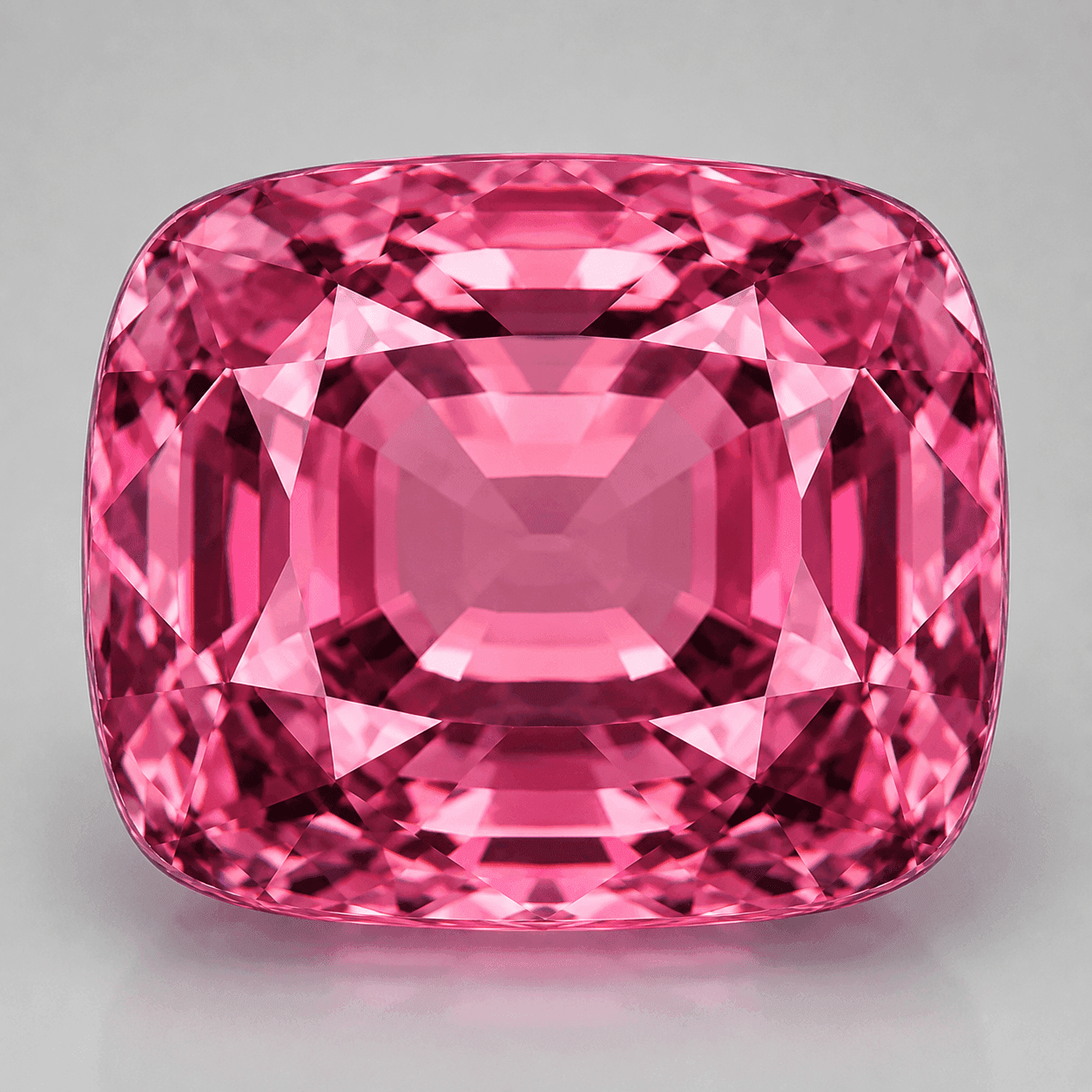
It is worth adding what the colours actually look like side by side, because the difference is real. Kunzite tends toward a soft, slightly cool lilac-pink with a translucent, almost watery glow — pretty, but often pale, and quieter under warm light than under daylight (which, ironically, is the light that fades it). Pink spinel reads brighter and more saturated, with a vivid inner life from its cubic clarity and, in chromium-rich stones, a gentle fluorescent lift that makes the pink glow. A fine hot-pink or lilac spinel simply holds more colour in a smaller stone. That is the collector's trade: kunzite gives you size and softness, spinel gives you intensity and staying power.
Most of these checks are non-destructive and take a competent gemmologist minutes. Our full walkthrough lives in how to tell if spinel is real, and if you are weighing a lab report before you buy, spinel certification explained is worth a read. The reassuring reality is that spinel and kunzite are easy to distinguish; the mistakes usually happen only when a stone is sold under a vague trade name with no testing at all.
Which should you choose for a ring, and which for occasional wear?
For a ring you will wear daily, choose spinel; for a pendant, earrings, or an occasional evening piece where you want size and softness on a budget, kunzite can be a lovely and honest choice. The decision is really about how and where the stone will live.
Kunzite's strengths are its large clean crystals, its gentle lilac-pink glow under warm light, and its accessibility — you can own a substantial, eye-clean gem for a fraction of what a comparable spinel costs. Its weaknesses are the ones we have covered: cleavage, softness, and colour that wants to be kept out of the sun. Set it in a protective bezel, reserve it for necklaces and earrings, and enjoy it in the evening, and it rewards you. Push it into a daily solitaire and you are gambling against physics.
Spinel asks for no such compromises. Its hardness, lack of cleavage, permanent colour, and natural, untreated character make it one of the most quietly practical fine gems in the trade — and one of the most collectible, precisely because top colours are one-of-one rarities. If you are drawn to the pink and lilac end, the pink spinel guide and purple and violet spinel guide will help you place your taste, while the natural spinel complete guide covers the species end to end. When you are ready to see stones, our pink spinel collection is the place to start, and the full inventory of loose natural spinel runs across every colour the species offers.
One last dealer's word. Kunzite and spinel are sometimes pitched as rivals because they share a colour lane, but they answer different questions. Kunzite answers "how much soft pink can I get for my budget, to wear now and then?" Spinel answers "what will still be beautiful, unfaded, and intact in fifty years?" Know which question you are asking, and the choice makes itself.
- Is spinel or kunzite more valuable?
- Fine pink spinel is considerably more valuable than kunzite. Top natural pink spinel can reach several thousand dollars per carat because it is rare, untreated, and durable, whereas kunzite is relatively abundant and often sells well under $200 per carat even in large, clean sizes. Kunzite offers size and clarity for less money; spinel offers rarity and permanence.
- Does kunzite really fade in sunlight?
- Yes, this is well documented. Kunzite's pink-lilac colour, often deepened by irradiation, is photosensitive and can pale with prolonged exposure to sunlight and strong light, which is why it is nicknamed an evening stone. Spinel does not fade; its colour comes from stable trace elements and holds under any lighting for the life of the gem.
- Can I wear kunzite in an everyday ring?
- It is not ideal. Kunzite is softer (Mohs 6.5 to 7) and has perfect cleavage in two directions, so it chips and can even split from a knock more easily than most ring stones. If you love kunzite in a ring, use a protective bezel setting and treat it gently. For daily wear, spinel at Mohs 8 with no cleavage is far more forgiving.
- Is spinel treated the way kunzite is?
- No. Spinel is one of the very few gems that is almost never treated — untreated is the norm — whereas kunzite is frequently irradiated to enhance colour. This is a major point in spinel's favour: what you see is naturally there, and it is stable. Contrast this with sapphire, where roughly ninety percent of blue material is heated.
- How do jewellers tell pink spinel from kunzite?
- Quickly and non-destructively. Kunzite is doubly refractive with strong pleochroism (two or three colours down different axes) and an RI near 1.66 to 1.68, while spinel is singly refractive with one colour and an RI near 1.72. Specific gravity also differs (spinel ~3.60, kunzite ~3.18). A dichroscope, refractometer, or a lab report settles it easily.
Sources
Facts on this page draw on independent gemmological authorities:
- Gemological Institute of America (GIA) · Institute
- Gübelin Gem Lab · Laboratory
- GRS (GemResearch Swisslab) · Laboratory
- Lotus Gemology · Laboratory