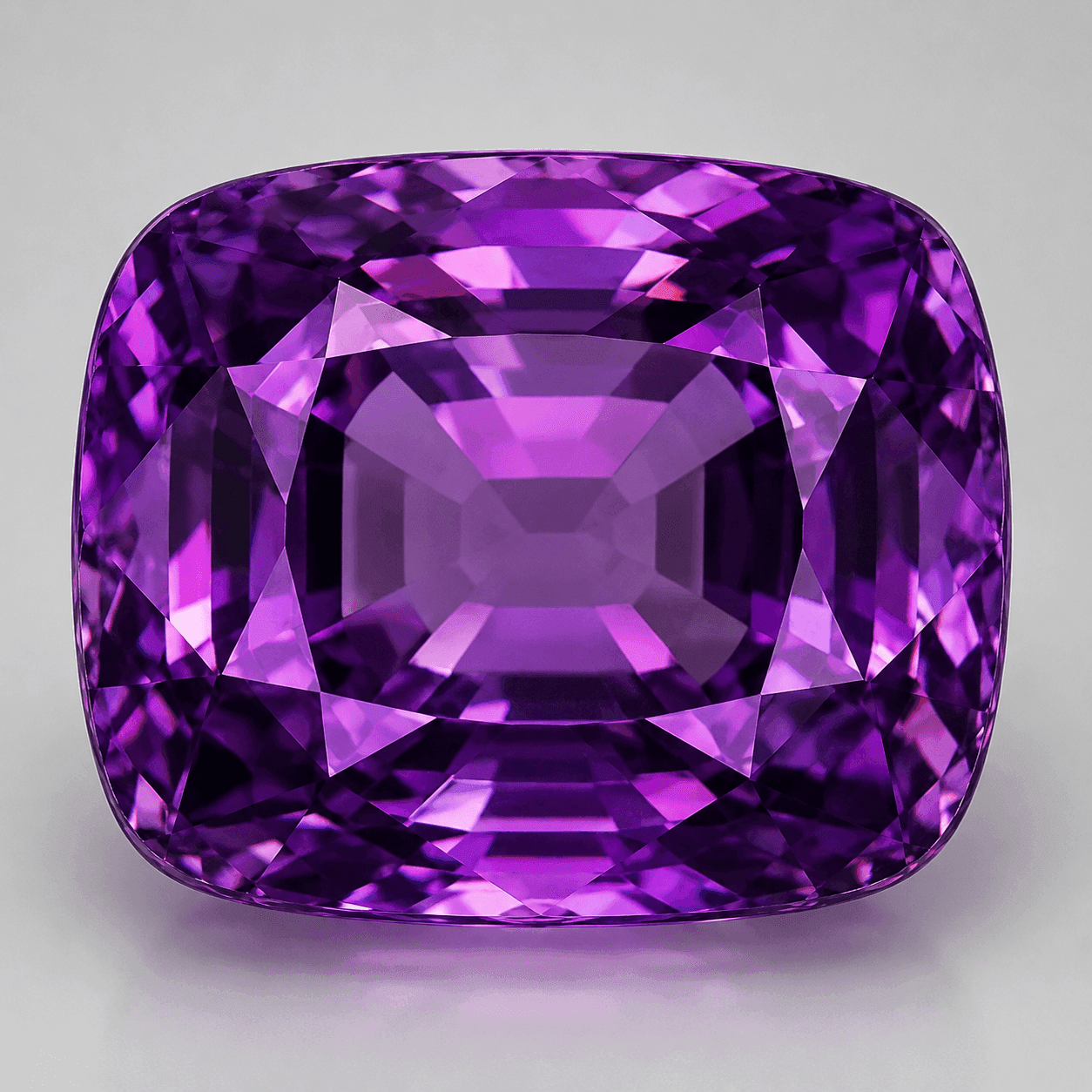
One of the rarest phenomena in the spinel world: a colour change spinel that reads blue-violet by day and purple-red by lamplight. Here is how the effect works, why it is so scarce, and how to judge the strength of the change before you buy.
Colour change spinel is a rare natural gem that shifts hue with lighting: blue to violet in cool daylight, warming to purple or reddish-purple under incandescent lamplight. The effect comes from trace elements and selective light absorption, and only a tiny fraction of spinel shows it strongly enough to earn the name.
What Is Colour Change Spinel?
Spinel is a single mineral - magnesium aluminium oxide, MgAl2O4 - that crystallises in the cubic system, carries a Mohs hardness of 8, and is singly refractive with a refractive index of roughly 1.712 to 1.762 and a specific gravity near 3.60. Colour change spinel is natural spinel whose chemistry sits at a rare tipping point, so its apparent hue depends on the light source. Move the same stone from a north-facing window to a table lamp and the colour genuinely shifts, most often from a blue or violet daylight face to a purple or reddish-purple face under warm indoor light. It is worth remembering that spinel spent centuries misidentified as ruby; the Black Prince's Ruby and the Timur Ruby in the British Crown Jewels are both spinels. A gem still shaking off that mistaken identity, quietly performing a colour change, is exactly the kind of underappreciated stone collectors look for.
Because spinel is singly refractive, it has no pleochroism - it cannot show different colours from different viewing angles the way a doubly refractive gem such as sapphire can. That single fact makes the phenomenon unusually clean: any real shift you see is a true illuminant effect, not a trick of the crystal axis. Spinel is also an official August birthstone, added by the AGTA in 2016 alongside peridot, which gives a phenomenal stone a natural place on a birthday list. For a fuller grounding in the species, see our complete guide to natural spinel.

What Causes the Colour Shift Between Daylight and Lamplight?
The mechanism is selective absorption. A colour change gem contains trace elements that absorb parts of the visible spectrum and leave two transmission windows open, one in the blue-green region and one in the red. Which window wins depends on the light. Daylight is rich in cool, blue wavelengths, so the blue-green window dominates and the stone reads blue to violet. Incandescent light and candlelight are heavy in warm, red wavelengths, so the red window takes over and the same stone reads purple to reddish-purple. Your eye is simply integrating whatever the light source gives it.
In spinel the balance is written by trace chemistry. Chromium drives red and pink; iron pushes toward steely blue, grey and violet. When a stone carries just enough of each to sit on the knife-edge between them, the illuminant decides the outcome - cool light lets the iron-driven blue speak, warm light lets the chromium-driven red speak. It is the same physics that makes alexandrite and colour-change sapphire perform, even though each species uses a different chemical recipe.
One subtlety worth knowing is how path length interacts with the effect. The distance light travels through the stone changes how saturated each window appears, so cut and depth influence how convincing the change looks - a well-proportioned stone can present a cleaner, more complete shift than a shallow one cut from the same rough. For the underlying spectroscopy, gem laboratories such as Lotus Gemology and the research teams at GIA publish the primary literature.
Where Does This Rare Spinel Come From?
Colour change spinel has no single famous mine the way Mahenge owns neon pink or Luc Yen owns cobalt blue. Instead it appears as an occasional guest in several classic spinel grounds. Sri Lanka's Ratnapura gem gravels are the most consistent source; the island's iron-rich chemistry naturally favours the blue-to-violet daylight face that a colour change needs. Myanmar's Mogok valley - the storied Valley of Rubies and Spinel - yields the occasional stone with cleaner, more chromium-driven warm colours. Tanzania and Tajikistan contribute sporadically. Because no deposit produces it reliably, supply is unpredictable and each parcel tends to be tiny, which is a large part of why a strong stone is so hard to find.
How Rare Is It, and Is It Treated?
Spinel is already a connoisseur's stone, scarce next to the sapphire and ruby it was confused with for centuries. Within spinel, colour change material is rarer still. Most stones arrive small; a clean example above a couple of carats is a genuinely uncommon find, and a strong change in a larger size is close to one-of-one. This is not manufactured scarcity or a numbered limited edition - it is the natural output of a handful of deposits that only occasionally deliver the exact chemistry the effect requires.
There is a quiet advantage here for collectors. Spinel is very rarely treated, and colour change spinel is almost always exactly what nature made, with no heat and no diffusion. Compare that with the coloured-stone mainstream, where roughly 90% of blue sapphire is heat-treated. A natural, untreated gem that also performs a colour trick is a rare intersection of scarcity and integrity. If placing it among the scarcest hues interests you, our guide to the rarest spinel colour sets the wider context, and the purple and violet spinel guide covers its closest single-colour cousins.
How to Evaluate the Strength of the Colour Change
Not every stone sold as colour change deserves the label. The trade grades the effect by how much of the hue actually moves between two reference lights, and a handful of checks separate a strong performer from a stone with a faint, marketing-led wobble. The GIA spinel quality factors are a useful reference for colour, clarity and cut; work through the steps below in order.
- Use two reference lights. Judge the stone under daylight or a D65 daylight lamp, then under incandescent or tungsten light near 2,800 to 2,900K. Never assess in mixed light, which muddies both faces and exaggerates the change.
- Estimate the percentage of change. Dealers describe the shift from weak to strong, often as a rough percentage of hue that moves. A faint 10 to 20% wobble is minor; a decisive 60 to 100% swing from blue-violet to purple-red is what commands a premium.
- Judge both colours, not just the change. A shift between two attractive, saturated hues beats a change between a dull grey and a muddy brown. Strong saturation in each lighting state is worth more than a dramatic move between two weak colours.
- Check clarity and cut. Spinel is often eye-clean, so demand it; a windowed, overly deep or lifeless cut hides the effect. A well-cut stone returns light evenly and lets both colours read clearly right across the face.
- Rule out pleochroism and synthetics. Rock the stone to confirm the change follows the light source, not the viewing angle - natural spinel is singly refractive. Flame-fusion synthetic spinel can also change colour, so provenance and testing matter.
- Insist on an independent report. For any significant stone, a certificate from a respected laboratory confirms natural origin, species and the absence of treatment. Our spinel certification explained guide walks through what a report should say.
Colour Change Spinel vs Alexandrite and Sapphire
Colour change spinel belongs to a small club of gems that perform this trick. Seeing how it compares clarifies both its character and its value.
| Gem | Daylight colour | Incandescent colour | Main cause | Typically treated? |
|---|---|---|---|---|
| Colour change spinel | Blue to violet | Purple to reddish-purple | Chromium and iron in balance | Very rarely treated |
| Alexandrite (chrysoberyl) | Green to bluish-green | Red to purplish-red | Chromium | Rarely treated |
| Colour-change sapphire | Blue to violet | Purple to reddish | Vanadium and iron | Often heat-treated |
| Colour-change garnet | Blue-green to grey | Red to purple | Vanadium and chromium | Never treated |
The comparison flatters spinel on origin. Because it is so seldom treated, the stone is almost always a natural, untreated gem, whereas a colour-change sapphire may owe part of its appearance to heat. For a deeper look at how the two species differ across colour, hardness and value, see our spinel vs sapphire comparison.
What Does Colour Change Spinel Cost in 2026?
There is no single published price for colour change spinel, because so few stones cross the market in any year. In practice it is valued by reference to fine blue, violet and purple spinel of the same size and clarity, with a premium added for the strength and cleanliness of the change. The verified 2026 ranges below are for other spinel colours, but they frame where a fine phenomenal stone tends to sit.
| Spinel type (as of 2026) | Approx. price per carat |
|---|---|
| Commercial red | $100-600 |
| Good red | $600-2,000 |
| High-quality red | $2,000-5,000 |
| Top red | $5,000-10,000 |
| Exceptional Myanmar red | $20,000+ |
| Cobalt-blue (second-tier to top) | $2,000-20,000+ |
| Well-cut grey | $300-500 |
Set against the stones spinel is mistaken for, the value is striking. Even a top red spinel often sells for roughly one-tenth the price of a comparable ruby. So while a strong colour change spinel carries a rarity premium over an equivalent single-colour stone, it remains far more attainable than the famous corundum it outperforms on scarcity. For the full picture across every hue, our spinel price guide breaks the market down, and the cobalt blue spinel guide covers the other blue that collectors chase. We would rather under-promise than dress a gem up as a guaranteed investment - buy the stone you love, on the strength of what you can see and what the certificate confirms.
Should You Add One to Your Collection?
Collectors who already understand spinel tend to treat a colour change stone as a capstone: proof that a single crystal can hold two moods and still be entirely natural. It is not a gem for someone who only wants a familiar name to recite - it is for the connoisseur who values the phenomenon, the untreated origin and the near one-of-one scarcity. We have handled enough spinel to say plainly that a genuine, strong change in a clean stone is one of the harder things to source anywhere in the species.
If that is the kind of gem you collect, start by seeing real stones side by side under both lights, then buy on the strength of the change and the certificate rather than the label alone. Browse the current colour change spinel collection, read the natural spinel buying guide before you commit, and always insist on an independent report for any significant purchase.
- Is colour change spinel natural or man-made?
- Both exist. Natural colour change stones are genuinely rare, while flame-fusion synthetic spinel is common and can also shift colour. The two are easy to confuse by eye, so any significant stone should carry an independent laboratory report confirming natural origin. See our guide to natural versus lab-created spinel.
- What colours does colour change spinel show?
- Most colour change spinel reads blue to violet in cool daylight and warms to purple or reddish-purple under incandescent lamplight. The exact hues and the strength of the swing vary from stone to stone, driven by the balance of trace chromium and iron in the crystal and by how the gem is cut.
- Is colour change spinel more valuable than red spinel?
- It depends on the individual stones. A strong, clean change in attractive colours carries a rarity premium, but a fine top-red spinel of larger size can still cost more. Value tracks base colour, clarity, size and the strength of the change together, not the phenomenon alone.
- How is colour change different from pleochroism?
- Pleochroism shows different colours from different viewing angles and needs a doubly refractive gem. Spinel is singly refractive, so it has no pleochroism at all. Any shift in the stone comes purely from the light source, which makes the effect clean and unambiguous to verify.
- Is colour change spinel treated or heated?
- Almost never. Spinel as a species is very rarely treated, and colour change stones are effectively always natural and untreated, with no heat and no diffusion. That contrasts sharply with sapphire, where around 90% of blue material is heat-treated. A laboratory report will confirm no treatment.
Ready to see the phenomenon for yourself? Explore the colour change spinel collection and request an independent certificate on any stone that holds your eye. Compare it with the benchmark in spinel vs alexandrite, and see the zoned bicolour spinel.
Sources
Facts on this page draw on independent gemmological authorities:
- Gemological Institute of America (GIA) · Institute
- Gübelin Gem Lab · Laboratory
- GRS (GemResearch Swisslab) · Laboratory
- Lotus Gemology · Laboratory