Colour-change spinel and alexandrite both shift hue with light, but they are different minerals. Compare their chemistry, optics, durability and price to decide which rare gem suits you.
Spinel and alexandrite are two different minerals that both perform a colour shift, but alexandrite is chrysoberyl with a dramatic green-to-red change, while colour-change spinel is a rarer, gentler blue-to-purple gem — alexandrite is harder, doubly refractive and far more expensive, whereas spinel is singly refractive, near-indestructible and better value. For a collector deciding between them, the honest answer is that these gems answer two different appetites: alexandrite for theatrical drama and blue-chip prestige, colour-change spinel for subtle beauty, untreated purity and price you can actually justify.
What is the difference between spinel and alexandrite?
Alexandrite is the colour-change variety of chrysoberyl (BeAl2O4), while spinel is magnesium aluminium oxide (MgAl2O4). They are unrelated minerals that happen to share one theatrical trick — a change of apparent colour under different light — but almost everything else about them, from crystal system to durability to price, diverges sharply.
The most important gemmological separator is optical. Alexandrite is orthorhombic and doubly refractive, which means it splits light into two rays and shows pleochroism — three different colours from three viewing directions. Colour-change spinel is cubic and singly refractive: no pleochroism, no facet-doubling, one clean colour body. That single fact underpins several of the identification tests below, and it is the same property that separates spinel from tanzanite, tourmaline and zircon. If you want the deeper physics of how spinel handles light, our spinel optical properties guide walks through refraction, dispersion and fluorescence in detail.
There is also a difference in why each gem changes colour. Alexandrite owes its dramatic shift to chromium sitting in the chrysoberyl lattice, which transmits both green and red light while absorbing the yellow band between them; the eye tips one way or the other depending on whether the light source is daylight-rich (green) or incandescent-rich (red). Colour-change spinel usually relies on a combination of iron, chromium and sometimes vanadium or cobalt, producing a softer swing — typically greyish-blue or violet in daylight to purple or plum under warm light. The mechanism is the same principle; the magnitude is not. Alexandrite's chromium chemistry is documented in the mineralogical literature on chrysoberyl, the parent species of which alexandrite is only one rare variety.
How do their colour changes actually compare?
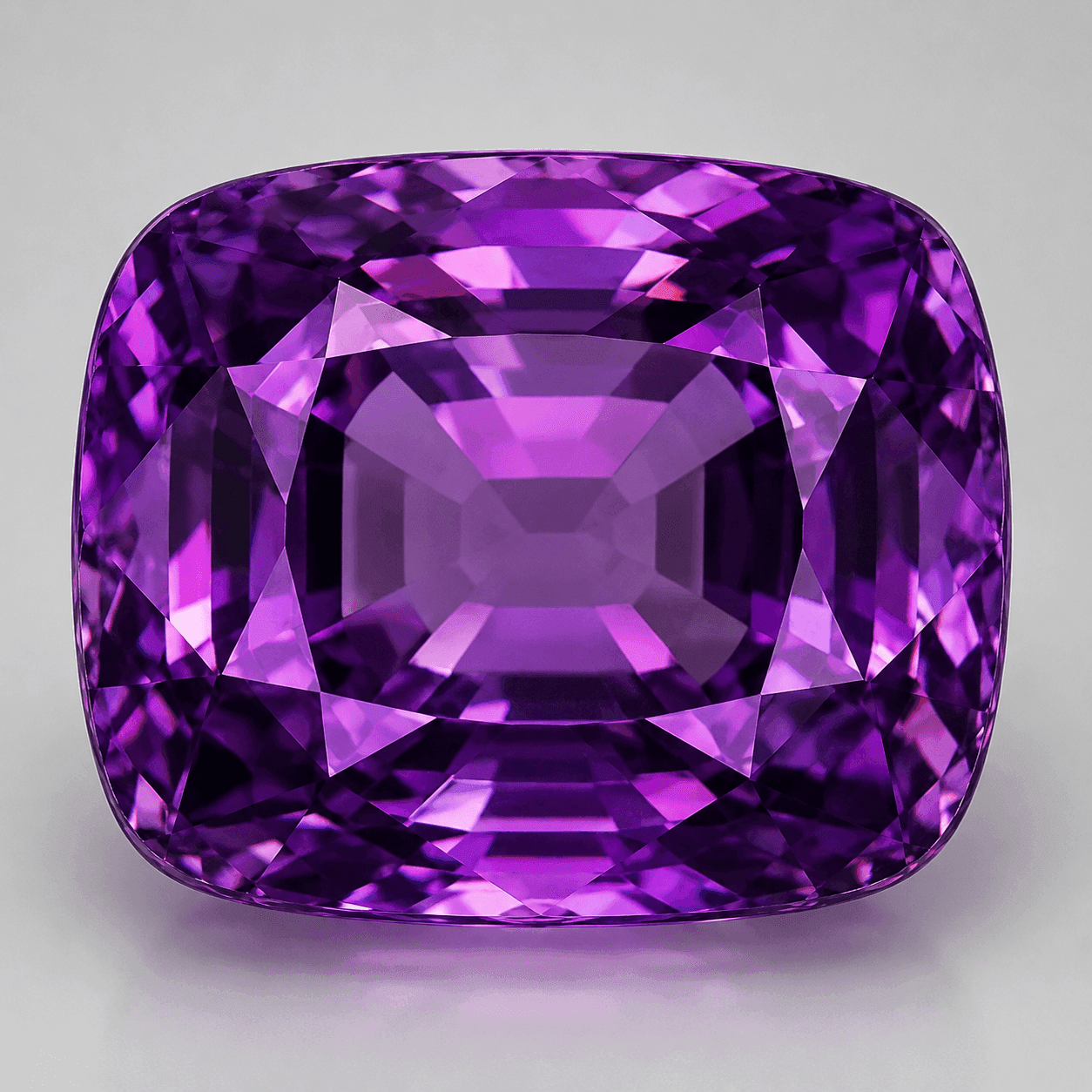
Alexandrite delivers the strongest colour change in the gem world — a full green-to-red or green-to-purple reversal that gave rise to the old jeweller's line "emerald by day, ruby by night." Colour-change spinel is real but more restrained: expect a blue or violet daylight face shifting to purple or reddish-purple under incandescent light, rarely the complete hue-flip that fine alexandrite achieves.
Grading a colour change comes down to three things: the percentage of change (how completely one hue replaces the other), the attractiveness of both states (a stone should be beautiful in daylight and in lamplight, not merely muddy-to-muddy), and the saturation of each colour. Top alexandrite from the original Russian Ural deposits — long exhausted — set the benchmark for a vivid, near-100% change, and that scarcity is a large part of its legend. Fine colour-change spinel typically shows a 40-70% change, which is genuinely lovely in the hand but should be described honestly rather than sold as "alexandrite-like."
Alexandrite changes its mind; colour-change spinel changes its mood.
That distinction matters when you shop. A gentle, elegant shift is not a flaw in spinel — it is the character of the material, and it comes wrapped in advantages alexandrite cannot match: usually no treatment, excellent transparency, and a price that leaves room in the budget for a beautiful setting. For a fuller tour of the phenomenon in our own material, see the colour-change spinel guide, and for how this rare hue sits among spinel's other scarce colours, the rarest spinel colour piece puts it in context.
Which is harder and more durable, spinel or alexandrite?
Alexandrite is marginally harder at Mohs 8.5 versus spinel's Mohs 8, but both are exceptionally tough and neither has troublesome cleavage. For everyday wear — rings especially — both gems are among the most durable coloured stones you can choose, and the half-point difference on the Mohs scale has little practical consequence in normal use.
Spinel's real durability strength is that it has no cleavage — no internal plane along which a sharp knock can split it — combined with good toughness and a hardness that shrugs off most household scratching. Alexandrite shares the no-easy-cleavage advantage and edges ahead on scratch resistance. In truth, both are ring-worthy for a lifetime; the decision rarely turns on durability. If you want the full picture on how spinel holds up in daily wear, our spinel hardness and durability guide covers care, settings and realistic expectations, and the how to care for your spinel jewellery piece adds practical routines.
| Property | Colour-change spinel | Alexandrite (chrysoberyl) |
|---|---|---|
| Chemistry | MgAl2O4 | BeAl2O4 |
| Crystal system | Cubic (isometric) | Orthorhombic |
| Optical character | Singly refractive | Doubly refractive |
| Pleochroism | None | Strong (three colours) |
| Mohs hardness | 8 | 8.5 |
| Cleavage | None | Distinct (one direction) |
| Typical change | Blue/violet to purple | Green to red/purple |
| Change strength | Gentle, 40-70% | Dramatic, up to ~100% |
| Treatment | Very rarely treated | Usually untreated; some synthetics |
| Typical fine price | ~$300-1,500/ct | ~$10,000-70,000/ct+ |
Why is alexandrite so much more expensive than colour-change spinel?
Fine alexandrite is one of the most expensive coloured gemstones on earth, with top stones commanding tens of thousands of dollars per carat, while colour-change spinel is a fraction of that. The gap comes down to extreme rarity of gem-quality alexandrite, a century of collector legend, and the sheer difficulty of finding stones that change strongly and look beautiful in both lights.
To put numbers on it: gem-quality alexandrite above a carat with a strong change routinely runs from roughly $10,000 to $70,000 per carat, and exceptional Russian or Brazilian material can exceed that. Colour-change spinel, by contrast, generally sits in the $300 to $1,500 per carat range depending on the strength of change, size and clarity — occasionally higher for an exceptional stone with a vivid shift. That is the same kind of value story spinel tells across every colour: a fine red spinel often costs around a tenth of a comparable ruby, and our spinel price guide lays out the current 2026 ranges colour by colour. The broader case for how the trade values spinel across every hue is set out in the GIA spinel buyer's guide, a useful neutral reference for anyone weighing the two gems.
Value, of course, is not only about the sticker. Colour-change spinel offers something alexandrite struggles to guarantee: near-certainty that your stone is natural and untreated. Spinel is very rarely treated, whereas the alexandrite market is complicated by synthetic chrysoberyl and by the notorious synthetic colour-change sapphire that fooled generations of buyers. Whether spinel makes sense as a store of value is a separate question we treat candidly in is spinel a good investment.
How can you tell colour-change spinel from alexandrite?
The fastest reliable separator is optical character: alexandrite is doubly refractive and pleochroic, colour-change spinel is singly refractive with no pleochroism. A gemmologist confirms this with a dichroscope, a polariscope and a refractometer — three quick tests that settle the question without ambiguity.
Here is the practical sequence a dealer runs through when a colour-change stone lands on the desk:
- Check pleochroism with a dichroscope. Rotate the stone in the window. Alexandrite flashes green, orange-red and purplish shadows from different directions; spinel shows one steady colour. Three colours means it is not spinel.
- Test with a polariscope. Spinel stays dark (or shows anomalous double refraction as a soft strain pattern) through a full rotation because it is singly refractive; alexandrite blinks light-and-dark four times per turn as a doubly refractive stone.
- Read the refractive index. Spinel sits near a single reading around 1.712-1.718; alexandrite gives a birefringent pair around 1.746-1.755. A refractometer separates them instantly.
- Weigh or estimate specific gravity. Spinel is about 3.60; chrysoberyl is heavier at roughly 3.73, so a stone's heft for its size is a useful cross-check.
- Confirm with a lab report if value warrants it. For any significant purchase, an independent report removes doubt about species, natural origin and treatment.
None of these tests requires damaging the stone, and any competent gemmologist can run them in minutes. For a broader toolkit on verifying spinel specifically — including the singly refractive tells that also separate it from ruby and sapphire — see how to tell if spinel is real. The same optical logic underpins our spinel versus sapphire comparison, where the synthetic colour-change sapphire trap is exactly the pitfall to avoid.
Where do these gems come from, and does origin matter?
Alexandrite was first found in Russia's Ural Mountains in the 1830s, with later important deposits in Brazil, Sri Lanka and East Africa; the original Russian material carries the greatest prestige. Colour-change spinel is scattered across the classic spinel sources — Sri Lanka (Ratnapura), Tanzania (Tunduru), Myanmar's Mogok, and Tajikistan — and origin influences price less dramatically than it does for alexandrite or sapphire.
For spinel generally, provenance can add a premium — Mogok and Mahenge names carry weight — but the stone is judged first on the beauty of its colour and change, then on origin. That is a healthier basis for buying than chasing a locality label, and it is why we encourage collectors to trust their eye. Our natural spinel complete guide covers the mineral from crystal habit to colour chemistry, and does spinel origin matter tackles the provenance question head-on. If a warm salmon-orange stone catches your eye along the way, that is our house-coined An Phu Sunset — a different phenomenon entirely, but a reminder of how much range this single mineral holds.
Which should you buy — colour-change spinel or alexandrite?
Buy alexandrite if you want the strongest colour change in gemmology and are prepared to pay blue-chip prices with careful attention to synthetics. Buy colour-change spinel if you value a gentler, elegant shift, near-certain natural-untreated status, excellent durability and a price that leaves room for a beautiful setting.
For most collectors building a considered coloured-stone collection, colour-change spinel is the quietly clever choice: it delivers the fascination of a light-dependent gem without the six-figure exposure or the synthetic minefield. It also sits within reach of a first-time buyer, which alexandrite rarely does. You can explore what we currently have in this rare hue in our colour-change collection, or browse the wider range of loose natural spinel by colour to see how the phenomenon compares with cobalt blue, red and grey.
Whichever way you lean, the deciding factor should be the stone itself — how it behaves as you walk from a window to a lamp, whether both faces are genuinely beautiful, and whether it has been honestly represented. A gentle spinel change described accurately is a far better purchase than an over-hyped stone sold on a name it cannot live up to. Ask to see the stone under a phone torch and by a north-facing window before you commit; a reputable dealer will welcome the request, because a genuine colour-change gem is at its most persuasive when you watch it work with your own eyes.
- Is colour-change spinel the same as alexandrite?
- No. Alexandrite is the colour-change variety of chrysoberyl (BeAl2O4), while colour-change spinel is a different mineral, magnesium aluminium oxide (MgAl2O4). They share the light-dependent colour-change phenomenon but differ in chemistry, crystal system, optical character and price. Alexandrite is doubly refractive; spinel is singly refractive.
- Does colour-change spinel change colour as strongly as alexandrite?
- Usually no. Alexandrite shows the most dramatic change in gemmology — often a near-complete green-to-red or green-to-purple flip. Colour-change spinel typically shows a gentler 40-70% shift, most often from a cool blue or violet in daylight to a warmer purple under incandescent light.
- Is colour-change spinel cheaper than alexandrite?
- Significantly. Fine alexandrite can run from roughly $10,000 to $70,000 per carat or more, while fine colour-change spinel generally sits between about $300 and $1,500 per carat. Spinel also offers near-certainty of being natural and untreated, which the alexandrite market cannot always guarantee.
- How do you tell colour-change spinel from alexandrite?
- The decisive test is optical character. Alexandrite is doubly refractive and strongly pleochroic, showing three colours through a dichroscope; spinel is singly refractive with no pleochroism. A refractometer (spinel ~1.712, alexandrite ~1.75) and a polariscope confirm the separation quickly and without damage.
- Which is more durable for a ring, spinel or alexandrite?
- Both are excellent. Alexandrite is slightly harder at Mohs 8.5 versus spinel's Mohs 8, but spinel has no cleavage, making it very resistant to chipping. In practice both gems wear beautifully for a lifetime in a well-made ring, so durability rarely decides the choice.
Sources
Facts on this page draw on independent gemmological authorities:
- Gemological Institute of America (GIA) · Institute
- Gübelin Gem Lab · Laboratory
- GRS (GemResearch Swisslab) · Laboratory
- Lotus Gemology · Laboratory