Bicolour spinel shows two colours in one natural crystal — pink to purple, grey to blue. Discover why it forms, how it is cut, and what makes this rare two-tone gem so collectible.
Bicolour spinel is a single natural spinel crystal that displays two distinct colours in one stone — most often pink drifting into purple, or grey shading toward blue — created when the trace-element chemistry feeding the crystal changed as it grew. It is genuinely rare, deeply collectible, and prized by connoisseurs who value one-of-one character over flat, uniform saturation.
Also called parti-coloured spinel, these two-tone stones sit at the intersection of geology and artistry. The colour zoning is a fingerprint of the gem's growth history, and cutting one well is a genuine test of a lapidary's judgement. In this guide we explain why bicolour spinel forms, which colour pairings occur, how the rough is oriented and cut to reveal both tones, and what drives value in a market where no two stones are alike. For the wider family, start with our overview of the many colours of natural spinel.
What is bicolour spinel, exactly?
Bicolour spinel is one continuous crystal of magnesium aluminium oxide (MgAl2O4) that shows two separate colour regions rather than a single even hue. Unlike a colour-change stone, which shifts hue under different light, a bicolour shows both colours at once, side by side within the same gem.
The effect is caused by colour zoning — sharply or gradually defined bands where the concentration of colouring trace elements differs from one part of the crystal to another. Spinel is cubic (isometric) and singly refractive, so it has no pleochroism; the two colours you see are not an optical trick of viewing angle, they are physically different chemistry frozen into a single stone. That is an important separator from doubly refractive gems such as tourmaline or tanzanite, where colour can also shift with crystal direction. In spinel, a bicolour is unambiguous evidence of a changing growth environment.
True bicolour spinel is uncommon precisely because spinel usually crystallises cleanly, as well-formed octahedra, in relatively stable pockets. When it does capture two colours, the boundary can be a crisp line or a soft, feathered transition — and both styles have their admirers.
Why does spinel grow in two colours?
Bicolour zoning happens when the chemistry of the fluid feeding the crystal changes partway through growth. Spinel takes its colour from trace elements, so a shift in which element dominates produces a shift in colour within the same stone.
Spinel forms in marbles and other metamorphic rocks over long geological timescales, and the mineralising fluids around a growing crystal are rarely perfectly constant. As temperature, pressure or the availability of trace elements changes, the crystal records that change as a new colour layer. The main colouring agents are well understood:
- Chromium produces red and pink, glowing strongest where chromium is concentrated.
- Cobalt produces vivid, electric blue — the rarest and most valuable spinel colour driver.
- Iron produces grey, denim and steely blue, violet, lavender, brown and near-black.
A bicolour arises when two of these regimes meet inside one crystal. A pocket that starts chromium-rich and later turns iron-influenced can grow a stone that runs from pink into greyish purple. A crystal whose iron and trace-cobalt balance shifts can move from grey into blue. Because these transitions depend on a specific, changing local environment, they are far less common than a single, evenly coloured stone. To understand how each element paints spinel, see our primer on what makes spinel so extraordinary and the deeper dive on how spinel is formed.
A bicolour spinel is a growth diary — two chapters of the earth's chemistry written into one crystal.
Which colour combinations occur, and which are rarest?
The most frequently seen bicolour pairings are pink-to-purple and grey-to-blue, because those hues share iron and chromium chemistry that can plausibly shift mid-growth. Sharp, high-contrast pairings — and any combination involving cobalt blue — are dramatically rarer and command a premium.
It helps to think of the pairings in tiers of scarcity. Softer, adjacent-hue transitions are the most attainable; bold, complementary contrasts are the trophies. The table below is a practical guide to what appears on the market and how collectors tend to rank it. For colour context on each hue, our library covers pink spinel, grey spinel, purple and violet spinel and the extraordinary cobalt-blue spinel.
| Bicolour pairing | How it forms | Relative rarity |
|---|---|---|
| Pink to purple | Chromium giving way to iron influence | More attainable |
| Grey to blue / denim | Iron-dominant chemistry shifting | More attainable |
| Lavender to grey | Subtle iron balance change | Moderate |
| Red to pink | Varying chromium concentration | Scarce |
| Purple to blue | Iron and trace cobalt interplay | Scarce |
| Any pairing with true cobalt blue | Cobalt regime meeting another | Exceptionally rare |
Sources matter here too. Vietnam's Luc Yen and An Phu region is celebrated for pastel pinks, lavenders and violets, making it a natural home for softer bicolour zoning — the same district that gives us our house-named An Phu Sunset orange. Myanmar's Mogok, the historic valley of rubies and spinel, produces the full palette and the occasional remarkable two-tone. Tanzania's Mahenge and Tunduru, and Sri Lanka's Ratnapura gravels, round out the map. For where the whole family is mined, see where spinel is found.
How is bicolour spinel cut to show both tones?
Cutting a bicolour is a deliberate act of composition: the lapidary orients the rough so that the colour boundary falls where it will read best face-up. Because spinel has no cleavage and takes a superb polish, the cutter has real freedom to prioritise colour placement over saving weight.
There is no single 'correct' way to present two colours — it is an aesthetic decision, and it is exactly where a thoughtful cutter earns their keep. The choices generally come down to a sequence like this:
- Map the rough. Study the crystal wet and backlit to locate the colour boundary and judge how sharp or diffuse it is.
- Choose the composition. Decide whether to split the stone roughly 50/50, place a thin band of the rarer colour as an accent, or blend the two through the middle.
- Orient for face-up colour. Angle the table and pavilion so light return carries both hues to the eye, not just one.
- Prioritise colour over yield. Accept some weight loss if it means a cleaner, more balanced two-tone presentation.
- Cut for even brilliance. Keep windowing and extinction under control so neither colour goes flat or dark.
- Polish and review face-up. Confirm both colours sing under normal lighting, then refine the final proportions.
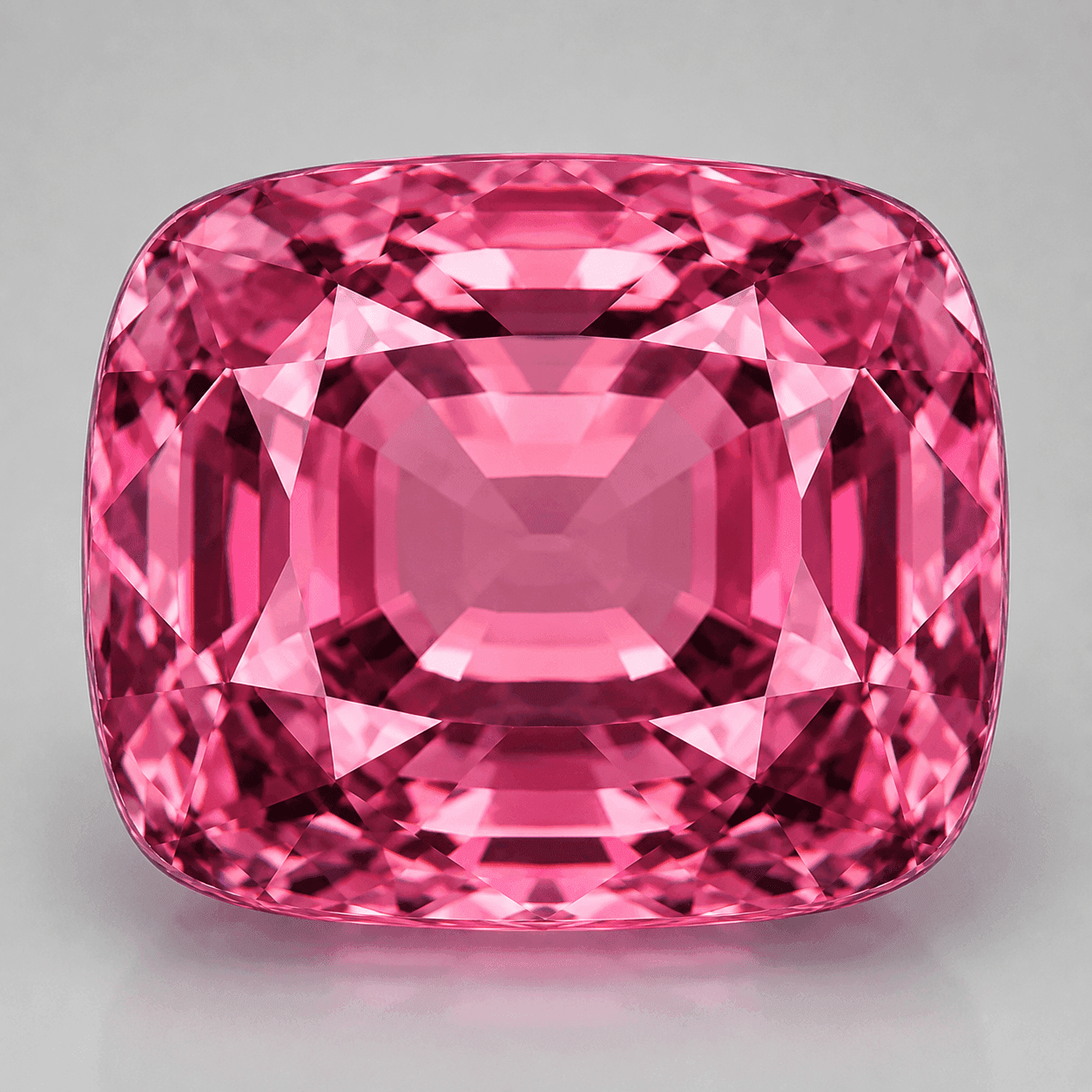
Emerald cuts, cushions, ovals and elongated shapes are popular because their broad, open tables give the boundary room to breathe. A skilled cutter may even set the divide diagonally for drama. If you want to understand how cut, clarity and shape interact for spinel generally, our guide to spinel clarity, cut and shape goes deeper, and how spinel is colour-graded explains how professionals describe hue, tone and saturation.
Bicolour spinel versus colour-change spinel: what is the difference?
They are entirely different phenomena. A bicolour shows two colours simultaneously in fixed positions within the stone, while a colour-change spinel is a single evenly coloured gem that appears one hue in daylight and another under incandescent light.
Collectors sometimes conflate the two because both are exotic, but the mechanisms and the buying logic differ. A bicolour is about spatial zoning — where the colours sit; a colour-change is about spectral response — how one colour behaves under different lighting. Both are rare, and a stone that did both would be a true unicorn. The comparison below lays it out.
| Feature | Bicolour spinel | Colour-change spinel |
|---|---|---|
| What you see | Two colours at once, side by side | One colour that shifts by light source |
| Cause | Colour zoning from changing chemistry | Trace-element response to light spectrum |
| Best viewed | Any single light source | Compared under daylight vs incandescent |
| Cutter's job | Place the boundary attractively | Maximise the strength of the shift |
| Rarity | Rare | Rare, often rarer still |
If the shifting-hue phenomenon intrigues you, read our dedicated colour-change spinel guide. And for a ranking of which spinel hues are hardest to find at all, see the rarest spinel colour.
How rare and valuable is bicolour spinel?
Bicolour spinel is rare enough that it rarely appears in commercial parcels and mostly circulates among collectors and specialist dealers. Value is driven less by a single colour grade and more by the beauty of the pairing, the clarity of the boundary, and overall size and cleanliness.
Because these are one-of-one stones, there is no neat per-carat chart the way there is for calibrated single-colour goods. What we can say is how the pricing logic works. A soft pink-to-lavender bicolour in a small size trades closer to fine single-colour pink spinel levels, while a large, sharply divided stone with a rare hue in the mix — anything touching true cobalt blue or vivid red — can move well beyond that on scarcity alone. As a frame of reference, fine single-colour red spinel sits around $2,000-5,000 per carat, top reds $5,000-10,000, and exceptional Myanmar reds beyond $20,000; top cobalt blue can also exceed $20,000 per carat, while grey spinel sits nearer $300-500. A distinctive bicolour is priced by its rarity story, not a formula.
- Colour pairing — bold, high-contrast or rare-hue combinations command the most.
- Boundary quality — a clean, well-placed transition beats a muddy overlap.
- Balance — a pleasing proportion of each colour face-up.
- Size — larger bicolours are disproportionately scarce.
- Clarity and cut — eye-clean, brilliant stones with controlled extinction.
- Provenance — a named origin such as Mogok or Luc Yen adds desirability.
For the full economics, our spinel price guide and honest take on whether spinel is a good investment put bicolours in context. Remember that spinel is almost always untreated — a natural bicolour needs no heat to show its two tones, which is part of its integrity as a collector's gem. When you are ready to see what is available, explore our collections or browse the full shop.
How do you buy and care for a bicolour spinel?
Buy the individual stone, not a category — with bicolours, personal taste in the pairing matters more than chasing a grade. Prioritise a pleasing colour balance and a clean boundary, and insist on natural, untreated material from a dealer who will say so plainly.
Ask to see the stone under more than one light and photographed face-up, since that is how you will actually wear or display it. Confirm it is natural spinel and not a lab-created stone — synthetic spinel is common in costume jewellery — and if you want independent reassurance on natural origin and no treatment, a report helps; our guide to spinel certification explains what to look for. For a broader checklist, how to buy natural spinel and the common spinel buying mistakes are worth reading first.
Care is straightforward. At Mohs 8 with no cleavage, spinel is an excellent daily-wear gem, tougher than many collectors expect. Clean it with warm water, mild soap and a soft brush; avoid harsh knocks against harder stones in a jewellery box. Our full care guide covers storage and cleaning in detail. For the authoritative external overview of the species, the GIA spinel buyer's guide is a reliable reference.
- What is bicolour spinel?
- Bicolour spinel is a single natural spinel crystal that shows two distinct colours at once — commonly pink to purple or grey to blue. The two tones come from colour zoning, where the crystal's trace-element chemistry changed during growth. It is also called parti-coloured spinel and is genuinely rare.
- How is bicolour spinel different from colour-change spinel?
- A bicolour shows two colours simultaneously in fixed positions within the stone. A colour-change spinel is a single evenly coloured gem that appears one hue in daylight and a different hue under incandescent light. Bicolour is about spatial zoning; colour-change is about how one colour responds to the light source.
- Why does spinel form two colours?
- Because the mineralising fluids feeding the crystal changed partway through growth. Chromium drives red and pink, cobalt drives vivid blue, and iron drives grey, blue, violet and brown. When two of these regimes meet inside one crystal, the stone records both as a bicolour band.
- Is bicolour spinel valuable?
- Yes, and often disproportionately so because it is rare and each stone is one of a kind. Value depends on the colour pairing, the quality and placement of the boundary, balance, size and clarity. Bold or rare-hue combinations — especially anything touching cobalt blue or vivid red — command the strongest premiums.
- Is bicolour spinel treated or heated?
- Almost never. Spinel is one of the very few coloured gems that is typically untreated, in contrast to sapphire, which is around 90 percent heated. A natural bicolour shows its two tones without any enhancement, which is central to its appeal as a collector's stone.
Sources
Facts on this page draw on independent gemmological authorities:
- Gemological Institute of America (GIA) · Institute
- Gübelin Gem Lab · Laboratory
- GRS (GemResearch Swisslab) · Laboratory
- Lotus Gemology · Laboratory