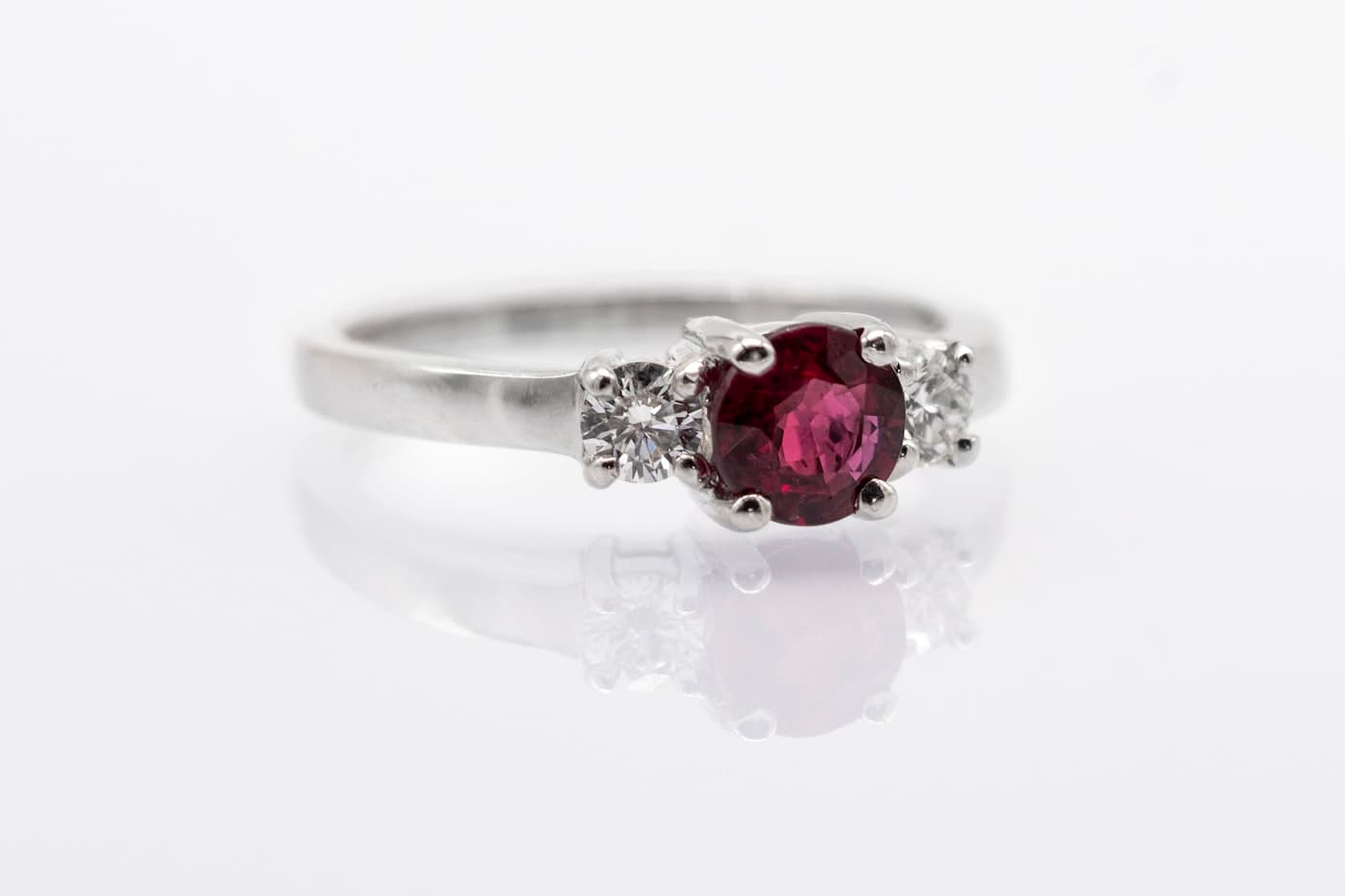
A dealer's guide to spinel wedding bands: eternity and half-eternity styles, colour choices, protective settings for daily wear, pairing with an engagement ring, and value versus sapphire.
A spinel wedding band is a ring set with natural spinel, usually as a run of matched accent stones in an eternity or half-eternity design, chosen for its Mohs 8 hardness, lack of cleavage, and pure saturated colour. It is durable enough for daily wear, far rarer than the stones it resembles, and typically costs a fraction of comparable sapphire or diamond.
For collectors who already understand spinel as a centre stone, the wedding band is where the gem earns its keep in a quieter, more structural role. A band lives on the hand every day, knocks against desks and door handles, and is rarely removed. That makes the material questions, durability, setting security, colour permanence, and how the ring pairs with an existing engagement ring, more important than sheer size. This guide is the dealer's view of how to choose one well.
Is spinel durable enough for a wedding band?
Yes. Natural spinel is exceptionally well suited to daily wear because it sits at Mohs 8 on the hardness scale and, crucially, has no cleavage plane along which it can split from a knock. That combination, hard surface plus no structural weakness, is exactly what a ring worn every day for decades needs.
Hardness resists scratching; toughness resists chipping and breaking. Diamond is harder at 10, but hardness and toughness are not the same property, and diamond's perfect cleavage means a sharp blow at the wrong angle can cleave it. Spinel has neither cleavage nor a tendency to part, so it takes daily knocks gracefully. It is also almost always untreated, meaning there is no fracture-filling or heat-induced stability to worry about, which matters over the decades a wedding band is worn. We cover the full picture in our spinel hardness and durability guide, but for a band the short version is simple: this is one of the most sensible coloured stones you can commit to lifelong wear.
Cleavage, not hardness, is what breaks a stone on the hand. Spinel has none, and that is its quiet advantage in a wedding band.
There is a caveat worth stating plainly. In a full eternity band the stones face outward all the way around, so the girdles and any exposed edges take more contact than a single protected centre stone would. Good setting, discussed below, is what turns spinel's inherent toughness into real-world longevity.
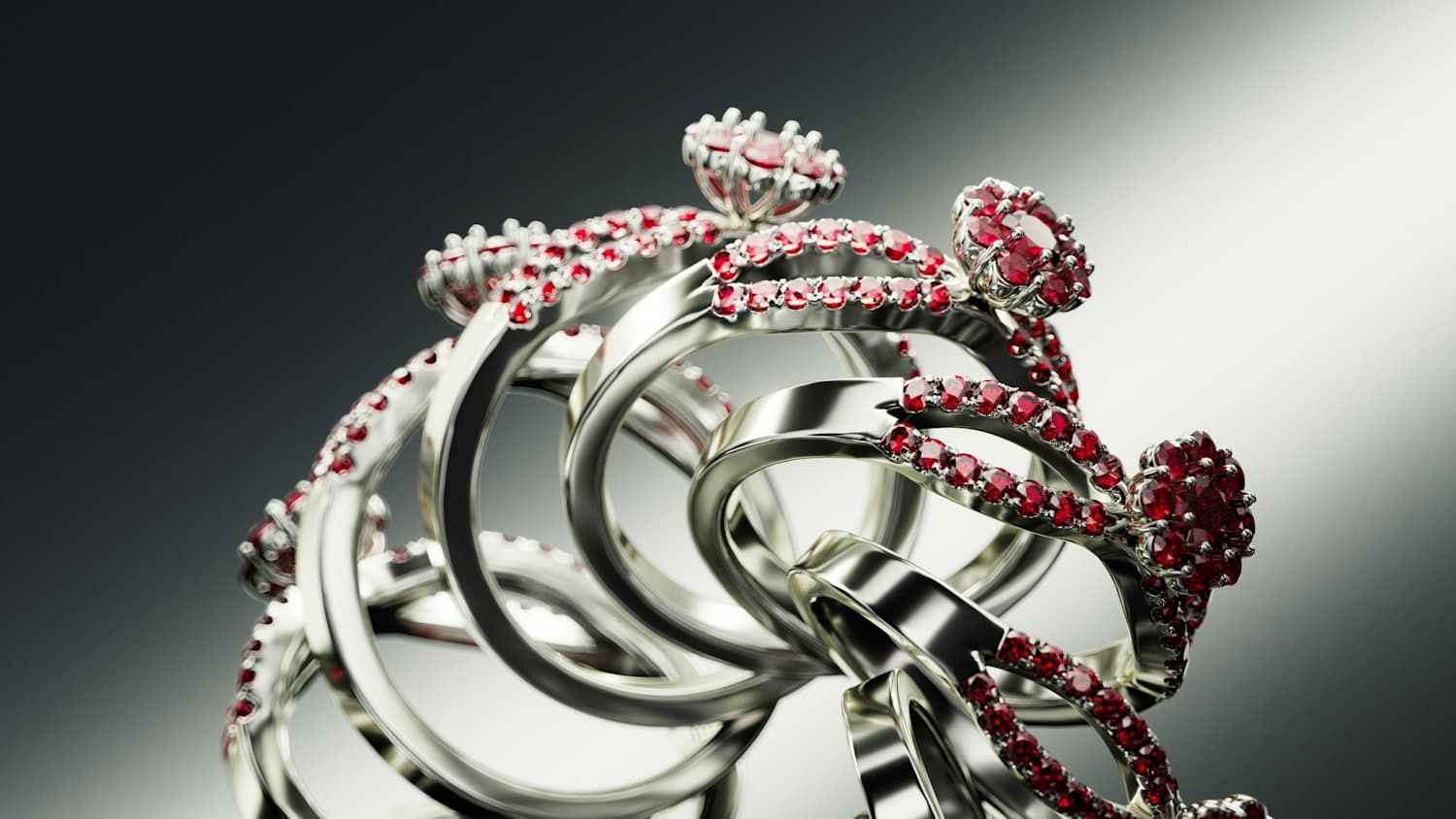
Eternity, half-eternity, or accent stones: which band style?
The three main formats trade off sparkle, comfort, and practicality. A full eternity band carries stones the whole way around; a half-eternity sets them across the top half only; an accent or three-stone band uses a few spinels to punctuate a metal band. Each has a clear use case.
A full eternity band is the most luminous and the most symbolic, an unbroken circle, but it cannot be resized without rebuilding, and the stones on the palm side see the most wear. A half-eternity solves both problems: it resizes easily, sits more comfortably against an adjacent engagement ring, and protects the underside of the finger from hard girdles. Accent-stone and three-stone bands put the least gemstone at risk and let a single fine spinel, perhaps a red or cobalt-blue stone, carry the ring. For a broader look at construction and proportion across ring types, our spinel rings guide is the companion piece.
| Band style | Best for | Resizable | Wear exposure |
|---|---|---|---|
| Full eternity | Maximum sparkle, symbolic unbroken circle | No (must rebuild) | Highest (stones all around) |
| Half-eternity | Everyday comfort, pairing with an engagement ring | Yes | Moderate (top half only) |
| Three-stone / accent | Showcasing one or a few fine spinels | Yes | Lowest (protected settings) |
| Channel-set band | Snag-free daily wear, active hands | Limited | Low (stones recessed) |
Which spinel colour works best in a wedding band?
Any of spinel's natural colours can make a beautiful band, but the most collectible choices are saturated red, hot pink, and cobalt blue, with grey and lavender offering an understated modern alternative. The right colour depends on whether the band stands alone or must harmonise with an existing ring.
Spinel's colours come from clean, well-understood chemistry: chromium drives red and pink, cobalt gives the electric blues, and iron produces grey, denim blue, violet, and lavender. That range means you can match almost any metal or centre stone. Red is the classic and the rarest in fine quality, a fine red spinel often costs around a tenth of a comparable ruby while offering the same visual fire; explore the red spinel collection to see how the colour reads across sizes. Cobalt blue is the trophy hue and the most expensive per carat. Pink offers romance at a gentler price, and the distinction between pink and red is worth understanding before you commit a whole band to one tone. For a warmer note, Mogok and Vietnam produce orange stones; the salmon-to-sunset material we call An Phu Sunset is a rare and characterful choice. Grey spinel, at roughly a few hundred dollars per carat, makes a surprisingly chic neutral band that pairs with white or yellow metal alike.
- Red / hot pink (chromium) — classic, fiery, the rarest in fine grades; pairs with yellow or rose gold.
- Cobalt blue (cobalt) — the most vivid and valuable; a statement band, striking in platinum or white gold.
- Grey / lavender (iron) — understated and modern; a versatile neutral for everyday wear.
- Orange / peach (Mogok, An Phu) — warm and unusual; flatters warm skin tones and yellow metal.
- Denim / teal blue (iron) — softer than cobalt, easy to live with, distinctive without shouting.
Because spinel is singly refractive it shows a single, pure body colour with no pleochroism, so every stone in a matched run reads the same hue from every angle, an advantage over doubly refractive stones like sapphire or tanzanite when you are trying to match a row. If you are still weighing the gem against the establishment stones, the spinel versus diamond comparison sets out where colour, rarity, and value diverge.
What setting keeps spinel safe for daily wear?
For a wedding band, choose a setting that recesses or shelters the girdle of each stone, channel, bezel, or a well-built shared-prong (French or bar) setting is ideal. These protect the most exposed edges while keeping the band low-profile and snag-free for hands that work.
Spinel is tough, but no gem benefits from repeated hard contact on an unprotected edge. A channel setting buries the girdles between two metal walls, giving the smoothest, most secure daily-wear surface. A bezel wraps each stone in a metal rim, the most protective option of all, and suits a single accent spinel beautifully. Shared-prong eternity bands look the most brilliant because more light reaches each stone, but they leave girdles slightly more exposed, so insist on heavier prongs and periodic checks. Whichever you choose, platinum and 18k gold hold stones more securely over time than softer low-karat alloys.
- Bezel — maximum protection; ideal for a single accent or three-stone band.
- Channel — girdles recessed between metal walls; the best all-round daily-wear band.
- Shared / French prong — brightest and most sparkling; needs robust prongs and routine checks.
- Bar setting — a modern look that shelters the sides of each stone.
How do I pair a spinel band with an engagement ring?
Match the metal first, then decide whether the band should echo or contrast the centre stone. A half-eternity spinel band that sits flush against the engagement ring gives the cleanest pairing, and choosing a band colour drawn from, or deliberately complementary to, the engagement stone ties the set together.
If the engagement ring holds a red or pink spinel, a matching-hue band reinforces the theme; if it holds a diamond or sapphire, a band of grey, lavender, or cobalt spinel adds colour without competing. Profile matters as much as colour: a band with the same rise as the engagement ring's gallery sits flush, while a contoured or notched band can nest around a raised solitaire. Our spinel engagement ring guide covers centre-stone selection in depth, and the complete guide to natural spinel is the best primer if you are building a set from scratch. Once the rings are chosen, keep them looking their best with our advice on caring for spinel jewellery.
Spinel versus sapphire: which is the better value for a band?
For a coloured wedding band, spinel usually offers better value than sapphire on rarity, treatment, and price, while sapphire wins narrowly on hardness. Both are excellent daily-wear stones, but the decision often comes down to whether you value an untreated, genuinely scarce gem or the name recognition of sapphire.
Roughly 90% of blue sapphire on the market is heat-treated to improve colour; fine natural spinel is almost always untreated, which many collectors consider the more honest purchase. Sapphire is harder (Mohs 9 versus 8), a real advantage, though spinel's Mohs 8 with no cleavage is more than adequate for a band. On price, fine spinel and fine sapphire overlap, but spinel's supply is far smaller, and connoisseurs increasingly prize that rarity. The full breakdown lives in our spinel versus sapphire comparison; for where prices actually sit in 2026, see the spinel price guide. The GIA's spinel buyer's guide is a useful neutral reference on quality factors, and the broader gemmological overview of spinel gives helpful context on the species.
| Factor | Natural spinel | Blue sapphire |
|---|---|---|
| Hardness (Mohs) | 8 | 9 |
| Cleavage | None | None |
| Typically treated? | No — untreated is the norm | Yes — ~90% heat-treated |
| Relative rarity (fine grades) | Scarcer | More available |
| Fine-grade price feel | Often better value per carat | Commands the name premium |
How do I choose a spinel wedding band, step by step?
Work from lifestyle inward to stone, not the other way around. Deciding how the ring will be worn, and whether it must pair with an existing ring, narrows the field before you ever choose a colour, and prevents the common mistake of buying a beautiful band that does not survive your daily habits.
- Assess daily wear. Active hands favour channel or bezel settings and a half-eternity over a full one; desk-based wear allows more exposed brilliance.
- Set the pairing brief. If a wedding band must sit beside an engagement ring, decide metal and profile first so the two sit flush.
- Choose the colour. Pick a spinel hue that either matches or deliberately complements the centre stone; red and pink flatter warm metals, grey and cobalt suit white metals.
- Fix the format. Full eternity for maximum sparkle, half-eternity for comfort and resizing, three-stone for showcasing fine individual gems.
- Specify the setting and metal. Favour platinum or 18k gold, and a setting that shelters each girdle for daily security.
- Insist on matched, untreated stones. For a run of accents, ask for stones matched in hue, tone, and clarity, and confirmation they are natural and untreated.
- Confirm documentation. For finer stones, ask for a report from a respected lab and keep it for appraisal and insurance.
When you are ready to look at loose stones or finished pieces, browse the full House of Spinel shop to see how colour, size, and clarity translate into a band. Building a set is a slow, pleasurable process, and starting from a clear brief means the ring you commission is one you will happily wear for a lifetime.
- Is spinel hard enough for a wedding band worn every day?
- Yes. Spinel is Mohs 8 with no cleavage, so it resists both scratching and chipping. It is one of the most practical coloured stones for daily wear, particularly in a protective channel or bezel setting. Only diamond, sapphire, and a few others are harder, and spinel's lack of a cleavage plane gives it real everyday toughness.
- Do spinel wedding bands need special care?
- No special care beyond common sense. Natural spinel is stable and almost always untreated, so warm soapy water and a soft brush keep it clean. Remove the band for heavy manual work or gym sessions to spare the setting, and have prongs checked periodically. See our guide on caring for spinel jewellery for the full routine.
- Which spinel colour is best for a wedding band?
- It depends on pairing and taste. Red and hot pink are the classic, fiery, and rarest fine choices; cobalt blue is the most vivid and valuable; grey and lavender make understated modern neutrals. Because spinel is singly refractive, every stone shows one pure colour from all angles, which makes matched rows especially clean.
- Is a spinel band cheaper than a sapphire or diamond one?
- Usually, yes, for comparable quality. Fine spinel often costs a fraction of comparable ruby and generally offers better per-carat value than fine sapphire, while remaining untreated. Diamond bands command a price premium for the name and hardness. Grey spinel in particular delivers a stylish band at a modest price.
- Can I have a full eternity spinel band resized later?
- Not easily. A full eternity band set all the way around cannot be sized without rebuilding, which is why many buyers choose a half-eternity for a wedding band. Half-eternity and three-stone bands resize normally and also sit more comfortably against an engagement ring, so confirm your finger size carefully before commissioning a full eternity.
Sources
Facts on this page draw on independent gemmological authorities:
- Gemological Institute of America (GIA) · Institute
- Gübelin Gem Lab · Laboratory
- GRS (GemResearch Swisslab) · Laboratory
- Lotus Gemology · Laboratory