Green spinel is one of the rarest colours in the family, coloured mainly by iron with a lift of chromium or vanadium. A collector-focused guide to its character, sources, gahnite cousins and 2026 value.
Green spinel is one of the genuinely rare colours in the spinel family, coloured mainly by iron — sometimes lifted toward a brighter, more saturated hue by traces of chromium or vanadium — and it typically appears as a darkish, slightly greyish or teal-leaning green rather than the vivid grass-green of emerald. For collectors, that rarity is precisely the appeal: a stone few people will ever see, in a hue almost no other gem delivers untreated.
Among the wider palette explored in our guide to the many colours of natural spinel, green sits at the quiet, cerebral end — never loud, rarely large, and almost always the mark of a collector who has moved past the obvious reds and blues. This guide covers what green spinel actually is, why it is so scarce, how it differs from its zinc-rich cousin gahnite, where the best material is found, and what fair value looks like in 2026.
What makes green spinel so rare?
Green is one of the scarcest colours in natural spinel, far rarer than red, pink, grey or even the celebrated cobalt blues. The reason is chemical: the trace elements that produce a clean, attractive green in spinel are uncommon in the right balance, and iron — the usual colouring agent — tends to darken and grey a stone rather than brighten it.
Spinel is magnesium aluminium oxide (MgAl2O4), a cubic, singly refractive mineral of Mohs 8 hardness with no cleavage. Its colour comes entirely from trace impurities swapping into the crystal lattice. Chromium gives the reds and hot pinks; cobalt gives the electric blues; iron produces greys, denim blues, violets, lavenders, browns, blacks — and most of the greens and yellows. Because iron so readily pushes toward grey and dark tones, a green that reads as genuinely green rather than muddy or blackish is an accident of nature that simply does not occur very often. That places green alongside yellow as one of the two colours we discuss in the rarest spinel colour, and it is a recurring theme in why spinel is rare as a species.
Green spinel is not a colour you go looking for on a shopping list — it is a colour you recognise when a rare parcel finally offers one.
It is worth stressing that spinel is very rarely treated. Where roughly nine in ten blue sapphires on the market have been heated, natural spinel is almost always exactly what nature made — untreated, unenhanced, its colour original. A green spinel is therefore a rare natural colour that has not been coaxed or cooked into existence, which is a large part of why connoisseurs prize it. You can read more on this in our note on whether spinel is treated or heated.
What gives green spinel its colour?
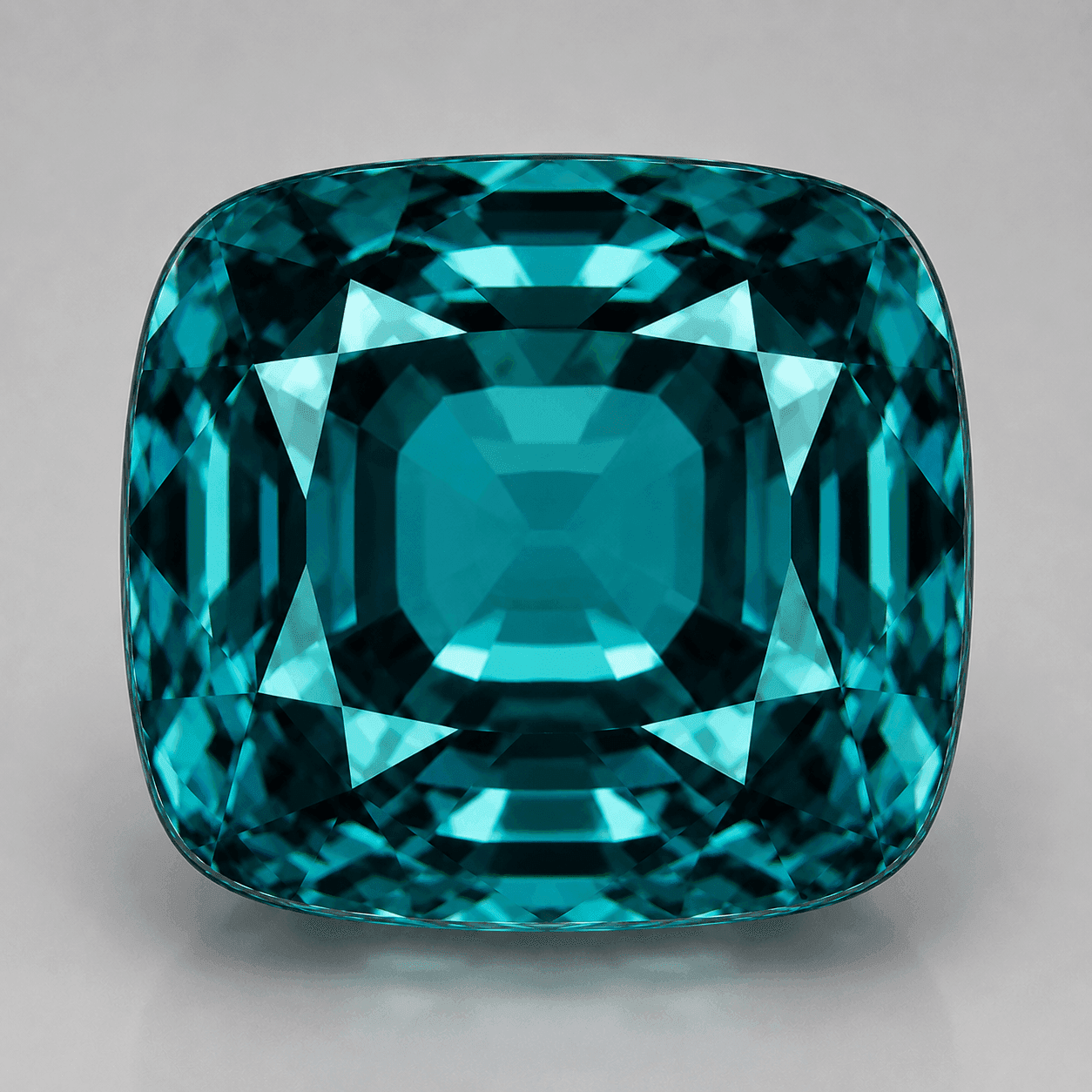
The green in spinel is driven principally by iron, with chromium or vanadium occasionally lifting the better stones toward a brighter, more saturated hue. Iron alone tends to produce darker, greyer, more olive or bottle-green tones, while a touch of chromium or vanadium can add a welcome vividness that the eye reads as 'true' green.
Because iron is the dominant chromophore, most green spinel you will encounter is on the dark and desaturated side — think forest, olive, bottle or khaki green, sometimes with a grey overtone that connects it to the character described in our grey spinel guide. The most desirable stones balance enough tone to read clearly as green in daylight without going so dark that they close up and look black in the hand. As with all coloured stones, saturation and tone matter more than the raw hue name.
There is also a natural continuum between green and blue. Iron and, in some stones, traces of cobalt can nudge a green spinel toward blue-green or teal, and the boundary is genuinely a judgement call. A stone that reads distinctly blue-green belongs to the world of our teal spinel guide, while a cleaner, cooler blue moves into the territory of the blue spinel guide. Green proper is the warmer, more yellow-leaning end of that spectrum — and it is the scarcest waypoint along it.
Green spinel versus gahnite: what is the difference?
Gahnite is a separate but closely related mineral — zinc aluminate (ZnAl2O4) — in the same spinel group, and it is often what people are actually holding when they think they own a green spinel. True green spinel is magnesium-based (MgAl2O4); gahnite substitutes zinc for magnesium, and intermediate zinc-magnesium stones are called gahnospinel.
This matters because gahnite and gahnospinel are frequently dark green to blue-green, and much of the darker 'green spinel' in circulation is really one of these zinc-rich members. They are distinguished in the lab chiefly by refractive index and specific gravity: as zinc content rises, both the RI and the density climb above the values expected for pure magnesium spinel. A reputable laboratory report will state the species precisely. We cover the full family in the gahnite and gahnospinel guide, and the reference minerals are catalogued at Mindat's gahnite entry.
| Property | Green spinel | Gahnite / gahnospinel |
|---|---|---|
| Composition | MgAl2O4 (magnesium) | ZnAl2O4 or Zn-Mg intermediate |
| Typical colour | Green, often greyish or teal-leaning | Dark green to blue-green, often near-black |
| Refractive index | ~1.712-1.735 | Higher, up to ~1.80 as zinc rises |
| Specific gravity | ~3.58-3.61 | Higher, ~3.9-4.6 as zinc rises |
| Optical character | Singly refractive, no pleochroism | Singly refractive, no pleochroism |
| Market position | Rare collector colour | Rarer still; niche, species-driven interest |
Note that both are singly refractive with no pleochroism and no facet-doubling — a green spinel or gahnite will never show the doubled facet edges of a doubly refractive stone, which is one quick way to separate them from green tourmaline or peridot without a lab. For anything you intend to buy as a fine green spinel, insist on a report that names the species; the difference between spinel, gahnospinel and gahnite is exactly the kind of thing a good spinel certification confirms.
Where does green spinel come from?
The classic sources for green and green-blue spinel are Sri Lanka, Myanmar and Tanzania, with occasional material from other spinel localities. Sri Lanka (Ceylon) in particular is well known for the iron-rich, sometimes greyish or teal-leaning stones that include the green range, while Myanmar and Tanzania contribute their own rarer greens.
- Sri Lanka (Ceylon): the most reliable origin for iron-coloured spinel across grey, denim-blue, violet and green, including the darker teal-greens. See the Ceylon spinel guide.
- Myanmar (Mogok and Man Sin/Namya): the historic heart of fine spinel, better known for reds and pinks but an occasional source of unusual greens, as covered in the Burmese spinel guide.
- Tanzania (Mahenge and beyond): famous for hot pinks and reds, but the broader East African deposits also yield rarer green and blue-green material.
- Other localities: Vietnam's Luc Yen, Tajikistan, Sri Lankan gravels and Madagascar all produce iron-rich spinel that can stray into the green-teal range in small quantities.
Origin affects character more than it dictates a fixed price for green spinel, simply because so few fine greens exist that the market has never settled into origin premiums the way it has for, say, Burmese ruby. What matters far more is the individual stone — its tone, saturation, clarity and life. For a broader view of how locality shapes spinel, see where spinel is found.
What does green spinel cost in 2026?
Green spinel is priced less by a settled market rate and more by rarity and individual quality, because so little of it exists in gem grade. As a rough guide, pleasant but darkish or greyish greens tend to sit in the low hundreds of dollars per carat, while a genuinely bright, clean, well-cut green — the sort a collector chases — can climb well into the four figures per carat.
To put that in context against the wider family: fine red spinel runs from roughly $2,000 to $10,000+ per carat, top cobalt-blue can exceed $20,000 per carat, and ordinary grey sits around $300-500 per carat. Green does not command red or cobalt money, but because supply is so thin, a standout green can outrun a merely good grey or brown by a wide margin. The table below is indicative only — every green is negotiated on its own merits.
| Quality tier | Typical character | Indicative 2026 range (per carat) |
|---|---|---|
| Commercial | Dark, greyish or olive; sleepy | ~$150-400 |
| Good | Clear medium green, some life, eye-clean | ~$400-1,200 |
| Fine / collector | Bright, saturated green (Cr/V lift), lively, eye-clean | ~$1,500-4,000+ |
These figures are consistent with our broader spinel price guide; treat them as orientation, not a quote. Because green is a rarity colour rather than a volume colour, you should expect to wait for the right stone rather than choose from a tray of ten. If you are weighing green as part of a collection strategy, our view on whether spinel is a good investment applies with a caveat: buy green for its rarity and beauty first, never on a promise of resale.
How do you buy a green spinel worth owning?
Buying green spinel well comes down to judging the stone in the hand and confirming its identity on paper. Because the colour is scarce and the species boundary with gahnite is real, the two priorities are a stone with genuine life and daylight green character, and a laboratory report that names the species and confirms no treatment.
- Judge tone and saturation in daylight. Reject stones that read black or muddy indoors; you want a green that stays green in ordinary light, ideally with a hint of the brightness that chromium or vanadium can add.
- Check it stays green, not teal or grey. Decide honestly which colour you are buying — a blue-green stone is a teal, a green-grey stone is closer to grey, and paying a green premium for either is a common mistake.
- Confirm the species. Ask whether it is spinel, gahnospinel or gahnite; the RI and SG on a lab report settle it, and the distinction affects both rarity framing and value.
- Verify it is natural and untreated. Spinel is rarely treated, but a report removes all doubt and separates it from synthetic spinel and green glass or doublets.
- Inspect clarity and cut. Green spinel is often cut to save weight; look for eye-clean material and a cut that returns light rather than a dark, over-deep stone. Our inclusions guide explains what is normal.
- Buy from a specialist. A dealer who works in spinel by colour will show you honest daylight photos and disclose exactly what a stone is.
For the full framework that applies to any colour, read how to buy natural spinel. And if you would like to see the current parcels rather than read about them, browse the shop or explore the wider collections — green comes and goes, so the pieces available at any moment are genuinely one-of-one.
A last word on character. Green spinel will never be the stone that stops a room the way a cobalt blue or a Mahenge pink can. Its pleasure is quieter and more private: a rare, untreated, singly refractive green that most gem lovers have never handled, in a species collectors already regard as underrated. That is exactly the sort of stone that rewards the patient eye — and the reason a serious spinel collection is rarely complete without one.
- Is green spinel real, and is it rare?
- Yes. Green is a genuine, naturally occurring colour in spinel (MgAl2O4), and it is one of the rarest — far scarcer than red, pink or grey. It is coloured mainly by iron, with chromium or vanadium sometimes brightening the better stones, and it is almost always untreated.
- What is the difference between green spinel and gahnite?
- Green spinel is magnesium-based (MgAl2O4), while gahnite is zinc aluminate (ZnAl2O4) and gahnospinel is a zinc-magnesium intermediate. Gahnite tends to be darker green to near-black and shows higher refractive index and specific gravity. A lab report naming the species is the reliable way to tell them apart.
- Why does most green spinel look dark or greyish?
- Because iron, the main chromophore, pushes toward dark, grey and olive tones. Only when a little chromium or vanadium is present does a green spinel gain the brightness and saturation that reads as a clean, lively green — which is why fine greens are so uncommon.
- How much is green spinel worth in 2026?
- It depends heavily on the individual stone. Darkish, greyish greens often sit around $150-400 per carat, good clear greens roughly $400-1,200, and bright collector-grade greens $1,500-4,000+ per carat. Green is a rarity colour, so exceptional stones command a premium despite the modest average.
- Is green spinel ever treated or heated?
- Very rarely. Unlike sapphire, where heating is routine, natural spinel is almost always untreated and its colour original. Even so, for a fine green spinel you should confirm both the species and the absence of treatment with a reputable laboratory report.
Sources
Facts on this page draw on independent gemmological authorities:
- Gemological Institute of America (GIA) · Institute
- Gübelin Gem Lab · Laboratory
- GRS (GemResearch Swisslab) · Laboratory
- Lotus Gemology · Laboratory