Star spinel shows a rare four- or six-rayed star from oriented needle inclusions, cut as cabochons in grey, black or blue. How the star forms, how to judge quality, value and care.
Star spinel is a rare natural spinel that displays asterism — a four- or six-rayed star of light that floats across the dome of a cabochon-cut stone. The effect comes from light scattering off tiny oriented needle-like inclusions, most often rutile. Most star spinel is dark grey, black, steely blue or purplish, and every genuine example is scarce.
What exactly is star spinel?
Star spinel is ordinary natural spinel — magnesium aluminium oxide, MgAl2O4 — that happens to contain enough fine, parallel inclusions to produce a moving star of light when it is cut en cabochon (with a smooth, rounded dome rather than facets). The phenomenon is called asterism, and spinel is one of the rarer gems to show it convincingly. Because spinel is cubic and singly refractive, its stars behave a little differently from the six-rayed stars everyone knows in corundum. To understand why star spinel is unusual, it helps to know how the species behaves in general; our complete guide to natural spinel covers the crystallography, colour causes and sources in depth.
Two things make star spinel a connoisseur's stone rather than a mainstream one. First, the inclusions that create a star also cut the transparency of a gem — so most facet-grade rough is deliberately free of them, meaning good star material is a minority within an already scarce species. Second, spinel is almost never treated, so what you see in a natural star spinel is the honest optical signature of the rough itself. That candour is a large part of the appeal, and it is a recurring theme across the many colours of natural spinel.
How does the star form in spinel?
The star forms when countless microscopic needle-like inclusions grow in fixed, parallel directions inside the crystal and reflect a band of light back to the eye. Each set of aligned needles produces one bright bar; two or three intersecting sets cross to make a four- or six-rayed star that pivots as the stone or the light source moves.
In spinel the needles are usually rutile (titanium dioxide), sometimes accompanied by other fine mineral fibres. Because spinel is isometric (cubic), the needles align along the crystal's symmetry directions, and the geometry of those directions decides how many rays you see. Spinel most commonly yields a four-rayed star, though six-rayed stars also occur — a genuine point of difference from ruby and sapphire, whose hexagonal structure almost always gives six rays. If you want the deeper contrast between the two species, our piece on spinel versus sapphire sets out the optical separators.
It is worth being precise about the language, because 'star' and 'cat's-eye' are often muddled. A single set of parallel needles produces chatoyancy — a single band of light, the cat's-eye effect. Only when two or more sets intersect do you get true asterism and a crossed star. In spinel, well-developed, multi-directional silk is uncommon, which is one more reason a clean star is such a scarce find. The same oriented inclusions that make the star are, in transparent facet-grade rough, exactly the 'silk' a cutter tries to avoid — so star spinel and fine faceted spinel are, in a sense, drawn from opposite ends of the same crystal pocket.
To actually see a star, three conditions must line up. Here is what a cutter — and later a buyer — is really checking for:
- A single, directional light source. A star needs one point of light (the sun, a torch, a fibre-optic lamp) to gather the rays. Diffuse overhead lighting scatters the effect and the star vanishes.
- Correct orientation of the rough. The cabochon must be cut so the needle sets sit symmetrically beneath the dome, with the base perpendicular to the crystal's main axis. Mis-orient the rough and the star sits off-centre or splits.
- A well-judged dome. Too flat and the rays smear; too high and the star bunches at the tip. The cutter balances height against the density of inclusions.
- Enough inclusions — but not too many. Sparse needles give a weak, ghostly star; a dense but even 'silk' gives a sharp one. Overly cloudy rough kills both star and colour.
- Tilt and rotate to test it. Under a single light, move the stone: a true star glides smoothly and stays centred. A painted or assembled fake tends to sit still or jump.
What colours does star spinel come in?
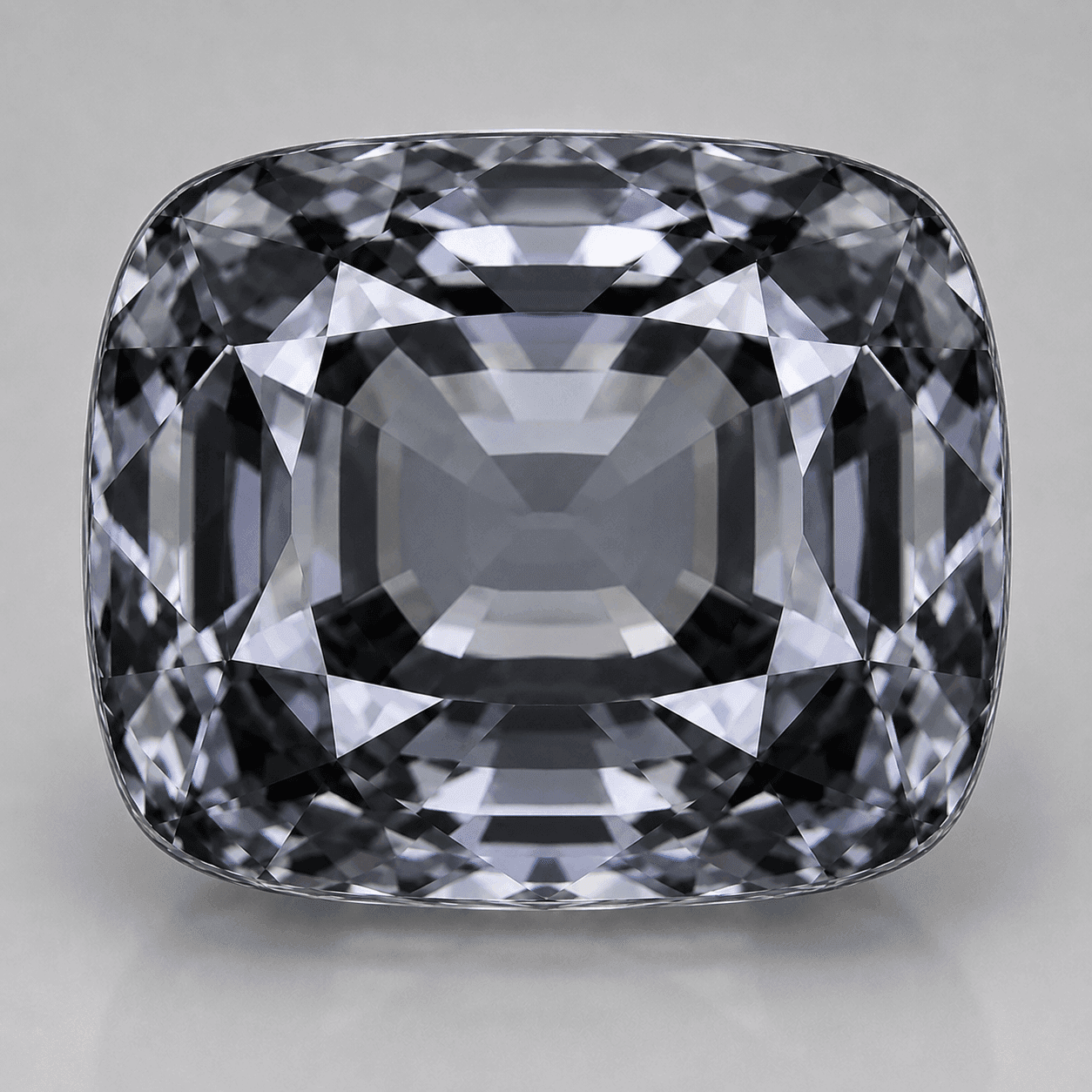
Star spinel is almost always dark and cool in tone: grey, near-black, steely or denim blue, and violet-to-purple. The very needles that create the star also add body, so pale or vivid transparent hues are rarely the ones that star well. Iron is the usual colourant behind these steely, smoky tones.
You will occasionally hear of dark reddish or brownish star spinel, but a fine red or a vivid electric cobalt-blue spinel is prized precisely for its transparency — so those colours are almost never sacrificed to a star. That is why the star phenomenon clusters at the grey and black end of the family. If you are drawn to those tones for their own sake, our grey spinel guide and black spinel guide explain why the quiet, monochrome members of the species have their own devoted following. For collectors chasing the truly uncommon, star spinel belongs in the same conversation as the rarest spinel colours.
A star spinel is two rarities at once: a gem that is seldom treated, showing a phenomenon it seldom shows.
How do you judge the quality of a star spinel?
Judge a star spinel on the sharpness, completeness and centring of the star first, then on body colour, then on the cabochon itself. A crisp, four- or six-rayed star with straight, unbroken legs that meet at a single point and sits centred on the dome is worth far more than a vague glow that wanders off to one side.
Because the star is the whole point, the usual clarity logic is inverted: you want fine inclusions, just even and well-oriented ones. The rest of the assessment mirrors ordinary cabochon grading — proportion, symmetry, polish and the strength of body colour. For faceted spinel these factors trade off differently; our guide to spinel clarity, cut and shape explains the transparent-stone version of the same craft. Use the table below as a working checklist.
| Quality factor | What to look for | What lowers value |
|---|---|---|
| Star sharpness | Crisp, bright, well-defined rays under a single light | Blurred, faint or 'ghosted' rays |
| Ray completeness | All 4 or 6 legs present, straight and unbroken | Missing, wavy or forked legs |
| Centring | Star sits at the top of the dome, symmetrical | Off-centre star that slides to one edge |
| Body colour | Even, attractive grey, blue or violet | Patchy, muddy or lifeless colour |
| Cabochon craft | Symmetrical outline, smooth dome, clean polish | Lopsided dome, flat spots, pits |
| Size & phenomenon | Larger stones with a strong star are exponentially rarer | Small stones where the star is barely readable |
What is star spinel worth?
Star spinel is valued on the strength of the star and the beauty of the body colour rather than on the per-carat records that chase fine red or cobalt-blue material. As a phenomenal cabochon in cool, dark tones, it typically sits nearer the accessible end of the spinel market — broadly in line with fine grey spinel at roughly a few hundred dollars per carat — with sharp, well-centred, larger examples commanding meaningful premiums for their rarity.
For context, transparent spinel spans an enormous range: fine red spinel runs roughly $2,000-5,000 per carat, top red $5,000-10,000, exceptional Myanmar red beyond $20,000, and the finest cobalt-blue can exceed $20,000 per carat — while grey often sits around $300-500. Star spinel is a phenomenon-driven niche within that spread, priced on effect rather than colour saturation. Our spinel price guide sets out the full landscape, and is spinel valuable? frames how rarity and demand actually meet. Treat any single quoted figure as a range, never a promise — value depends on the individual stone in the hand.
Where does star material come from? The classic phenomenal spinels trace to the historic deposits of Mogok in Myanmar, with additional star and dark spinel reported from Sri Lanka (Ratnapura) and other iron-rich sources. Mogok's storied ground is the same valley of rubies and spinel that produced the great red stones, which is why so many phenomenal curiosities surface there too.
A candid word on the market, dealer to collector: star spinel is genuinely thin on the ground, so it is rarely stocked in depth and almost never appears in matched pairs or calibrated sizes. That scarcity is the appeal — a fine star spinel is a true one-of-one, not a stone you can simply reorder — but it also means you should buy the individual cabochon in front of you on its own merits rather than waiting for a 'better one' that may never come to market. When a sharp, well-centred star turns up, collectors who know the field tend to move quickly.
How can you tell a natural star spinel is real?
The two things to confirm are that the star is natural rather than assembled or painted, and that the stone is spinel rather than a look-alike. A genuine star spinel shows a soft, slightly diffuse star that glides smoothly across a domed top under one light, with tiny natural needle inclusions visible under magnification.
Common red flags include a star that is suspiciously sharp and 'drawn on', a flat interface line inside the stone (a sign of an assembled doublet), or perfectly regular internal 'inclusions' that betray a synthetic or diffusion-treated look-alike. Spinel's single refraction — no doubling of back facets, no pleochroism — is a key separator from doubly refractive stones. For the full toolkit of at-home checks, see how to tell if spinel is real, and for the manufactured versions that circulate, natural versus lab-created spinel. Anything approaching serious money should carry a report from a respected laboratory; the GIA buyer's guide to spinel is a sound starting point, and the GIA spinel quality factors page explains how colour, clarity and cut are weighed for the species.
How do you care for a star spinel?
Care for star spinel exactly as you would any fine spinel: it is a Mohs 8 stone with no cleavage, making it genuinely tough for daily wear. The one caveat particular to cabochons is that the needle inclusions creating the star can, in rare cases, sit near the surface, so avoid hard knocks and abrasive cleaning.
Warm water, mild soap and a soft brush are all a star spinel needs; skip ultrasonic and steam cleaners if the stone is heavily included, and store it apart from harder gems like diamond and sapphire. Spinel's durability is one of its quiet strengths — the full picture is in our spinel hardness and durability explainer and the practical how to care for your spinel jewellery routine. When you are ready to see phenomenal and transparent stones in person, browse the House of Spinel shop or explore our curated collections by colour.
- What causes the star in a star spinel?
- The star is caused by asterism — light reflecting off fine, oriented needle-like inclusions (usually rutile) that grow in parallel directions inside the crystal. Under a single light, each set of needles reflects one bright bar, and the intersecting sets cross to form a four- or six-rayed star.
- Does star spinel show four or six rays?
- Both occur. Because spinel is cubic (isometric), it most commonly produces a four-rayed star, but six-rayed stars are also found depending on how the inclusions align. This differs from ruby and sapphire, whose hexagonal structure almost always gives a six-rayed star.
- Is star spinel rare?
- Yes. Star spinel is doubly uncommon: spinel itself is scarce and very rarely treated, and only a small fraction of rough contains enough evenly oriented inclusions to show a clean star. Sharp, well-centred stars in larger sizes are especially hard to find.
- What colour is star spinel usually?
- Most star spinel is dark and cool in tone — grey, near-black, steely or denim blue, and violet to purple. The inclusions that create the star also add body, so vivid transparent reds and cobalt blues are almost never sacrificed to produce a star.
- Is star spinel treated?
- Spinel is one of the least-treated of all gems, and star spinel is prized precisely because its optical effect is a natural feature of the rough rather than the result of treatment. Always confirm authenticity, and for valuable stones obtain a report from a respected gemmological laboratory.
Sources
Facts on this page draw on independent gemmological authorities:
- Gemological Institute of America (GIA) · Institute
- Gübelin Gem Lab · Laboratory
- GRS (GemResearch Swisslab) · Laboratory
- Lotus Gemology · Laboratory