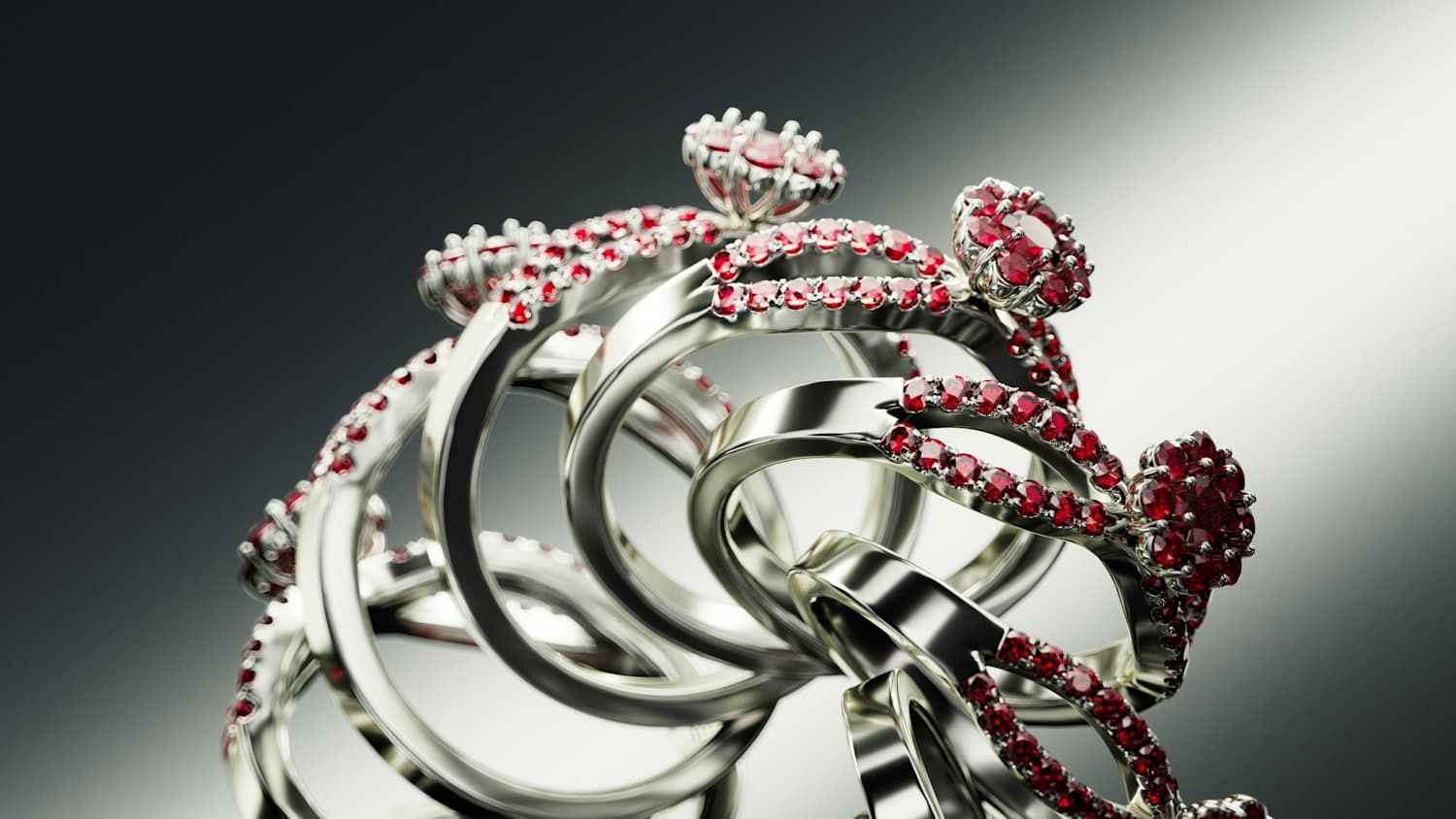
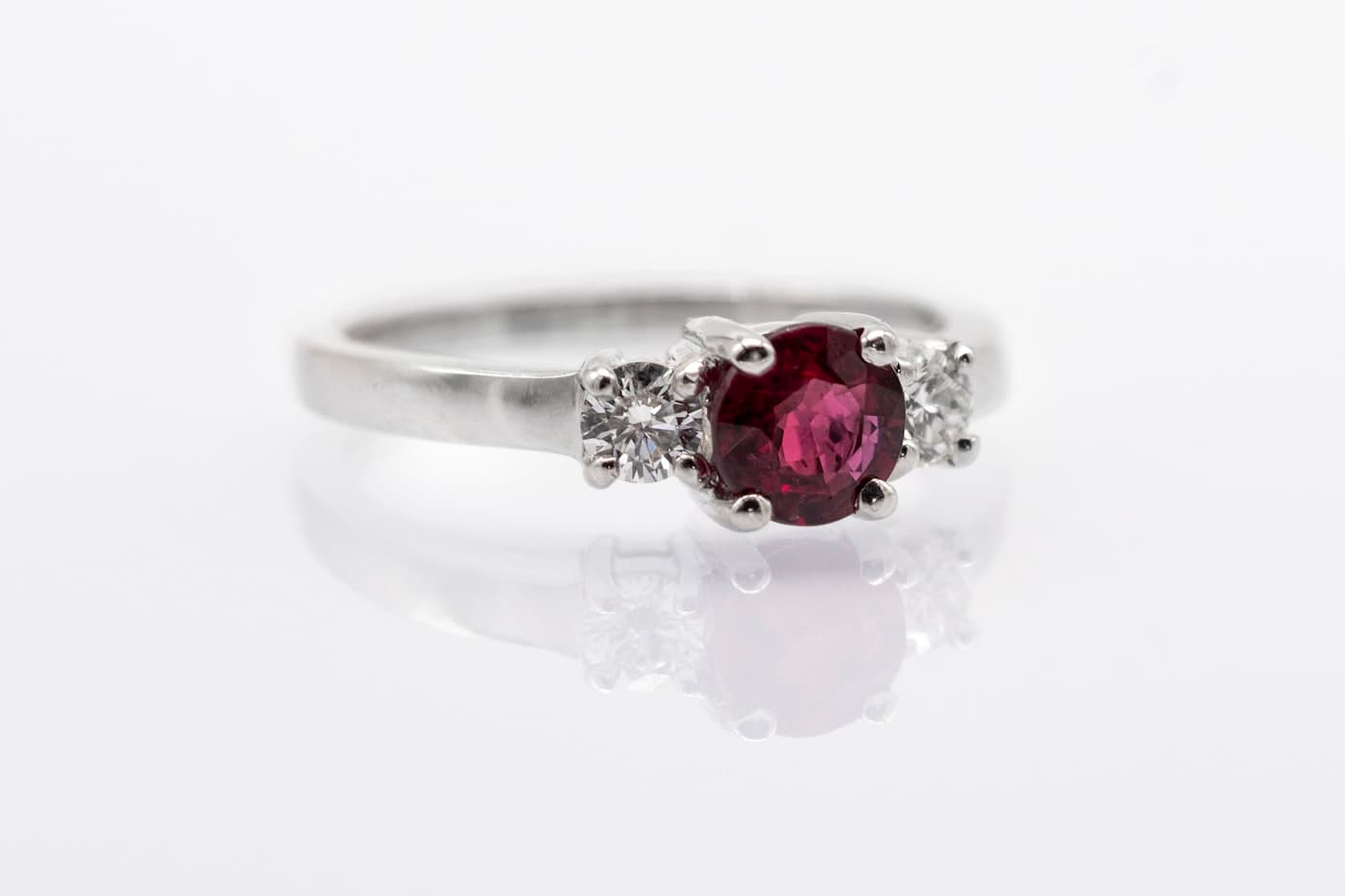
Kuh-i-Lal in the Pamir Mountains is the ancient Balas ruby source: Silk Road pink-red spinel that crowned kings and, misidentified as ruby, still glows in the British and Iranian regalia today.
Tajikistan spinel comes from Kuh-i-Lal, an ancient mine in the Pamir Mountains of Badakhshan whose pink-to-red crystals were traded along the Silk Road for over a thousand years as 'Balas rubies' — the very stones that adorn crowns and, long misidentified as ruby, gave spinel much of its hidden history. Today the deposit is worked only intermittently, which makes genuine Kuh-i-Lal material both historically resonant and genuinely scarce.
Where does Tajikistan's spinel actually come from?
The source is Kuh-i-Lal, a mountainside on the right bank of the Panj River in the Gorno-Badakhshan region of eastern Tajikistan, close to the Afghan border. Its name translates loosely as 'Mountain of the Ruby', and the workings sit high in the western Pamir at altitudes above 2,000 metres — a punishing place to mine, then and now.
Geologically, Kuh-i-Lal is one of the oldest known gem-spinel deposits on earth. The crystals grow in metamorphosed, magnesium-rich marbles — the same broad recipe that produces spinel at Mogok and across Sri Lanka — but here the dominant colouring agent is chromium, which pushes the stones toward pink, rose and a warm raspberry red rather than the deep 'flame' reds of Burma. Because spinel is singly refractive and, in almost every case, completely untreated, what a Kuh-i-Lal crystal shows is entirely its own: no heat, no diffusion, just chromium sitting in a magnesium aluminium oxide lattice.
What is a 'Balas ruby', and why the confusion with ruby?
'Balas ruby' is the historic trade name for the pink-red spinel of this region, and the word itself is a corruption of 'Badakhshan', the province that supplied it. For most of recorded history, buyers drew no line between these gems and true ruby — both were simply 'red stones from the East', valued by size and colour rather than by species.
The mineralogy that separates them was not properly understood until the late 18th and 19th centuries. Ruby is corundum: doubly refractive, coloured by chromium. Spinel is a separate species — cubic, singly refractive — and although chromium colours both, spinel never shows the pleochroism or the birefringent doubling of corundum. That single optical fact is why so many legendary 'rubies' eventually proved to be spinel, a story we tell in full in why spinel is so often mistaken for ruby. For collectors drawn to the deep reds of the species proper, our complete guide to red spinel sets out how chromium reds are judged today.
How did Kuh-i-Lal shape the Silk Road spinel trade?
Kuh-i-Lal was one of the very few sources of large, clean red gems available to the medieval and early-modern world, and its output moved west along the Silk Road into Persia, the Ottoman lands, Mughal India and, eventually, Europe. For well over a millennium it was arguably the single most important spinel mine on the planet.
The mine's importance is hard to overstate. Long before Burma's deposits reached wider trade, and centuries before Mahenge or Luc Yen existed as names, Kuh-i-Lal supplied the courts of Asia with almost all their large red gems. Marco Polo, passing through Badakhshan in the 13th century, recorded that the finest 'balas rubies' came from a mountain here and that the local ruler kept the mine under tight control, releasing stones only as royal gifts to preserve their value — an early, deliberate exercise in scarcity. Caravans carried the gems to Samarkand, Isfahan, Delhi and Istanbul, where the largest examples were polished, drilled for stringing, and engraved with the names of kings.
Because the great stones were mostly worn as cabochons or simply polished pebbles — and often pierced — many surviving historical spinels can still be traced to this tradition. The engraving of a ruler's name onto a gem, common on Mughal and Persian spinels, is itself a marker of provenance we explore in famous spinels in history.
Beyond commerce, these red gems carried meaning. Across Persian and Central Asian courts a great red spinel signalled sovereignty and protection, worn as a talisman as much as an ornament — beliefs we treat strictly as tradition rather than medical or scientific fact in our note on spinel meaning and symbolism. Whatever one makes of the folklore, the political reality was concrete: to own the largest Balas stone was to advertise power, which is precisely why the mine's output was hoarded and its finest pieces engraved rather than sold.
Which famous crown jewels are Kuh-i-Lal spinels?
The most celebrated are the Black Prince's Ruby, a roughly 170-carat red spinel set at the front of the British Imperial State Crown, and the Timur Ruby, a 361-carat engraved spinel in the Royal Collection — neither is a ruby at all. Both are widely attributed to the Badakhshan workings that include Kuh-i-Lal, the historic home of the Balas stones.
The Black Prince's 'Ruby' has sat in English royal regalia since the 14th century, reputedly worn by Henry V at Agincourt, and today it crowns the Imperial State Crown held in the Royal Collection. The Timur Ruby carries the engraved names of several Mughal and Persian rulers — a running record of the hands it passed through. That these celebrated 'rubies' are in fact spinels is now settled: the Black Prince's Ruby is documented as a red spinel, and its story arguably did more than any gemmological paper to rescue spinel's reputation.
For four centuries the most famous 'ruby' in the English crown was, quietly, a spinel from a Tajik mountainside.
The list does not stop at Britain. The Cote de Bretagne, a roughly 105-carat dragon-carved spinel, sits among the French Crown Jewels in the Louvre, while the Samarian Spinel — at around 500 carats one of the largest cut spinels known — anchors the Iranian Crown Jewels. Taken together, these stones show how thoroughly the Balas trade seeded the treasuries of Europe and Asia, and how long the ruby-and-spinel confusion persisted at the very top of the market.
| Stone | Approx. weight | Where it is now | Actually a… |
|---|---|---|---|
| Black Prince's Ruby | ~170 ct | Imperial State Crown, UK | Red spinel |
| Timur Ruby | ~361 ct | Royal Collection, UK | Red spinel |
| Cote de Bretagne | ~107 ct | Louvre, France | Red spinel |
| Samarian Spinel | ~500 ct | Iranian Crown Jewels | Red spinel |
What does Kuh-i-Lal spinel look like, and how is it graded?
Kuh-i-Lal spinel runs from pale pink and rose through to a warm raspberry or 'ruby-pink' red; the finest are a clean, slightly pinkish red with high transparency. Because the colour is chromium-driven, many stones glow with a soft red fluorescence under longwave UV — the same behaviour seen in Mogok-type material.
Size matters to the story too. Because the historical Balas stones that reached royal courts were often very large — the crown spinels run to hundreds of carats — Kuh-i-Lal earned a reputation for producing sizeable crystals, even if the very finest colour remains rare. Typical inclusions are healed fissures and small octahedral crystals, features a laboratory reads alongside trace-element chemistry when forming an origin opinion. At Mohs 8 with no cleavage, the species is also tough enough for daily wear, as we set out in spinel hardness and durability.
As with all spinel, grading follows colour first, then clarity, cut and carat weight. The material is prized as much for its history and its gentle, glowing pink-reds as for rivalling the saturated 'stoplight' red of the best Burmese stones. Weigh that against origin honestly: a great Mogok red will always out-price a comparable Tajik gem on pure colour, which is exactly why origin matters in how these stones are valued. For the classic benchmark reds, Mogok, the valley of rubies and spinel remains the reference point against which everything else is measured.
| Source | Colour driver | Typical hue | Collector note |
|---|---|---|---|
| Kuh-i-Lal (Tajikistan) | Chromium | Rose to raspberry red | Ancient Balas source; provenance premium |
| Mogok (Myanmar) | Chromium | Vivid flame red | Benchmark for top red |
| Mahenge (Tanzania) | Chromium | Hot neon pink to red | Modern discovery, electric colour |
| Luc Yen (Vietnam) | Iron / cobalt | Pink, lavender, cobalt-blue | Fine untreated blues and pinks |
How can you tell a Kuh-i-Lal stone from Mogok or Mahenge?
You rarely can by eye alone; confident origin calls come from a laboratory reading trace-element chemistry and inclusions. But there are sensible steps a collector can follow before reaching for paperwork.
- Start with hue: Kuh-i-Lal leans pink-to-raspberry, Mogok toward saturated flame red, and Mahenge toward an almost neon hot pink.
- Check fluorescence: chromium reds from all three tend to glow red under UV, so use it to confirm chromium — not to pin the country of origin.
- Confirm the species with basic gemmology: a single RI reading near 1.718, no birefringence and no pleochroism separates spinel from ruby instantly.
- Examine provenance and paperwork: for historical or high-value stones, insist on a report from a respected independent laboratory.
- Weigh the story against the price: genuine Kuh-i-Lal often carries a provenance premium, so documentation can matter more than the carat count.
For the wider toolkit — refractometer readings, inclusion study and lab reports — see our guide to spinel certification explained, which covers what a credible origin report should and should not claim.
Is the Kuh-i-Lal mine still producing?
The deposit has never been fully exhausted, but it has never been a reliable modern producer either. Soviet-era geologists surveyed it in detail, and small quantities of rough still surface, yet Kuh-i-Lal today yields far less than Mogok, Mahenge or Luc Yen. Remoteness, high altitude and the region's difficult logistics mean fresh fine material reaches the market only in a trickle.
For the collector, that scarcity cuts both ways. Well-cut Tajik stones of real size and colour are hard to find, so much of what circulates is either older, historically traded material or smaller modern pieces. When buying, treat every provenance claim with the same rigour you would anywhere else: our guidance on how to buy natural spinel and where to buy natural spinel applies with full force to anything sold as Tajik or Balas.
Is Tajik spinel worth collecting today?
Yes — for its history as much as for its colour. Kuh-i-Lal is worked only sporadically, output is small, and a documented stone from the Balas source carries a narrative that very few gems can match, which supports value even where the raw colour sits below the top Burmese reds. This is one-of-one storytelling backed by a real mineralogical pedigree, not marketing invention.
In 2026 terms, fine chromium red spinel trades broadly from around $2,000-5,000 per carat, with top reds at $5,000-10,000 and exceptional Myanmar stones beyond $20,000 — and a fine red spinel still often costs roughly a tenth of a comparable ruby. Kuh-i-Lal material tends to sit in the pink-to-raspberry band rather than at the very top of the red scale, but provenance can add a premium of its own. If you are building a collection around the red-spinel story, our red spinel collection is the place to begin, and you can browse the full range of natural, untreated loose spinel by colour. For how these numbers are actually set, our spinel price guide breaks down colour, size and origin premiums in detail.
- Where is Tajikistan's spinel mined?
- At Kuh-i-Lal, a high-altitude deposit in the western Pamir Mountains of the Gorno-Badakhshan region of eastern Tajikistan, on the right bank of the Panj River near the Afghan border. It is one of the oldest known gem-spinel mines in the world.
- What is a 'Balas ruby'?
- 'Balas ruby' is the historic trade name for the pink-red spinel of Badakhshan; the word 'balas' derives from 'Badakhshan' itself. Despite the name, these stones are spinel, not ruby — the two were simply not distinguished for most of history.
- Is the Black Prince's Ruby really a ruby?
- No. It is a red spinel of roughly 170 carats, set in the British Imperial State Crown and generally attributed to the Badakhshan (Kuh-i-Lal) workings. Its misidentification is one of the most famous cases of spinel being mistaken for ruby.
- Is Tajik spinel treated or heated?
- Almost never. Spinel is one of the least-treated gems in the trade — untreated is the norm — and Kuh-i-Lal stones are natural, chromium-coloured spinel that owe their colour to nature rather than to heat or diffusion.
- How much does Kuh-i-Lal spinel cost?
- It depends on colour, clarity and size, but fine red spinel broadly runs $2,000-5,000 per carat, with top reds higher. Kuh-i-Lal material usually sits in the pink-to-raspberry band, and documented provenance from the ancient Balas source can add a premium of its own.
The same belt runs west into our Afghan spinel guide.
Sources
Facts on this page draw on independent gemmological authorities:
- Gemological Institute of America (GIA) · Institute
- Gübelin Gem Lab · Laboratory
- GRS (GemResearch Swisslab) · Laboratory
- Lotus Gemology · Laboratory